
Thursday, September 10, 2026 at 11:42 AM PDT
Wholesale Prices Jumped in August, and Your Mortgage Rate Is Feeling It
A government report out this morning showed prices climbing faster before goods ever reach a store shelf. Here is what that means for what you'd pay on a home loan today — and the three dates between now and Wednesday that matter more than anything else.
What happened this morning
At 8:30 a.m. Eastern, the Bureau of Labor Statistics released the Producer Price Index for August. Think of it as the wholesale price tag: it tracks what businesses charge each other before anything gets marked up and sold to you and me — a preview of the inflation you'll feel at the register a few months from now.
The number was warm. Producer prices rose 0.4% in a single month, and they're now up 5.4% from a year ago (Bureau of Labor Statistics, September 10, 2026). When the July figure came out a month ago, that 12-month reading was 4.7%. These numbers get revised as late reports arrive, but the direction is unmistakable: wholesale inflation sped up over the summer.
Strip out the jumpy categories — food, energy, and trade services — and prices still rose 0.3% for the month and 4.7% over the year. So this isn't only a fuel story. But fuel is the loudest part.
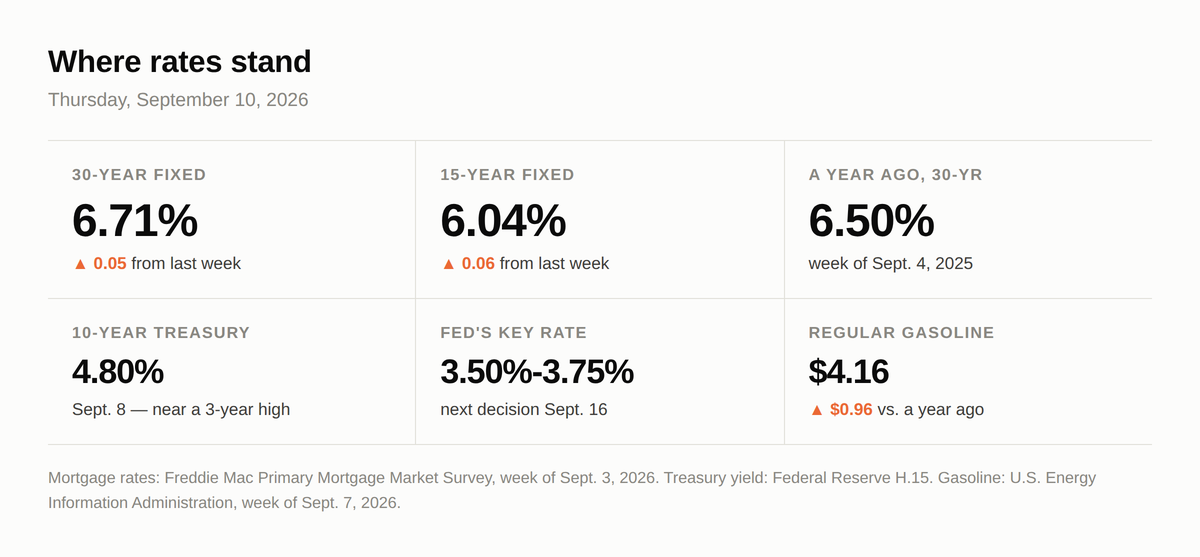
Figure 1. Rate snapshot as of September 10, 2026. Sources: Freddie Mac Primary Mortgage Market Survey (week of September 3, 2026); Federal Reserve H.15 Selected Interest Rates (September 8, 2026); U.S. Energy Information Administration (week of September 7, 2026).
Where the pressure is coming from
Wholesale energy prices rose 4.2% in August alone. Diesel fuel — the stuff that moves nearly every product in this country by truck, train, and ship — rose 24.1% in one month. Transportation and warehousing services followed, up 2.3%.
You're seeing the retail version at the pump: regular gasoline averaged $4.16 a gallon in the week of September 7, up about 96 cents from a year earlier, and diesel hit $5.97, up $2.20 (U.S. Energy Information Administration). Rising oil prices tied to the Middle East conflict are the engine behind it.
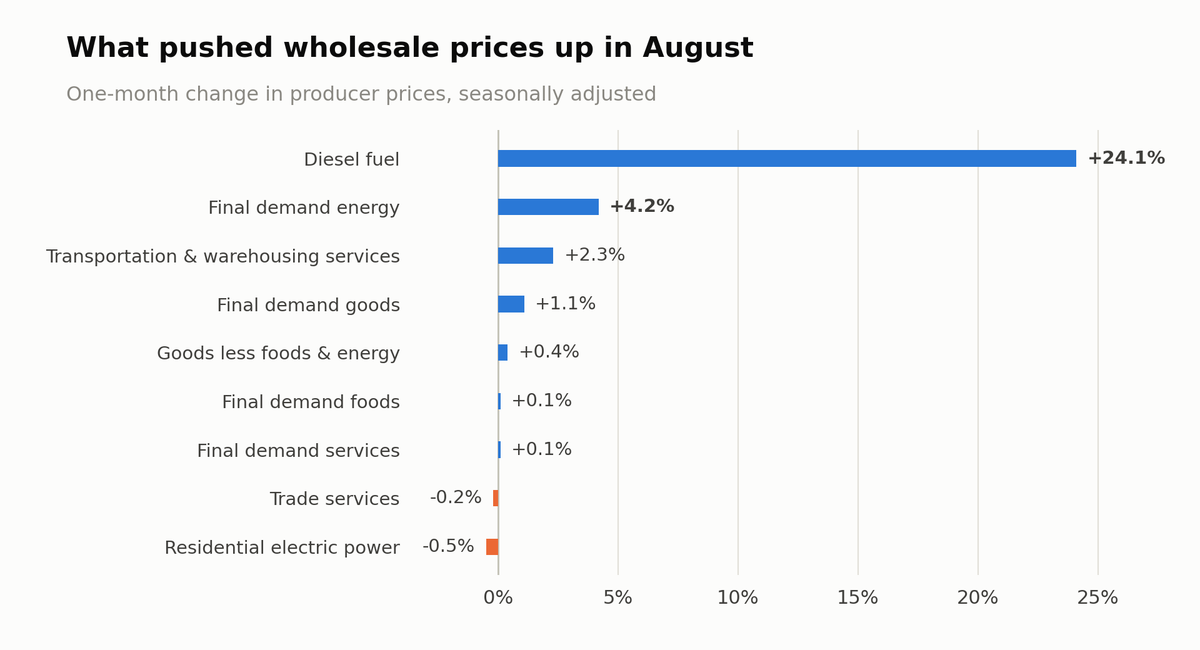
Figure 2. One-month changes in selected producer price categories, seasonally adjusted. Source: U.S. Bureau of Labor Statistics, Producer Price Index — August 2026, released September 10, 2026.
Why inflation news moves your mortgage rate
Here's the connection most people never get told. The Federal Reserve does not set mortgage rates. Mortgage rates mostly follow the 10-year Treasury yield — the interest the U.S. government pays to borrow money for ten years. Investors who fund a 30-year mortgage are locking in a fixed payment for a long time, and inflation quietly eats the value of every one of those future payments. So when inflation runs hot, they demand a higher rate to take that risk. Your quote goes up.
The 10-year Treasury closed at 4.80% on September 8, according to the Federal Reserve's H.15 report — near its highest level in almost three years, and the single biggest reason mortgage rates have climbed all summer.
Where rates actually stand
Freddie Mac's weekly survey put the 30-year fixed at 6.71% for the week of September 3, up from 6.66% the week before. The 15-year fixed came in at 6.04%. A year ago, the 30-year averaged 6.50%.
That 6.71% is the highest weekly average since July 2025, and a long way from where this year started: rates bottomed at 5.98% in late February, then climbed through spring and summer.
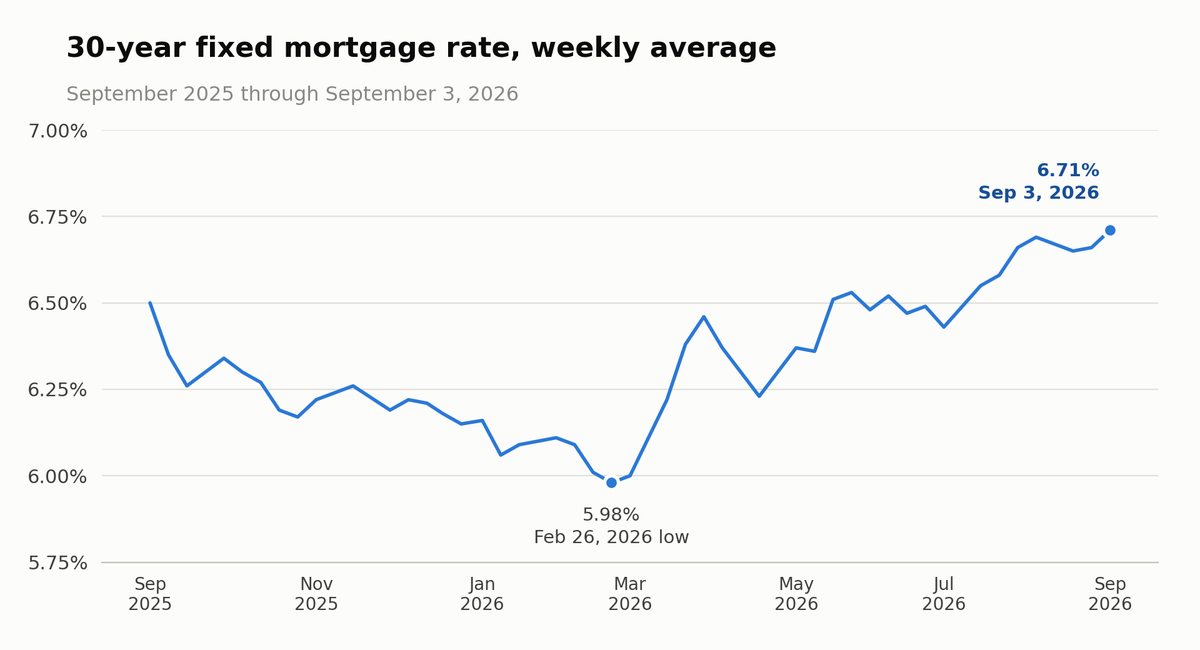
Figure 3. Freddie Mac 30-year fixed-rate mortgage weekly averages, September 2025 through September 3, 2026. Source: Freddie Mac Primary Mortgage Market Survey.
What this costs in real dollars
Percentages are abstract; payments aren't.
The median existing home sold for $434,100 in July (National Association of REALTORS®). Put 20% down and you're borrowing $347,280. At today's 6.71%, principal and interest run about $2,243 a month.
Drop that rate to 6.00% and the same loan costs $2,082 — $161 less a month, or $1,933 a year. Push it to 7.00% and you're at $2,310, or $67 more a month than today.
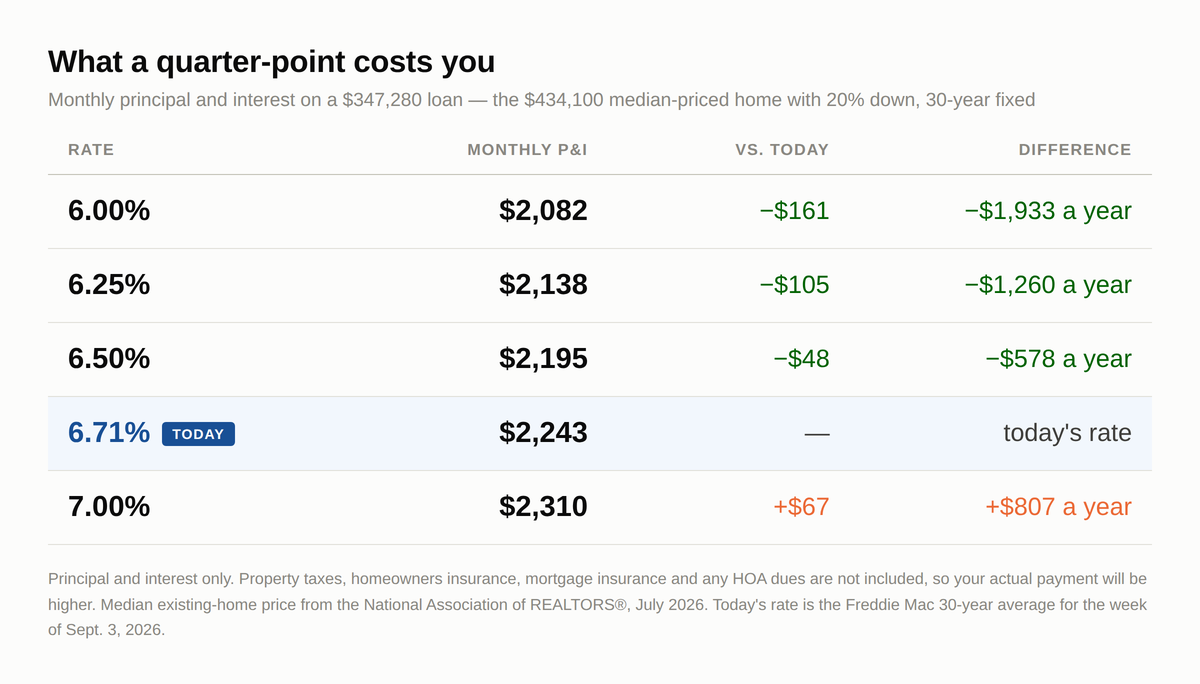
Figure 4. Monthly principal and interest at selected rates on a $347,280 loan. Sources: National Association of REALTORS® Existing-Home Sales (July 2026, released August 11, 2026) for the median price; Freddie Mac PMMS (week of September 3, 2026) for today's rate. Calculation by Daily Rate News.
Two things stand out. A quarter-point is worth about $50 a month here — real money, but rarely the difference between buying and not. And the whole span from 6.00% to 7.00% is only $228 a month; people wait years for a move that size.
The housing market, briefly
Existing-home sales ran at an annual pace of 4.06 million in July, down 1.7% from June but up 0.7% from a year earlier (NAR, released August 11). The median price rose just 2.0% over the year — roughly flat after inflation.
The number I'd watch is inventory: 1.54 million homes for sale, a 4.6-month supply, the best selection buyers have had in years. As NAR chief economist Lawrence Yun put it, "Home sales have been remarkably stable, even amid the rising mortgage rate environment of the past few months."
Translation: sellers no longer hold all the cards. Ask for repairs. Ask for closing-cost help. Ask a seller to buy your rate down. Those conversations work now in a way they didn't in 2021.
What to watch — three dates
Today at noon ET — Freddie Mac's new weekly survey. The 6.71% above is the week of September 3. This morning's report landed after lenders were surveyed, so today's print won't fully reflect it either.
Friday, September 11, 8:30 a.m. ET — Consumer Price Index for August. This is the retail version of this morning's report, and it's the bigger market mover. In July, consumer prices were up 3.4% over the year, with the core reading at 2.5% (BLS). If August comes in hot, expect rates to drift up. A soft number could pull them back.
Tuesday and Wednesday, September 15–16 — the Federal Reserve meets. The Fed's key rate sits at 3.50%–3.75%. What's unusual is the direction of the debate: as of September 8, futures traders were pricing roughly a 56% chance the Fed raises rates at this meeting, according to CME Group's FedWatch tool as reported by Yahoo Finance and CNBC. Those odds were set before this morning's report.
One caution: a Fed hike doesn't automatically raise your mortgage rate, and a cut doesn't automatically lower it. Markets price these in ahead of time. What moves your quote is whether the Fed sounds more or less worried about inflation than investors already expect.
What I'd do
If you're under contract and the payment works at today's rate, lock it.With two inflation reports and a Fed decision inside of six days, this is not a week to float a rate you can't afford to lose. Ask your lender whether your lock includes a float-down — many do, and it lets you capture a drop without carrying the risk of a spike.
If you're shopping but not yet in contract, shop the home, not the headline. Inventory is the best it's been in years and sellers are negotiating. A seller-paid buydown, which lowers your rate for the first year or two, is worth more right now than waiting on a market that has moved against buyers all summer.
If you're thinking about refinancing, do the break-even math instead of waiting for a magic number. Divide your total closing costs by your monthly savings: save $180 a month at a cost of $4,500 and you break even in 25 months. Staying longer than that, it's worth doing. Moving sooner, it isn't.
And if you already own, your existing rate is fixed — nothing this morning changed your payment. What it changes is the math on a move, a second home, or a cash-out. If any of those are on your list this fall, reply or call and let's run the numbers before next week's meeting rather than after. I'd rather you ask than guess.
References
1. U.S. Bureau of Labor Statistics. Producer Price Indexes — August 2026. September 10, 2026. https://www.bls.gov/news.release/ppi.nr0.htm
2. Freddie Mac. Primary Mortgage Market Survey. Week of September 3, 2026. https://www.freddiemac.com/pmms
3. Board of Governors of the Federal Reserve System. H.15 Selected Interest Rates. Data for September 8, 2026. https://www.federalreserve.gov/releases/h15/
4. Board of Governors of the Federal Reserve System. FOMC Meeting Calendar. Meeting of September 15–16, 2026. https://www.federalreserve.gov/monetarypolicy/fomccalendars.htm
5. U.S. Energy Information Administration. Gasoline and Diesel Fuel Update. Week of September 7, 2026. https://www.eia.gov/petroleum/gasdiesel/
6. National Association of REALTORS®. Existing-Home Sales — July 2026. August 11, 2026. https://www.nar.realtor/newsroom/nar-existing-home-sales-report-shows-1-7-decrease-in-july
7. U.S. Bureau of Labor Statistics. Consumer Price Index — July 2026. August 12, 2026. https://www.bls.gov/news.release/cpi.nr0.htm
8. U.S. Bureau of Labor Statistics. The Employment Situation — August 2026. September 4, 2026. https://www.bls.gov/news.release/empsit.nr0.htm
9. Yahoo Finance (citing CNBC and CME Group's FedWatch tool). FOMC September 2026 Odds for a Rate Hike Surpass 50%. September 8, 2026. https://finance.yahoo.com/economy/policy/articles/fomc-september-2026-odds-rate-201618784.html
All four figures in this issue were built by Daily Rate News from the published data cited above. They are original work, free for you to reproduce and send to your own clients, and contain no AI-generated imagery.