
Wednesday, August 19, 2026 at 6:14 AM PDT
Three Fed officials voted to raise rates last month. Today we find out how close they came.
The Federal Reserve releases the notes from its July meeting this afternoon. Mortgage rates have barely budged all month — and the reason has more to do with a gallon of gas than with anything happening in housing.
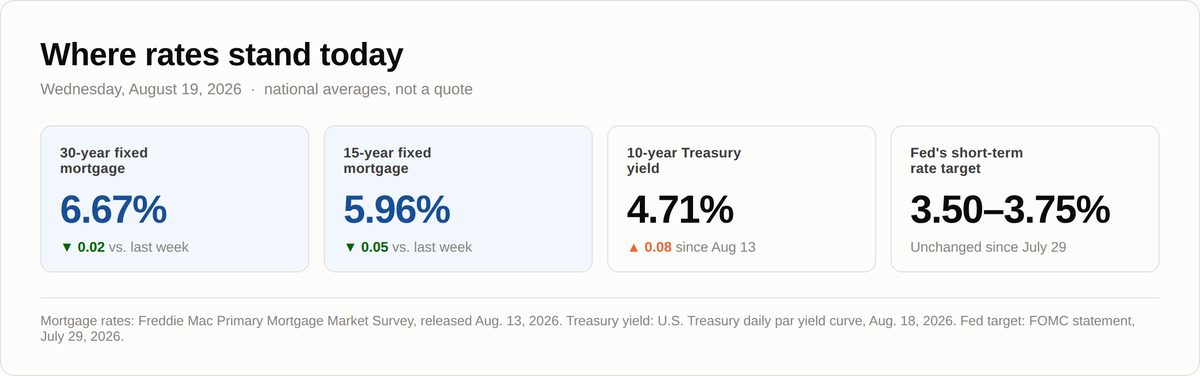
Figure 1. Rate snapshot. Sources: Freddie Mac Primary Mortgage Market Survey, released Aug. 13, 2026; U.S. Treasury daily par yield curve, Aug. 18, 2026; FOMC statement, July 29, 2026.
What happens today
At 2:00 p.m. Eastern this afternoon, the Federal Reserve publishes the minutes of its July 28–29 meeting. Minutes are the detailed notes of what officials actually argued about behind closed doors. They always come out three weeks after the decision itself, and they matter because they show what the Fed is worried about — not just what it did.
We already know what it did. The Fed left its short-term interest rate target unchanged at 3.50% to 3.75%. What made that meeting unusual was the vote: nine officials voted to hold, and three voted to raise rates by a quarter point. Those three were Beth Hammack, Neel Kashkari and Lorie Logan (FOMC statement, July 29, 2026).
Three dissents on a twelve-person committee is a lot. It tells you a real argument is going on. Today's minutes are the first chance to see how that argument was framed — and whether the officials who wanted a hike are a small holdout or a growing group.
Why anyone wants to raise rates right now
Because inflation has stopped falling. The Bureau of Labor Statistics reported on Aug. 12 that consumer prices rose 3.4% over the 12 months through July. The Fed's target is 2%.
But look one layer down and the picture changes.
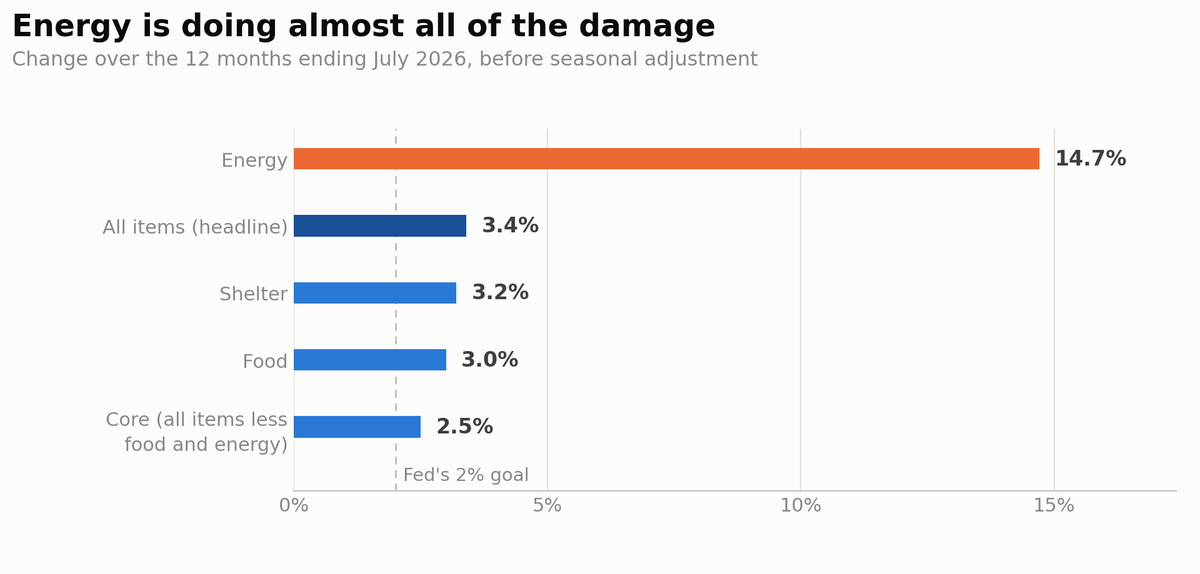
Figure 2. Consumer Price Index, 12-month changes. Source: U.S. Bureau of Labor Statistics, Consumer Price Index — July 2026, released Aug. 12, 2026.
Energy prices are up 14.7% over the past year. That one category is doing most of the work in that 3.4% headline number. Strip out food and energy — what economists call “core” inflation, because those two prices swing wildly for reasons that have nothing to do with Fed policy — and inflation is running at 2.5%. Shelter, the biggest single piece of most families' budgets, is up 3.2% and rose just 0.1% in July.
So the Fed is split for a reason that makes sense. One camp looks at 3.4% and sees a problem that's getting away from them. The other looks at 2.5% core and sees an energy shock that interest rates can't fix — raising the cost of a mortgage does not produce more oil.
The rest of the economy is not making the choice easier. Retail sales fell 0.6% in July (Census Bureau, released Aug. 14), and Goldman Sachs chief economist Jan Hatzius said on Aug. 17 that a September hike now looks “very unlikely,” citing softer spending and a cooling job market.
Why your mortgage rate barely moved
Mortgage rates don't follow the Fed's short-term rate. They follow the 10-year Treasury yield — what the U.S. government pays to borrow money for a decade. That's the number to watch, and it has gone almost nowhere.
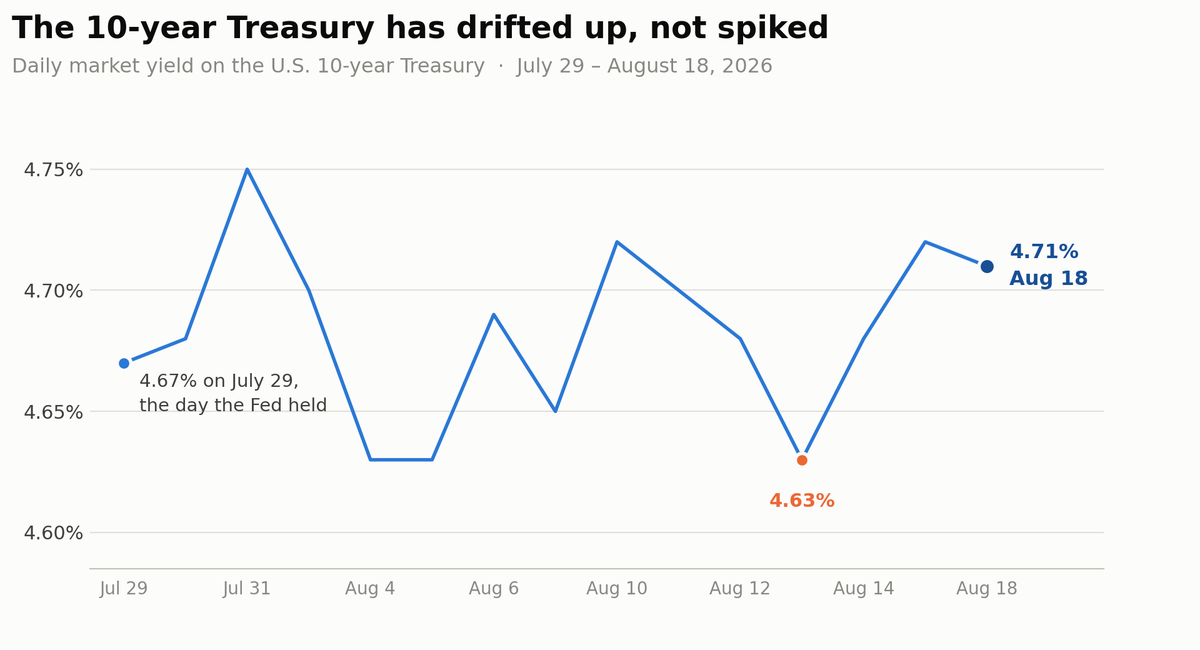
Figure 3. Daily market yield on the 10-year U.S. Treasury. Source: U.S. Department of the Treasury, Daily Treasury Par Yield Curve Rates, July 29 – Aug. 18, 2026.
Since the day of the July Fed meeting, the 10-year has traded between 4.63% and 4.75%. It closed at 4.71% on Aug. 18. That is a range of about one-tenth of a percentage point over three weeks — quiet, by bond market standards.
Mortgage rates have followed suit. Freddie Mac's weekly survey put the average 30-year fixed rate at 6.67% on Aug. 13, down from 6.69% the week before and up from 6.58% a year ago. The 15-year averaged 5.96%. Sam Khater, Freddie Mac's chief economist, noted that recent increases in purchase and refinance applications “suggest that borrowers continue to respond to even modest changes in mortgage rates.”
Futures markets currently put the odds of a September rate increase at roughly 30%, with about a 70% chance the Fed holds again, according to CME FedWatch data reported on Aug. 17. Those odds have moved around by several points in recent days.
What this costs you in dollars
Here is what the current rate means on a typical purchase.
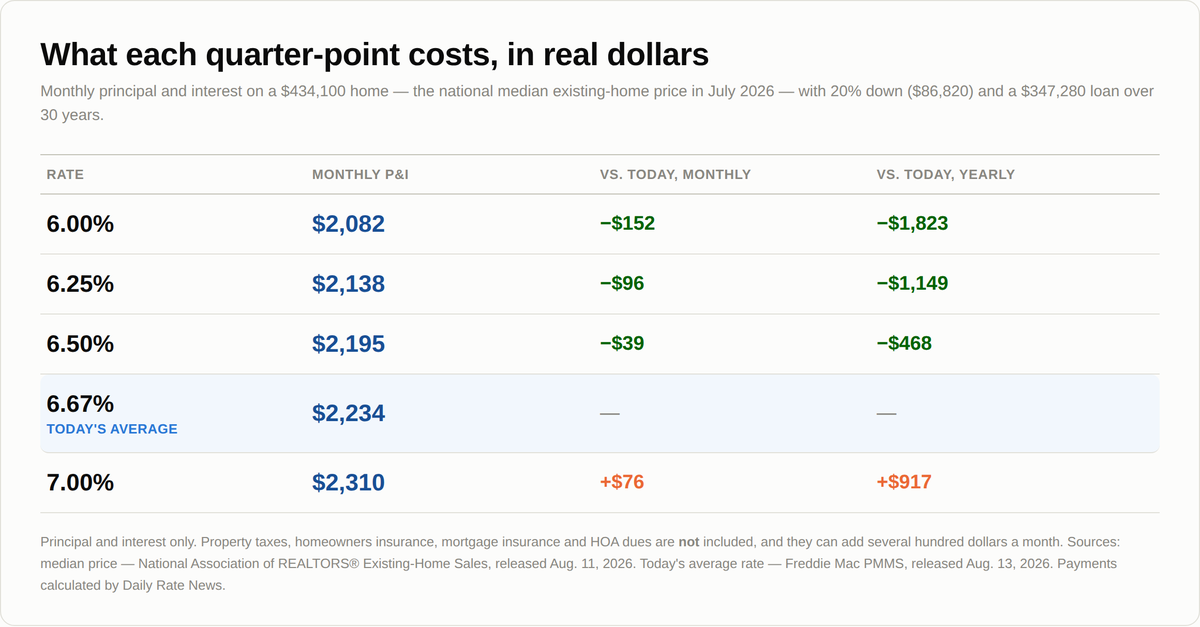
Figure 4. Monthly principal and interest at a range of rates. Sources: National Association of REALTORS® Existing-Home Sales, released Aug. 11, 2026 (median price); Freddie Mac PMMS, released Aug. 13, 2026 (current rate). Payments calculated by Daily Rate News.
On a $434,100 home with 20% down, every quarter-point is worth roughly $55 to $60 a month. Getting from today's 6.67% to 6.00% would save about $152 a month, or $1,823 a year. That's real money — but it is not life-changing money, and it is worth remembering that when you're deciding whether to wait.
The housing market, briefly
Two reports landed in the past week and they point in opposite directions.
Existing-home sales ran at an annual pace of 4.06 million in July, down 1.7% from June but up 0.7% from a year ago (NAR, Aug. 11). The median price was $434,100, up 2.0%. There were 1.54 million homes for sale — a 4.6-month supply, which is closer to balanced than anything buyers saw a few years ago. Homes sold in a median of 29 days.
Homebuilders, though, pulled back sharply. Housing starts fell 12.4% in July to an annual rate of 1.24 million, with single-family starts down 9.9% (Census Bureau, released Aug. 18). Permits — the leading indicator, since builders pull permits before they break ground — rose 5.0%. So builders slowed down in July but have not given up on the fall.
What to watch this week
Thursday morning: Freddie Mac's weekly rate survey. Given where Treasury yields have been, expect something close to flat.
Aug. 27–29: The Kansas City Fed's Jackson Hole symposium. It will be Chair Kevin Warsh's first Jackson Hole speech since taking office in May, and markets will read it closely.
Sept. 15–16: The next Fed meeting, which comes with updated forecasts from every official.
What I'd do
If you are buying and you find the right house, don't wait for a rate that nobody can promise you. The 10-year Treasury has moved a tenth of a point in three weeks. Nothing in this week's data suggests a drop is coming that would change your budget in a meaningful way.
If you are under contract, a rate lock protects you from an increase while your loan closes — and with the Fed clearly split, an upside surprise is a real possibility. Locking is the cautious call right now.
If you are sitting on a rate above 7.5%, run the refinance math today rather than waiting for a headline. Take the monthly savings and divide it into your closing costs. That number is how many months it takes to break even. If you'll be in the house well past that point, it can work at today's rates — you don't need to wait for a rally.
And if your loan is at 5% or lower, you already have the win. Keep it.