
Tuesday, August 18, 2026 at 1:26 AM PDT
The Fed's Next Move Probably Isn't a Hike Anymore
Six weeks ago traders were betting the Federal Reserve's next step would be to raise rates. Two government reports have quietly flipped that bet — and that matters more for your mortgage than anything else this month.
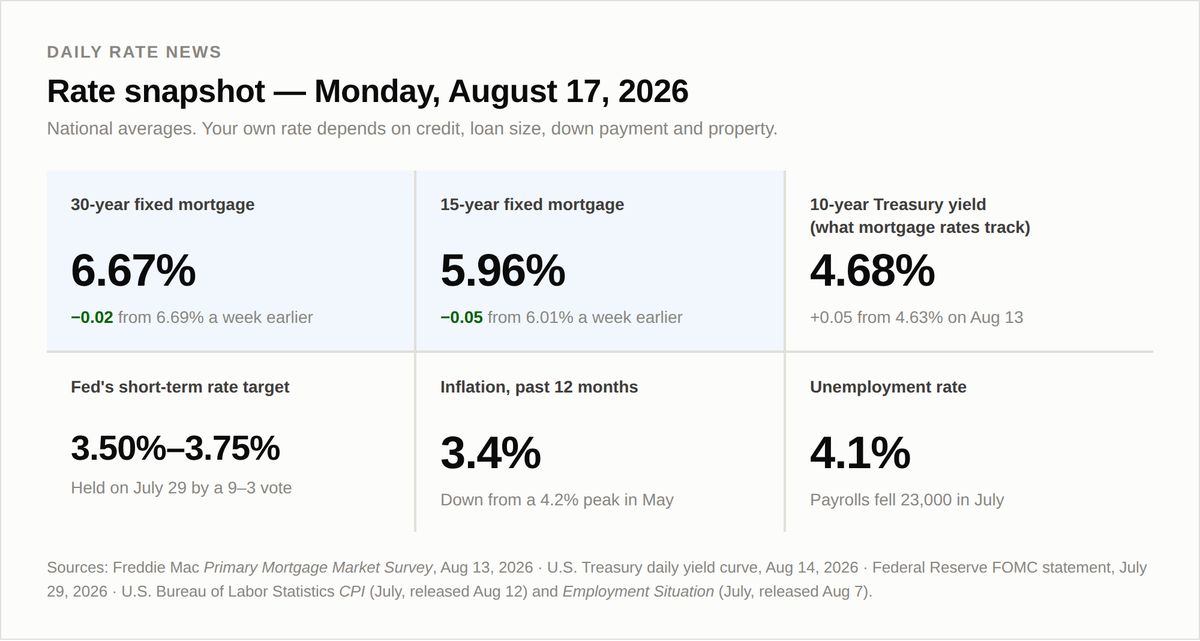
Figure 1. Rate snapshot for Monday, August 17, 2026. Sources: Freddie Mac Primary Mortgage Market Survey (Aug 13, 2026); U.S. Treasury daily yield curve (Aug 14, 2026); Federal Reserve FOMC statement (July 29, 2026); U.S. Bureau of Labor Statistics CPI (released Aug 12, 2026) and Employment Situation (released Aug 7, 2026).
Where rates stand this morning
The average 30-year fixed mortgage is 6.67%, per Freddie Mac's weekly survey released Thursday, August 13 — down from 6.69% the week before. The 15-year fixed averaged 5.96%, down from 6.01%.
Let's be honest about what that is: noise. Two hundredths of a point is not a trend, and 6.67% is still the second-highest weekly reading Freddie Mac has published all year. Rates bottomed at 5.98% on February 26 and have climbed about seven-tenths of a point since.
What's changed isn't the rate. It's the direction of the risk — and if you're deciding whether to lock or wait, that's the part that matters.
Two reports in six days changed the story
In late July, the bond market was worried the Fed would raise short-term rates. Energy prices had spiked, inflation had run up to 4.2% in May, and the loudest voices inside the Fed wanted to act. When the Fed met on July 29 and voted to hold its target at 3.50%–3.75%, three officials dissented — Beth Hammack, Neel Kashkari and Lorie Logan — and all three wanted a quarter-point increase.
Then two reports landed.
August 7 — the jobs report. The Bureau of Labor Statistics said employers cut 23,000 jobs in July, and revised the two prior months sharply lower: May from +129,000 to +63,000, June from +57,000 to +20,000. Average monthly job growth over the prior twelve months was just 34,000. Unemployment held at 4.1%.
August 12 — the inflation report. Consumer prices rose 0.1% in July and 3.4% over twelve months, down from that 4.2% May peak. Strip out food and energy — the part economists watch for the underlying trend — and prices rose 0.2% in the month and 2.5% over the year.
A Fed worried about a weakening job market does not raise interest rates. Traders got the message: futures pricing tracked by CME Group's FedWatch tool put September hike odds near 31% this morning, per CoinDesk — down from 60% just after the Fed's July press conference, as Charles Schwab reported then. Goldman Sachs chief economist Jan Hatzius told clients “we still think market pricing for the funds rate is too hawkish.”
The practical takeaway: the scenario where mortgage rates jump another half point this fall has gotten a lot less likely.
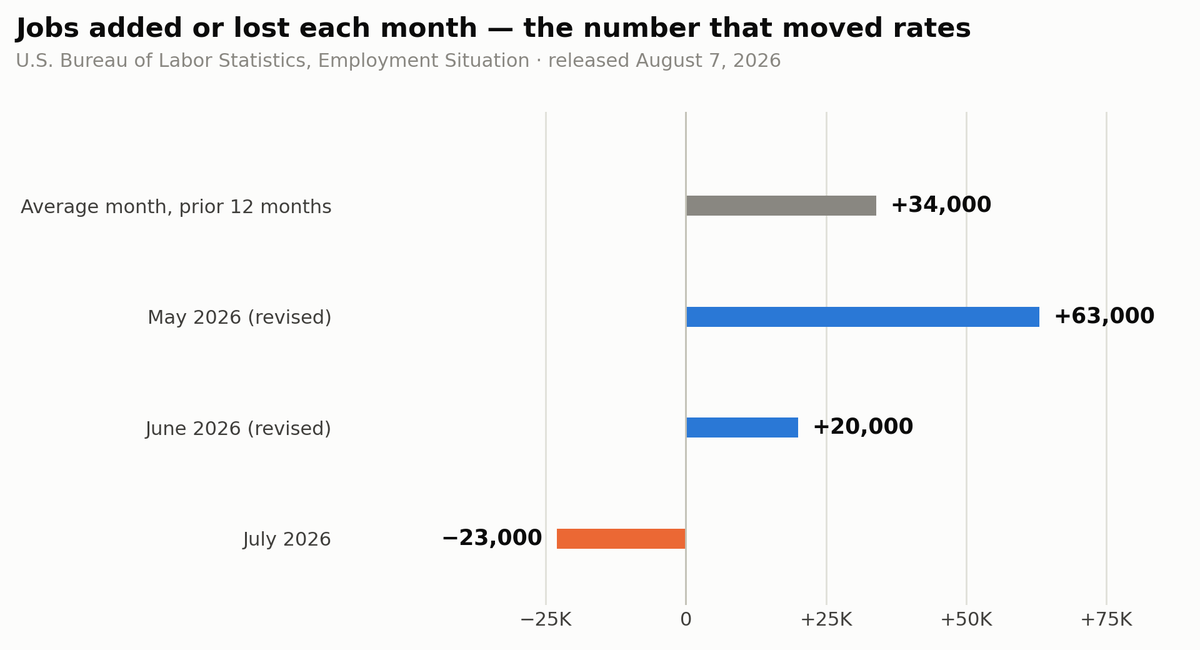
Figure 2. Monthly change in U.S. nonfarm payroll employment, seasonally adjusted. Source: U.S. Bureau of Labor Statistics, Employment Situation Summary for July 2026, released August 7, 2026.
So why hasn't my rate come down?
Because mortgage rates don't follow the Fed's short-term rate. They follow the 10-year Treasury yield — what big investors demand to lend the U.S. government money for a decade — and that yield has been stubborn. It closed at 4.68% on Friday, August 14, up from 4.63% the day before, per Treasury's daily figures.
Two reasons bond investors haven't rallied harder on the soft data:
Inflation is still 3.4%, not 2%. The gap between that 3.4% headline and the 2.5% core reading is almost entirely energy: energy costs were up 14.7% over twelve months and gasoline alone was up 24.6%. Investors lending for ten years want to be paid for that risk, even if they expect it to fade.
Shelter costs keep grinding. Housing was July's single biggest contributor to inflation, accounting for roughly two-thirds of the monthly increase by itself, even at a modest 0.1% rise.
So it's a standoff. The jobs picture argues for lower rates, lingering inflation argues against, and until one side wins expect the 30-year to keep chopping around in the mid-6s.
What a quarter-point is actually worth
Percentages are abstract, so here's the money. The median existing home sold for $434,100 in July, per the National Association of Realtors. With 20% down, that's a $347,280 loan.
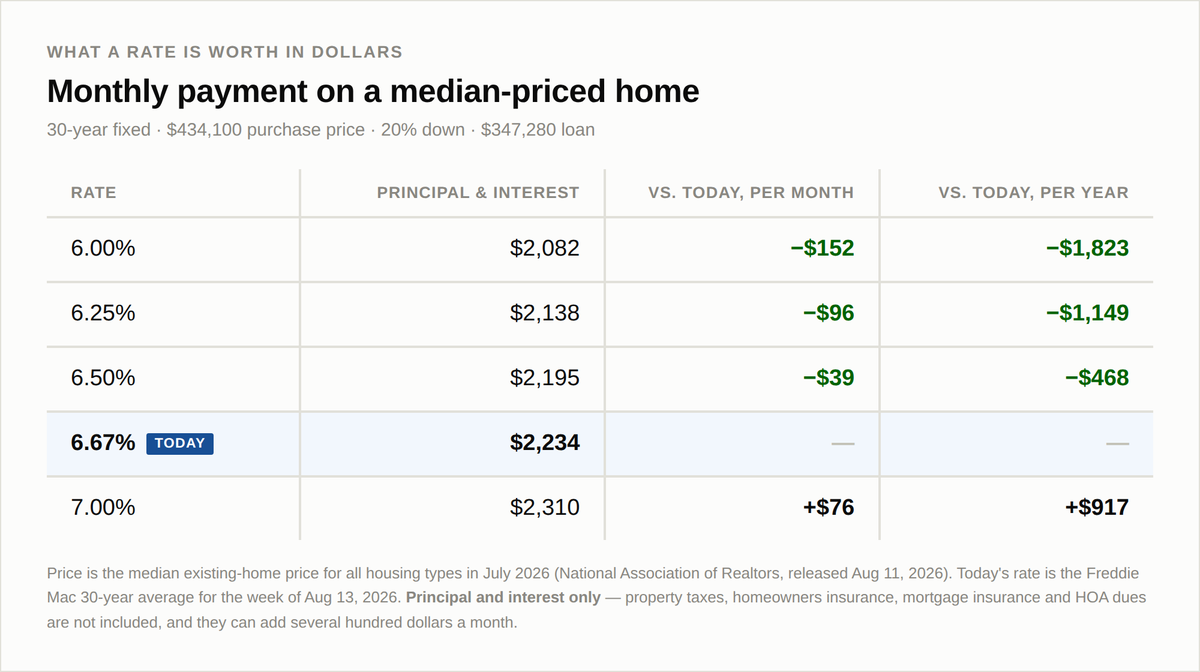
Figure 3. Monthly principal and interest on a 30-year fixed loan of $347,280 at selected rates. Price is the July 2026 median existing-home price for all housing types (National Association of Realtors, released August 11, 2026); today's rate is Freddie Mac's 30-year average for the week of August 13, 2026 (released August 13, 2026). Taxes, insurance, mortgage insurance and HOA dues excluded.
Dropping from today's 6.67% to 6.25% saves about $96 a month, or $1,149 a year. Getting to 6.00% saves roughly $152 a month. Going the wrong way to 7.00% costs about $76 a month. Real money — but notice the scale. A quarter-point is meaningful, not life-changing.
The housing market right now
Sales are flat. Existing-home sales ran at an annual pace of 4.06 million in July, down 1.7% from June but up 0.7% from a year ago, NAR reported on August 11. There were 1.54 million homes for sale — a 4.6-month supply — and homes took an average of 29 days to sell, up from 28 a year earlier. First-time buyers made up 29% of purchases. Prices are rising gently: that $434,100 median is 2.0% above July 2025.
NAR's chief economist Lawrence Yun put it plainly: “Home sales have been remarkably stable, even amid the rising mortgage rate environment of the past few months. Year-to-date sales are up 2.4% and there's no doubt that the housing market would be thriving if average mortgage rates were to return near 6%.”
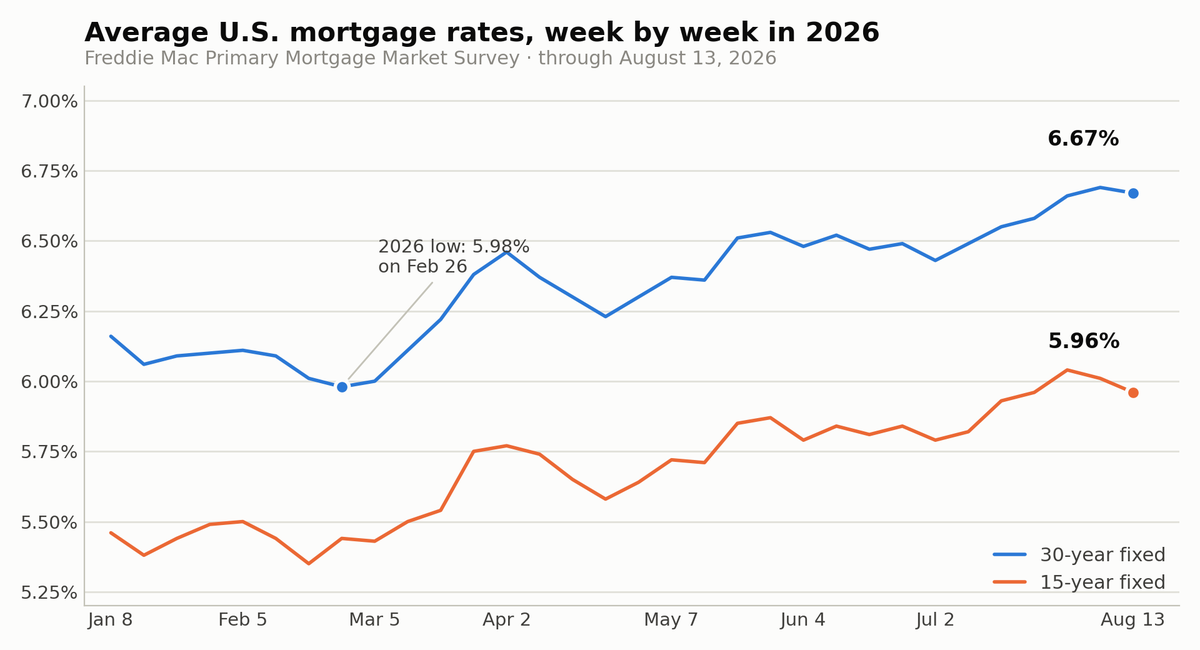
Figure 4. Weekly average U.S. 30-year and 15-year fixed mortgage rates, January 8 through August 13, 2026. Source: Freddie Mac, Primary Mortgage Market Survey, weekly releases through August 13, 2026.
What to watch this week
It's a light calendar, which means any single report can move rates more than it normally would.
Tuesday, 8:30 a.m. ET — housing starts and building permits (Census Bureau). June's starts ran at an annual pace of 1,427,000. That looked like a 19% monthly jump, but the gain was all apartments — single-family starts slipped 0.2% — and Census put a ±15.9% margin of error on it, so read it with caution.
Wednesday, 2:00 p.m. ET — minutes of the July Fed meeting (Federal Reserve). The week's main event: how close the committee came to hiking, and what would change their minds. Note the chronology — that meeting happened before the weak jobs report, so treat hawkish language as slightly out of date.
Thursday, 8:30 a.m. ET — weekly unemployment claims. With the labor market now the deciding factor, this usually-ignored release matters more than normal.
Ahead: the Kansas City Fed's Jackson Hole symposium runs August 27–29, where Chair Kevin Warsh speaks for the first time in that role. The official topic is financial innovation and payments, but markets will listen for anything on rates.
What I'd do
If you're under contract with 30 days or less to close: lock. The upside from waiting is a few hundredths of a point; the downside is one hawkish paragraph in Wednesday's minutes. Not a fair trade on a short fuse.
If you're 45 to 60 days out: ask me about a lock with a float-down option — protection now, plus a second bite if rates improve. It usually costs a little, and this two-sided market is what it's built for.
If you're refinancing: run the break-even math instead of guessing. Divide your total closing costs by your monthly savings — that's how many months you need to stay to come out ahead. Near 6.67%, a refinance generally pencils out if you're above roughly 7.25%, or if you're consolidating higher-cost debt, dropping mortgage insurance, or leaving an adjustable loan.
If you're waiting for 5.99%: that's a bet, not a plan. Rates hit 5.98% in February and nobody rang a bell. Buy on the payment you can afford today and treat a future refinance as a bonus, not the plan.