
Thursday, August 27, 2026 at 9:07 AM PDT
The Fed's new chair speaks tomorrow — and the question isn't when rates will fall
Mortgage rates have edged down two weeks running. But the argument inside the Federal Reserve right now is whether its next move should be up, not down. Here's what that means for your payment.
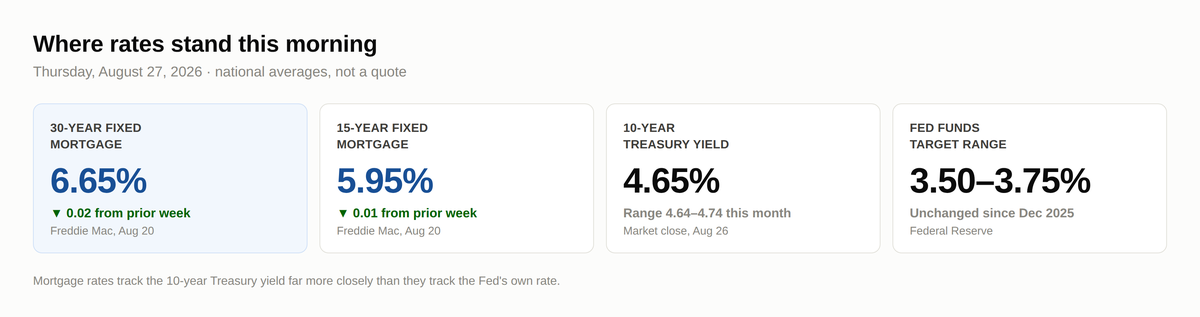
Figure 1. Rate snapshot for August 27, 2026. Mortgage averages: Freddie Mac Primary Mortgage Market Survey, released August 20, 2026. 10-year Treasury: market close, August 26, 2026. Federal funds target range: Federal Reserve FOMC statement, July 29, 2026.
What happened
The Jackson Hole Economic Symposium opens today in Wyoming. It's the yearly gathering where central bankers from around the world compare notes, and markets watch it closely because the Federal Reserve chair usually gives a major speech there.
This year that speech matters more than usual. Kevin Warsh became Fed chair on May 22, 2026, and he speaks tomorrow morning — his first Jackson Hole address in the job. Traders will be listening for one thing: any hint about what the Fed does at its next meeting on September 15–16.
Here's the part that surprises people. For most of the past two years, the question was when will the Fed cut rates? Right now it's the opposite. At the Fed's July 29 meeting, the committee held its rate steady — but three members voted against that, and all three wanted a rate increase. After Wednesday's inflation report, traders put the odds of a September hike at about 44%, up from roughly 36% before the report, according to figures reported by Reuters from the CME FedWatch tool.
Why rates haven't moved much
The reason is inflation that won't finish the job.
The Fed's preferred inflation measure, the PCE price index, came in Wednesday at 3.7% for the 12 months through July — unchanged from June, and a touch above the 3.6% economists had expected. Strip out food and energy, and “core” PCE sat at 3.3%. The Fed's target is 2%.
Consumer prices tell a slightly gentler story. The Consumer Price Index rose 3.4% over the year through July, and core CPI — again, minus food and energy — was 2.5%.
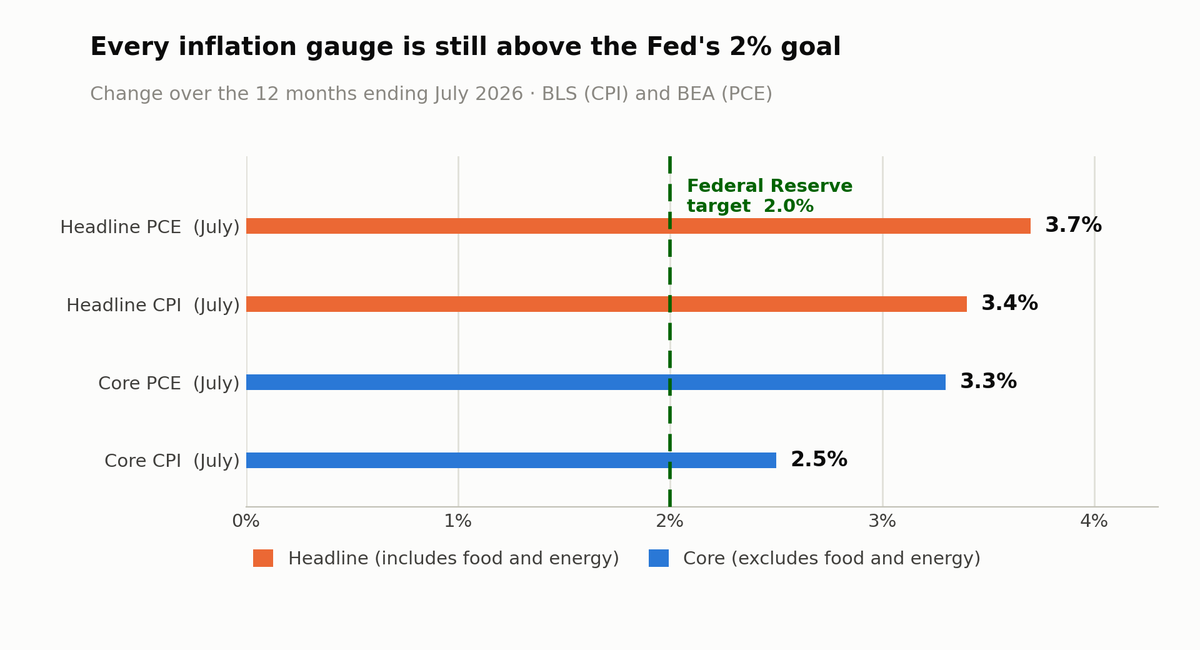
Figure 3. Twelve-month price changes through July 2026. CPI: Bureau of Labor Statistics, Consumer Price Index — July 2026, released August 12, 2026. PCE: Bureau of Economic Analysis, Personal Income and Outlays, July 2026, released August 26, 2026.
Why the gap between the two? Mostly housing costs. Rent and related shelter costs make up a much bigger slice of the CPI basket than they do in the PCE basket, and shelter inflation has been cooling. So the CPI looks calmer. The Fed, however, steers by PCE — and at 3.3% core, that gauge is still well above where the Fed wants it.
Energy is the other piece. The CPI energy index was up 14.7% over the past year. Brent crude oil traded near $87 a barrel on Wednesday, roughly 30% higher than a year ago. Expensive fuel pushes up the cost of nearly everything that gets shipped, and that keeps the Fed cautious.
Meanwhile the economy is neither booming nor breaking. The economy grew at a 1.5% annual pace in the second quarter. Employers cut 23,000 jobs in July and unemployment sits at 4.1%. But new claims for unemployment benefits released this morning came in at 203,000 — down 4,000 and lower than forecast. A soft-but-not-collapsing job market gives the Fed no urgency to cut.
Put simply: rates are stuck near 6.65% because inflation is stuck near 3.5%, and nothing in this week's data changed that.
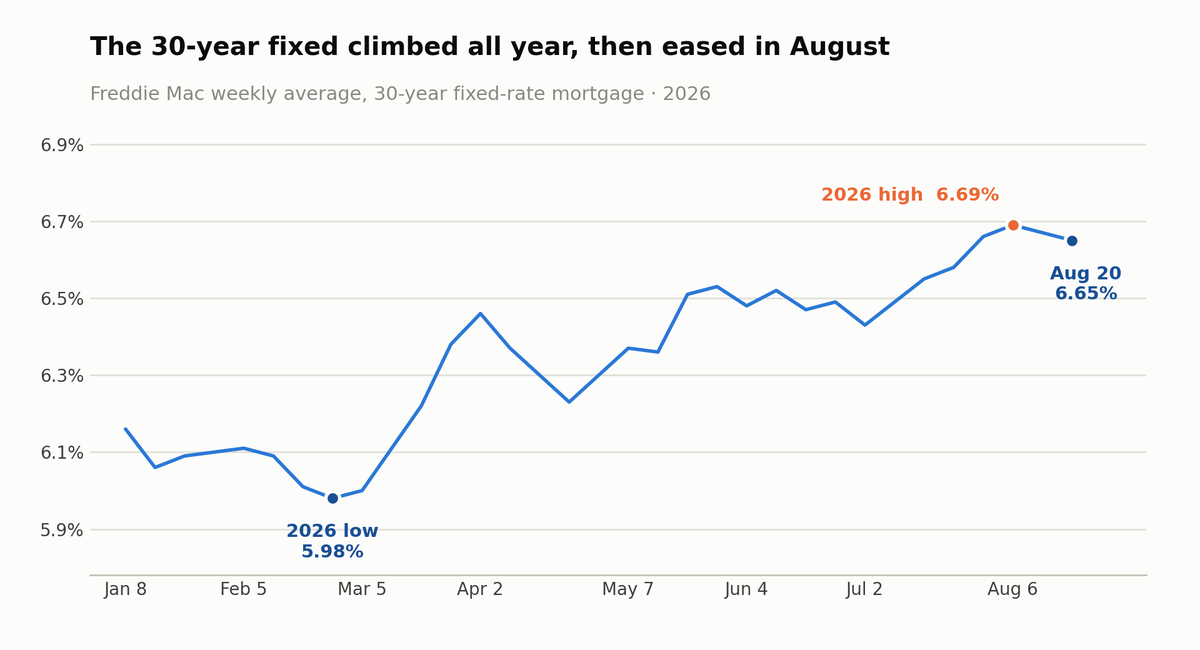
Figure 2. Freddie Mac Primary Mortgage Market Survey, 30-year fixed-rate weekly averages, January 8 through August 20, 2026. Most recent release: August 20, 2026.
What it costs in dollars
This is where it gets practical. The median existing home sold for $434,100 in July, according to the National Association of Realtors. With 20% down, that's a loan of $347,280.
At today's average of 6.65%, principal and interest run about $2,229 a month.
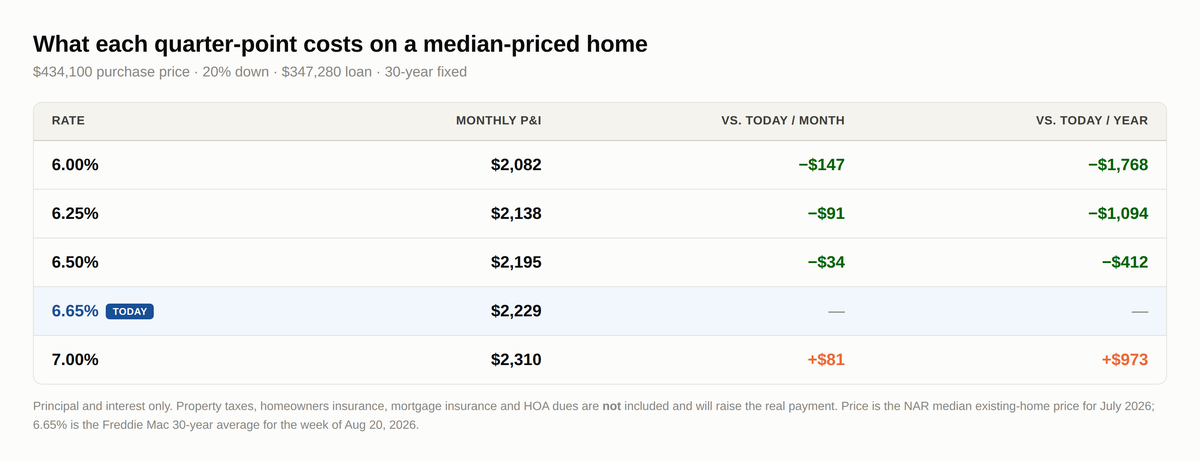
Figure 4. Monthly principal and interest on a $347,280 loan — the National Association of Realtors median existing-home price of $434,100 for July 2026 (released August 11, 2026) with 20% down. Rate of 6.65% from Freddie Mac, August 20, 2026. Payments calculated by Daily Rate News. Taxes, insurance, mortgage insurance and HOA dues are excluded.
Notice how small the gaps are. Getting from today's rate down to 6.50% saves about $34 a month. Even a drop all the way to 6.00% — a level we haven't seen since February — saves $147 a month, or about $1,768 a year. Real money, but probably not life-changing.
That cuts both ways, and it's worth sitting with. Waiting for a better rate is a bet, and the payoff on that bet is smaller than most people assume. A quarter-point is roughly the price of a phone bill. Meanwhile the home you want may sell, and prices are still drifting up about 2% a year.
The housing market right now
Existing-home sales ran at an annual pace of 4.06 million in July, down 1.7% from June but up 0.7% from a year ago. Prices rose 2.0% over the year.
The genuinely good news is inventory. There were 1.54 million homes for sale, a 4.6-month supply. Anything under six months is generally considered a seller's market, but 4.6 months is far healthier than the punishing 2-to-3-month supply of a few years back. Homes took a median 29 days to sell. First-time buyers made up 29% of purchases.
Translation: you have more to choose from and more room to negotiate than buyers had in 2021. That's a real advantage, and it doesn't show up in the rate.
What to watch this week
Today at noon Eastern: Freddie Mac publishes this week's mortgage rate survey. Last week's reading was 6.65%.
Tomorrow morning: Chair Warsh speaks at Jackson Hole. If he sounds worried about inflation, expect rates to tick up. If he sounds worried about jobs, they may ease.
September 15–16: the Fed's next decision.
One thing worth understanding: the Fed doesn't set mortgage rates. Your rate follows the 10-year Treasury yield — currently around 4.65% — much more closely than it follows the Fed's own rate. That's why mortgage rates barely budged even after the Fed cut in December.
What I'd do
If you're buying and you've found the house, buy the house. Nobody can promise you a lower rate this fall, and right now the market thinks the next Fed move might be upward. Negotiating $8,000 off the price beats waiting for a quarter-point.
If you're shopping lenders, shop harder. Freddie Mac's own chief economist, Sam Khater, made this point in last week's release: borrowers “can potentially save thousands by shopping around for the best mortgage rate.” Two or three quotes on the same day is the highest-value hour you'll spend.
If you have a rate above 7.5%, let's run the numbers. Refinancing makes sense when the monthly savings pay back your closing costs in a reasonable time. That's simple arithmetic, and I'm happy to do it for you.
If you're locked and closing soon, stay locked. With a Fed speech tomorrow and a live rate debate, this is not the week to float.
If you're waiting for 5.5%, have a backup plan. It may come. It may not come this year. Decide what you'll do in either case, rather than waiting by default.
Questions about your specific situation? Reply to this email or call me — that's what I'm here for.
REFERENCES
1. Freddie Mac. Primary Mortgage Market Survey — Mortgage Rates Decline for Second Consecutive Week. Released August 20, 2026. https://www.freddiemac.com/pmms
2. Bureau of Labor Statistics. Consumer Price Index — July 2026. Released August 12, 2026. https://www.bls.gov/news.release/cpi.nr0.htm
3. Bureau of Economic Analysis. Personal Income and Outlays, July 2026. Released August 26, 2026. https://www.bea.gov/data/personal-consumption-expenditures-price-index
4. Bureau of Labor Statistics. The Employment Situation — July 2026. Released August 7, 2026. https://www.bls.gov/news.release/empsit.nr0.htm
5. Bureau of Economic Analysis. Gross Domestic Product, 2nd Quarter 2026 (Second Estimate). Released August 26, 2026. https://www.bea.gov/news/2026/gdp-second-estimate-and-corporate-profits-2nd-quarter-2026
6. U.S. Department of Labor. Unemployment Insurance Weekly Claims. Released August 27, 2026. https://www.dol.gov/ui/data.pdf
7. National Association of Realtors. Existing-Home Sales, July 2026. Released August 11, 2026. https://www.nar.realtor/newsroom/nar-existing-home-sales-report-shows-1-7-decrease-in-july
8. Federal Reserve. FOMC Statement. Released July 29, 2026. https://www.federalreserve.gov/newsevents/pressreleases/monetary20260729a.htm
9. Federal Reserve. H.15 Selected Interest Rates (Daily). Released August 26, 2026. https://www.federalreserve.gov/releases/h15/
10. Federal Reserve. Kevin M. Warsh Sworn In as Chair of the Board of Governors. May 22, 2026. https://www.federalreserve.gov/newsevents/pressreleases/other20260522a.htm
11. Federal Reserve Bank of Kansas City. Jackson Hole Economic Symposium 2026. August 27–29, 2026. https://www.kansascityfed.org/research/jackson-hole-economic-symposium/
12. Reuters, via Yahoo Finance. CME FedWatch September rate-hike probabilities following the July PCE release. August 26, 2026. https://finance.yahoo.com/economy/policy/
13. Fortune. Oil prices — Brent and WTI crude. August 26, 2026. https://fortune.com/article/price-of-oil-08-26-2026/
About these figures. All four figures were built by Daily Rate News from the published data cited above and are free for [[COMPANY]] to reproduce and redistribute. Payment figures in Figure 4 are our own calculations. No AI-generated imagery is used anywhere in this newsletter. If you add a photo, free-license options include Unsplash, Pexels and Pixabay; photography produced by US federal government agencies is generally in the public domain. Always keep the credit line.