
Friday, August 28, 2026 at 9:15 AM PDT
The Fed's New Chair Just Told You Not to Wait for a Signal
Kevin Warsh gave his first Jackson Hole speech this morning. He called 2% inflation “a firm, fixed target,” said he wants a “quieter Fed” that stops telegraphing its next move, and left the 30-year mortgage sitting almost exactly where it has been all month — 6.66%.
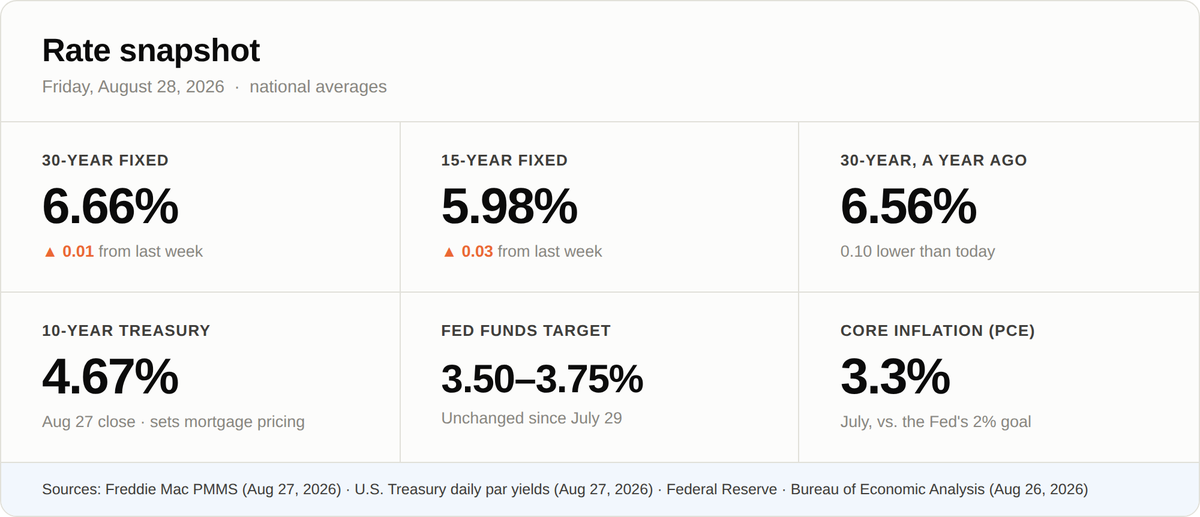
Figure 1. Rate snapshot. Sources: Freddie Mac Primary Mortgage Market Survey, week ended August 27, 2026; U.S. Treasury daily par yields, August 27, 2026; Federal Reserve; Bureau of Economic Analysis, released August 26, 2026.
What happened this morning
At 10:00 a.m. Eastern, Federal Reserve Chair Kevin Warsh delivered the keynote address at the Kansas City Fed's Jackson Hole symposium in Wyoming. It was his first as chair, and it was less about the Fed's next rate decision than about how the Fed talks about its decisions at all.
Two passages matter if you have a mortgage application open.
On inflation, he was blunt: “The Fed's price-stability objective of 2 percent, as measured by the personal consumption expenditures (PCE) price index, is a firm, fixed target.” He added that “price stability is not self-executing, nor is inflation necessarily mean-reverting.” Inflation is currently running at 3.7% over the past 12 months. That is not a chair preparing to cut.
On communication, he criticized forward guidance — the Fed's long-standing habit of hinting at its next move — calling it “a hall-of-mirrors problem.” If markets lean on the Fed's hints and the Fed leans on market prices, he argued, “we are all more likely to be blinded.” He wants “a quieter Fed.”
The practical translation: stop waiting for the Fed to announce that lower rates are on the way. The new chair just said he doesn't plan to announce it.
Why your rate hasn't moved
Freddie Mac's weekly survey, released Thursday, put the 30-year fixed at 6.66%, up one hundredth of a point from the week before. The 15-year averaged 5.98%. A year ago the 30-year was 6.56% — so twelve months of waiting has left buyers one-tenth of a point worse off, not better.
“Mortgage rates changed little this week averaging 6.66%,” said Sam Khater, Freddie Mac's chief economist. “The economy remains resilient, demonstrated by steady consumer spending and rising household incomes.”
Here's the piece most people miss. The Fed's own interest rate — the federal funds target, currently 3.50% to 3.75% — is an overnight rate between banks. It is not your mortgage rate and it does not set your mortgage rate. Your rate tracks the 10-year Treasury yield, which closed Thursday at 4.67%, up from 4.48% on July 1.
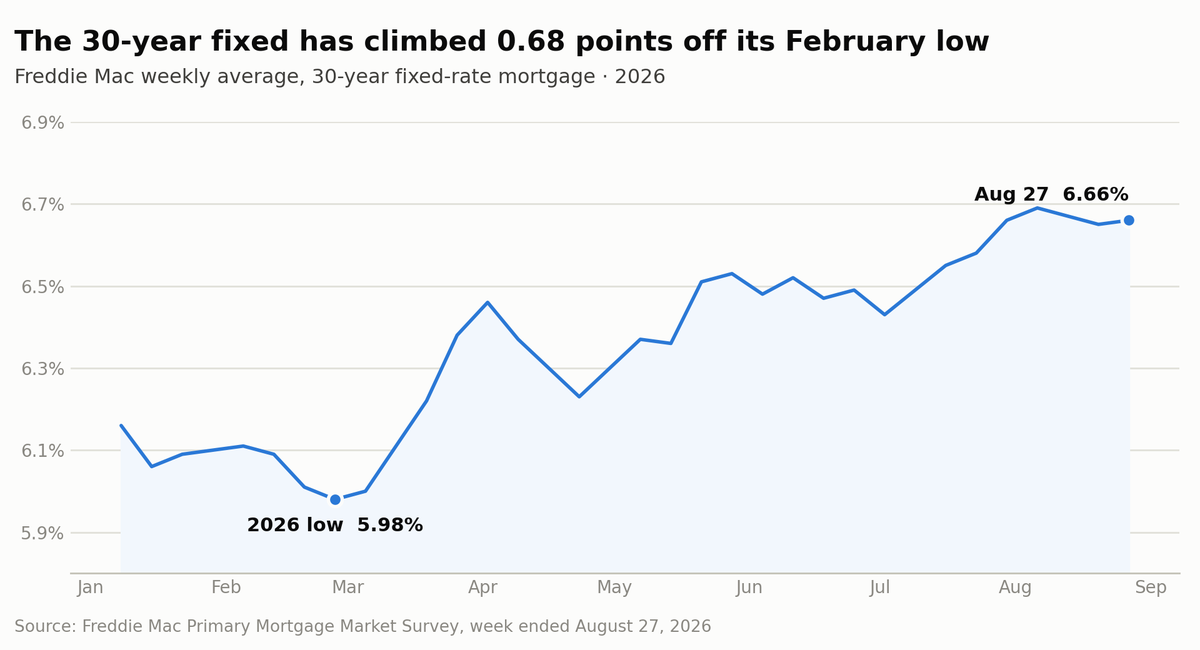
Figure 2. Source: U.S. Department of the Treasury, Daily Treasury Par Yield Curve Rates, retrieved August 28, 2026.
That yield is stuck because inflation is stuck. The Bureau of Economic Analysis reported Wednesday that its PCE price index rose 3.7% over the year through July, with the “core” measure that strips out food and energy at 3.3%. The Fed's goal is 2%. (The government's other inflation gauge, the Consumer Price Index, showed 3.4% headline and 2.5% core for July. The two measures use different baskets and weightings, and the Fed steers by PCE.)
And the Fed itself is genuinely divided. When it held rates steady on July 29, the vote was 9 to 3 — and all three dissenters, Cleveland's Beth Hammack, Minneapolis' Neel Kashkari and Dallas' Lorie Logan, wanted to raise rates a quarter point. The minutes released August 19 confirmed that “several participants favored an increase of 25 basis points,” and that some thought financial conditions “might not currently be sufficiently restrictive.”
After Wednesday's inflation report, ADM Investor Services put the market-implied odds of a September rate hike at roughly 40%.
Pulling against all of that is a labor market losing steam: employers cut 23,000 jobs in July, and the Bureau of Labor Statistics revised May and June down by a combined 103,000. Unemployment held at 4.1%. A Fed worried about jobs cuts; a Fed worried about inflation hikes. Right now it's worried about both, so it does nothing — and mortgage rates sit still.
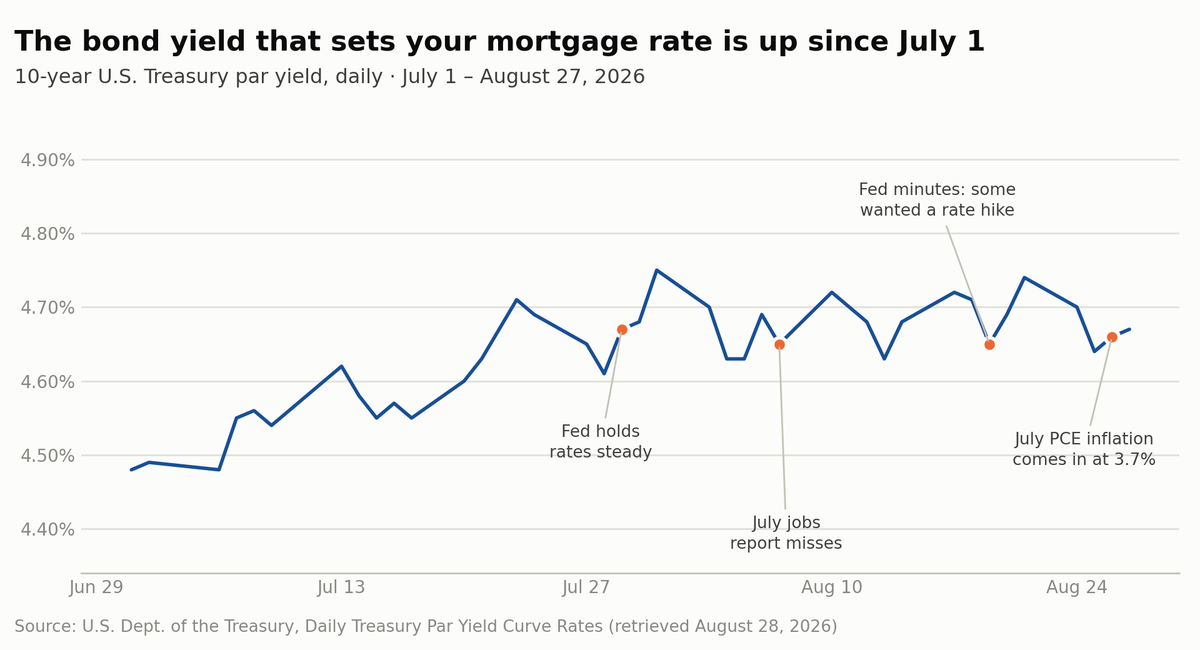
Figure 3. Source: Freddie Mac Primary Mortgage Market Survey, weekly 30-year fixed averages through the week ended August 27, 2026.
What it actually costs
Numbers help more than adjectives. The national median existing-home price in July was $434,100 (National Association of Realtors). With 20% down, that's a $347,280 loan.
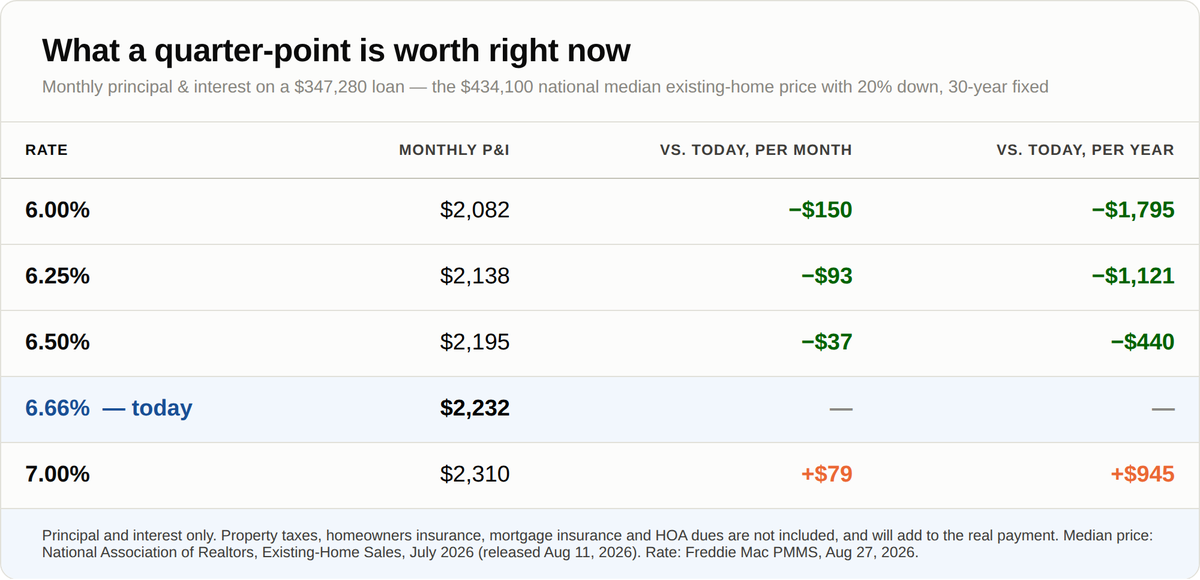
Figure 4. Monthly principal and interest by rate. Median price: National Association of Realtors, Existing-Home Sales, July 2026, released August 11, 2026. Rate: Freddie Mac PMMS, August 27, 2026. Author's calculation.
At today's 6.66%, principal and interest run about $2,232 a month. Every quarter-point is worth roughly $56 a month on this loan — about $675 a year. Getting back to 6.00% would save $150 a month, or nearly $1,800 a year. Drifting to 7.00% costs $79 a month.
That's the honest scale of it. A quarter-point move is real money over thirty years, but it is not usually the difference between buying and not buying.
The housing market, briefly
Existing-home sales ran at a 4.06 million annual pace in July, down 1.7% from June but still 0.7% above a year earlier, NAR reported on August 11. There were 1.54 million homes for sale — a 4.6-month supply — and homes went under contract in 29 days. First-time buyers made up 29% of sales.
“Home sales have been remarkably stable, even amid the rising mortgage rate environment of the past few months,” said NAR chief economist Lawrence Yun.
New construction is a different story. The Census Bureau reported August 25 that new single-family home sales fell 10.5% in July to a 607,000 annual pace, with 9.6 months of supply on builders' books and a median new-home price of $393,800. Warsh himself named housing as a sector “showing strains.”
For a buyer, that last number is leverage. Builders sitting on nine-plus months of inventory are the people most willing to pay for a rate buydown.
What to watch over the next three weeks
Friday, September 4 — August jobs report (BLS). The single biggest scheduled mover.
Thursday, September 10 and Friday, September 11 — wholesale prices, then August CPI (BLS).
Tuesday–Wednesday, September 15–16 — the Fed meets. Given this morning's speech, expect less guidance about what comes after, not more.
What I'd do
If you're under contract, lock. The risk is genuinely two-sided right now, and there's no reward for guessing.
If you're shopping, price the payment at today's rate, not a hoped-for one. Don't buy a house you can only afford after a refinance that may not arrive.
If you closed above 7%, run the break-even. Divide your total closing costs by your monthly savings. If you'd stay in the home past that number of months, refinancing pencils out; if not, wait.
Ask sellers and builders for concessions instead of asking the market for a better rate. With 4.6 months of existing supply and 9.6 months of new, a seller-paid buydown is often faster than waiting.
If you'd like me to run your actual numbers — your price, your down payment, your credit profile — reply to this email or call me. That takes about ten minutes and it beats guessing.
REFERENCES
Freddie Mac. Primary Mortgage Market Survey — Mortgage Rates Hold Steady. August 27, 2026. https://www.freddiemac.com/pmms
Board of Governors of the Federal Reserve System. In Our Time — Chair Kevin Warsh, Jackson Hole Economic Policy Symposium. August 28, 2026. https://www.federalreserve.gov/newsevents/speech/warsh20260828a.htm
Board of Governors of the Federal Reserve System. FOMC Statement. July 29, 2026. https://www.federalreserve.gov/newsevents/pressreleases/monetary20260729a.htm
Board of Governors of the Federal Reserve System. Minutes of the Federal Open Market Committee, July 28–29, 2026. released August 19, 2026. https://www.federalreserve.gov/monetarypolicy/fomcminutes20260729.htm
U.S. Department of the Treasury. Daily Treasury Par Yield Curve Rates. retrieved August 28, 2026. https://home.treasury.gov/resource-center/data-chart-center/interest-rates/TextView?type=daily_treasury_yield_curve&field_tdr_date_value=2026
U.S. Bureau of Economic Analysis. Personal Income and Outlays, July 2026. August 26, 2026. https://www.bea.gov/news/2026/personal-income-and-outlays-july-2026
U.S. Bureau of Labor Statistics. Consumer Price Index — July 2026. August 12, 2026. https://www.bls.gov/news.release/cpi.nr0.htm
U.S. Bureau of Labor Statistics. The Employment Situation — July 2026. August 7, 2026. https://www.bls.gov/news.release/empsit.nr0.htm
National Association of Realtors. Existing-Home Sales, July 2026. August 11, 2026. https://www.nar.realtor/newsroom/nar-existing-home-sales-report-shows-1-7-decrease-in-july
U.S. Census Bureau and U.S. Department of Housing and Urban Development. New Residential Sales, July 2026. August 25, 2026. https://www.census.gov/construction/nrs/pdf/newressales.pdf
ADM Investor Services. PCE Above Forecasts. August 26, 2026. https://www.admis.com/pce-above-forecasts/
U.S. Bureau of Labor Statistics. Schedule of News Releases, September 2026. retrieved August 28, 2026. https://www.bls.gov/schedule/2026/09_sched_list.htm
All four figures in this issue are original charts and tables built from the published data cited above. They are free for you to reproduce. No AI-generated imagery is used anywhere in this issue. If you want to add a photograph, an HTML-commented photo slot with a credit field is included near the top of this file; free-license options include Unsplash, Pexels and Pixabay, and photography produced by U.S. federal government agencies is generally in the public domain. Always fill in the credit field.