
Friday, August 28, 2026 at 9:21 PM PDT
The Fed's chairman spoke Friday, and mortgage rates went up the same afternoon
Kevin Warsh told an audience in Wyoming that inflation is still too high and that money isn't tight enough. Traders heard “we might raise rates,” and lenders repriced within hours. Here's what it means for your payment.
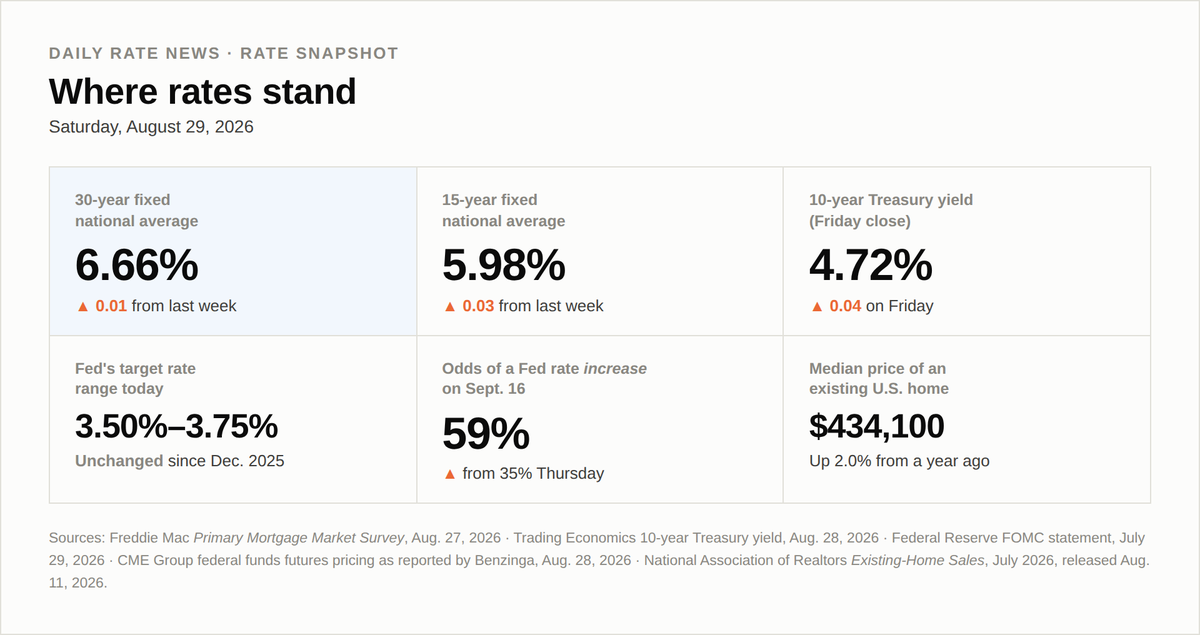
Figure 1. Rate snapshot as of Saturday, August 29, 2026. Sources: Freddie Mac Primary Mortgage Market Survey (Aug. 27, 2026); Trading Economics 10-year Treasury yield (Aug. 28, 2026); Federal Reserve FOMC statement (July 29, 2026); CME Group federal funds futures pricing as reported by Benzinga (Aug. 28, 2026); National Association of Realtors Existing-Home Sales for July 2026 (released Aug. 11, 2026).
What happened Friday
Every August, the Federal Reserve holds a conference in Jackson Hole, Wyoming. The chairman's speech there is usually the most closely watched thing the Fed says all summer. On Friday morning, Chairman Kevin Warsh gave his first one, titled “In Our Time.”
He did not announce a rate change. He did something that mattered more to the bond market: he made clear he isn't finished fighting inflation.
“Inflation is running above our 2 percent target,” Warsh said. “So the Fed's predominant focus right now should be on prices.” He went further and said he “would be hard pressed to describe broad financial conditions as restrictive” — plain English translation: money is not tight enough to be slowing inflation down. He also refused to promise anything about the next meeting, saying he was “committed to a discipline, not to a decision.”
Markets read that as a real chance the Fed's next move is up, not down. Futures pricing put the odds of a rate increase at the September meeting at 59%, up from 35% the day before, according to CME Group data reported by Benzinga. Other outlets citing the same market that afternoon put the number somewhat lower, in the mid-50s, so treat it as “roughly a coin flip that leans toward a hike” rather than a precise figure.
Why the Fed is worried
The numbers back him up. The Bureau of Economic Analysis reported on August 26 that its PCE price index — the inflation gauge the Fed actually targets — rose 0.2% in July and was up 3.7% over the past 12 months. Core PCE, which strips out food and energy because those bounce around, was up 3.3%. The headline number came in a tenth of a point above what forecasters expected; core landed right in line.
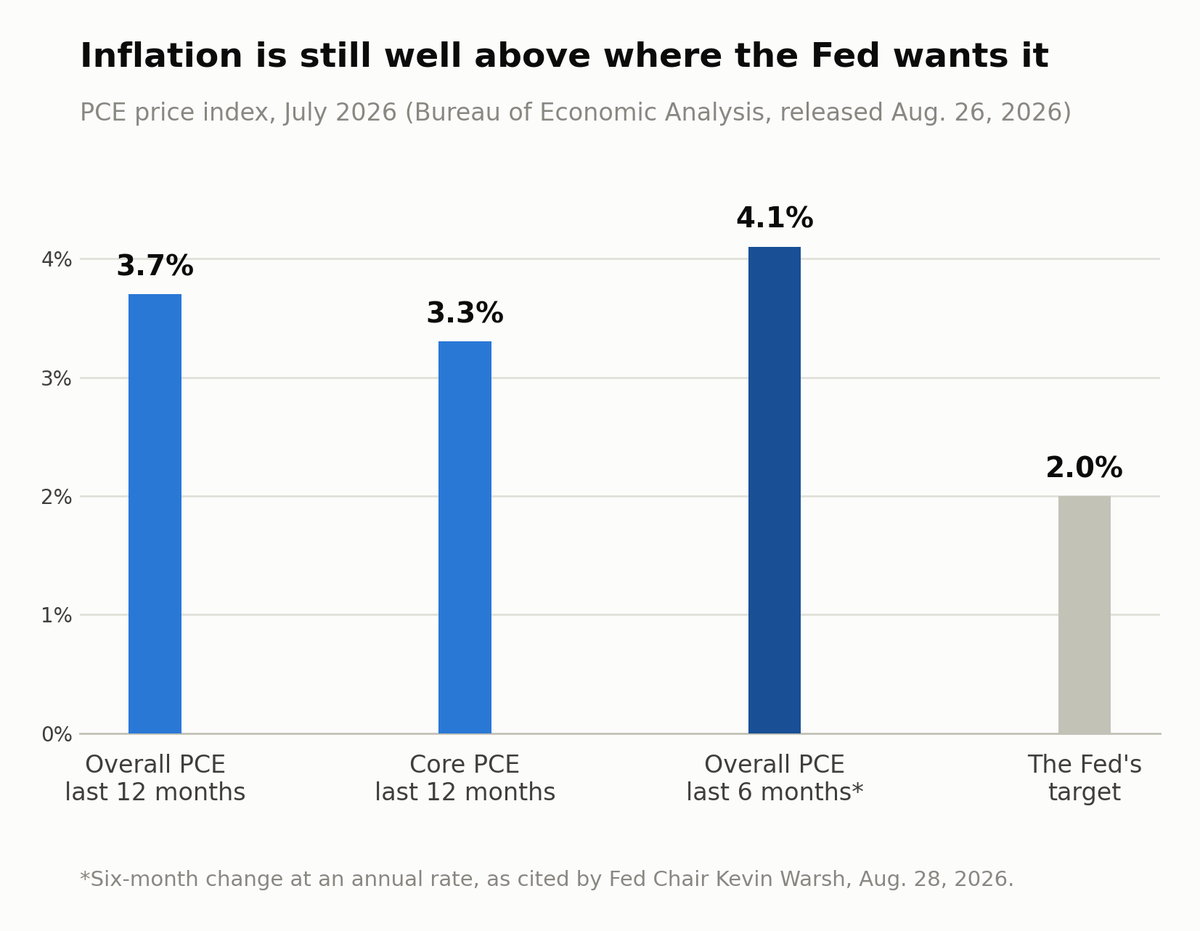
Figure 2. PCE price index, July 2026. Source: U.S. Bureau of Economic Analysis, Personal Income and Outlays, July 2026 (released Aug. 26, 2026). Six-month figure as cited by Fed Chair Kevin Warsh, Aug. 28, 2026.
Meanwhile the economy isn't buckling. Personal income rose 0.4% in July and spending rose 0.2%, per the same BEA report. Warsh pointed to a 4.1% jobless rate and strong business investment as evidence the Fed has room to keep pressing.
The Fed's target range has sat at 3.50%–3.75% since a quarter-point cut in December 2025. It has been held there at every meeting this year. The next decision comes Wednesday, September 16.
Why mortgage rates moved — and why not more
Mortgage rates don't follow the Fed's short-term rate directly. They follow the 10-year Treasury yield, which reflects what investors think inflation and growth will look like years from now.
The Federal Reserve's official reading had it at 4.67% on Thursday. It closed Friday around 4.72%, per Trading Economics — the Fed's own figure for Friday doesn't publish until Monday. Lenders followed. Mortgage News Daily's daily 30-year fixed average finished at 6.81%, up 0.06 on the day and the highest in about three weeks.
Freddie Mac's weekly survey — the number you see quoted in the news — was published Thursday morning, before the speech, at 6.66% for the 30-year and 5.98% for the 15-year. So this week's headline number is already stale. Expect next Thursday's survey to catch up.
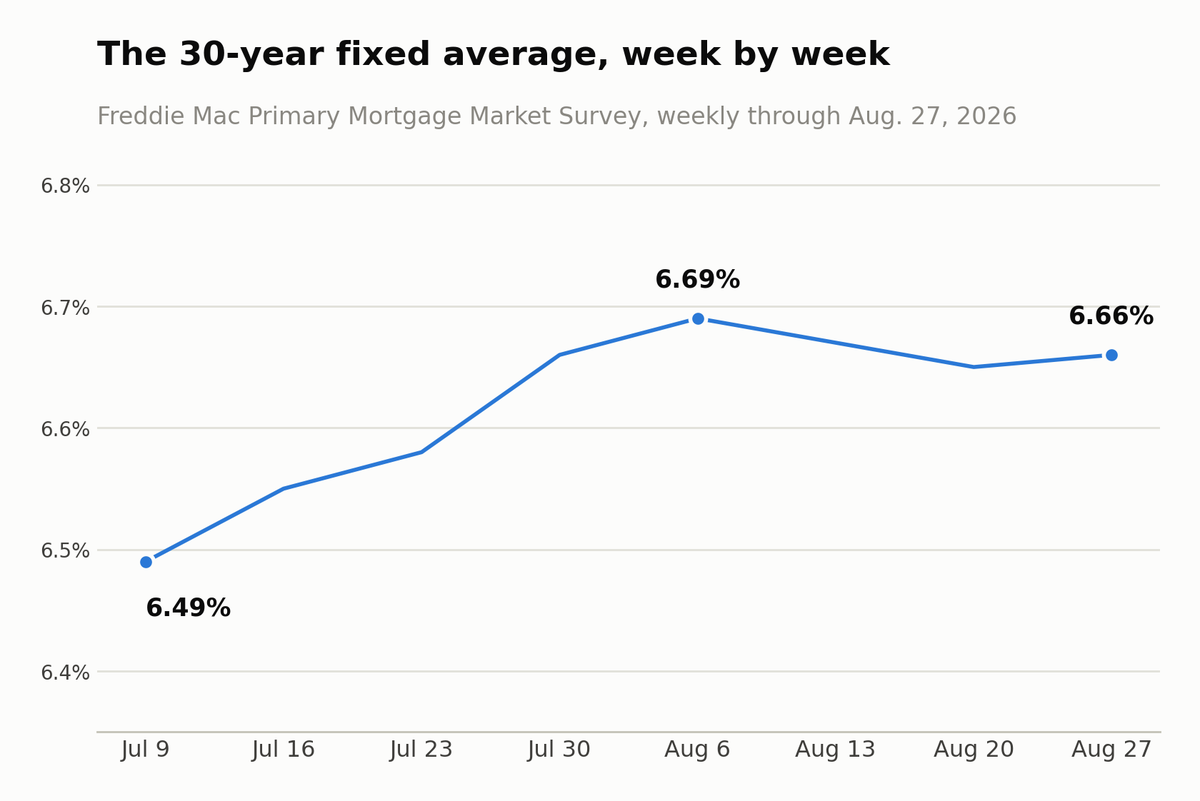
Figure 3. Freddie Mac 30-year fixed-rate average, weekly, July 9 through Aug. 27, 2026. Source: Freddie Mac Primary Mortgage Market Survey.
The bigger picture: rates have drifted up from 6.49% in early July, but they're moving in a narrow band. This was a nudge, not a lurch.
What it costs in dollars
Here's the part that matters at the kitchen table. The median existing U.S. home sold for $434,100 in July, according to the National Association of Realtors. With 20% down, that's a loan of $347,280.
pưFigure 4. Monthly principal and interest on a 30-year fixed loan of $347,280. Rate source: Freddie Mac Primary Mortgage Market Survey (Aug. 27, 2026). Price source: National Association of Realtors Existing-Home Sales for July 2026 (released Aug. 11, 2026). Taxes, insurance, mortgage insurance and HOA dues excluded.
A quarter-point on this loan is worth about $56 a month, or roughly $675 a year. That's real, but it isn't the difference between affording a house and not. Getting from 7.00% down to 6.00% is worth $228 a month, or about $2,740 a year. That's the move worth waiting for, and nobody can promise it.
The housing market right now
• Existing-home sales ran at an annual pace of 4.06 million in July, down 1.7% from June but up 0.7% from a year earlier (NAR, released Aug. 11).
• Inventory stood at 1.54 million homes, a 4.6-month supply at the current sales pace (NAR). More homes sitting on the market means more to choose from and more room to negotiate.
• New-home sales fell 10.5% in July to an annual pace of 607,000, with builders sitting on a 9.6-month supply (Census Bureau and HUD, released Aug. 25). Builders with that much standing inventory tend to get creative on price and rate buydowns.
• Housing starts dropped 12.4% in July to 1.239 million, though building permits rose 5.0% to 1.443 million (Census and HUD, released Aug. 18).
• Loan applications were soft. For the week ending August 21, purchase applications slipped 0.3% and refinances fell 2.0%, with the Mortgage Bankers Association's own 30-year conforming average at 6.78% (MBA, released Aug. 26).
What to watch this week
Friday is the one that counts.
• Tuesday, Sept. 1 — ISM manufacturing index; job openings (JOLTS) for July.
• Wednesday, Sept. 2 — ADP private payrolls; the Fed's Beige Book.
• Thursday, Sept. 3 — ISM services index; weekly jobless claims.
• Friday, Sept. 4 — The August jobs report from the Bureau of Labor Statistics. This is the last major labor reading before the Fed meets on Sept. 16, and it will do more to set rates than anything else this week.
A hot jobs number strengthens the case for a Fed hike and would likely push mortgage rates higher. A soft one does the opposite.
What I'd do
If you're under contract and closing in the next 45 days: lock. The next two weeks carry the August jobs report and then a live Fed meeting where the market can't agree on the outcome. That's not a window to gamble in.
If you're shopping but haven't found the house: don't let this change your plans. A tenth of a point moved this week. What matters more is supply: 4.6 months of existing homes and a 9.6-month supply of new ones. Price and seller concessions are worth more to you right now than a small rate move.
If you're waiting to refinance: the math hasn't changed. Know the rate that makes it worth it for you, and give me that number so I can watch it. Don't wait for a headline to tell you.
If you have an adjustable-rate loan or a HELOC: those follow the Fed's short-term rate, not the 10-year. If the Fed does raise in September, you'd feel it. Worth a conversation now.
One last thing, because it's easy to miss in a week like this: Warsh explicitly declined to signal what the Fed will do. Anyone telling you they know what happens on September 16 is guessing. Plan for the payment you can afford today, not the one you hope for later.