
Thursday, October 22, 2026 at 6:39 AM PDT
The Fed meets Tuesday. Every economist in a new Reuters poll says the hike is coming in December instead.
Mortgage rates have been parked at 7.40% for two weeks while the bond market waits on the Federal Reserve. Here's what next week's meeting means for your payment — and why a Fed hike and a mortgage-rate hike are not the same thing.
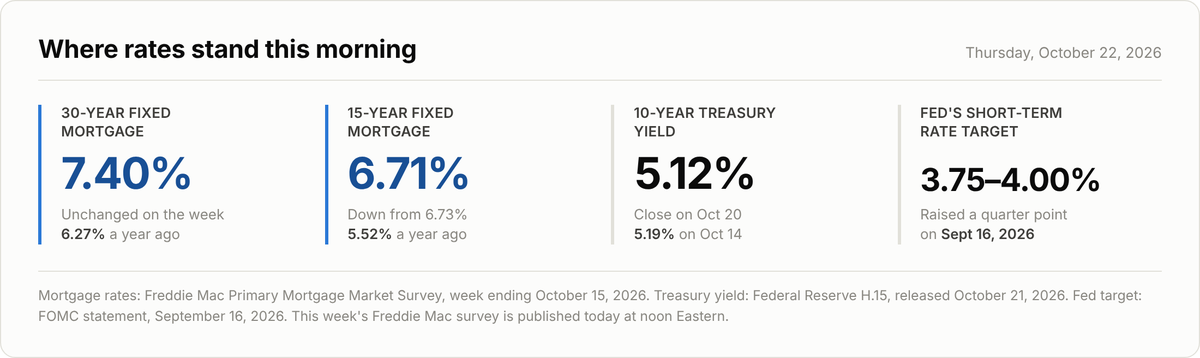
Figure 1. Rate snapshot. Mortgage rates: Freddie Mac Primary Mortgage Market Survey, week ending October 15, 2026. Treasury yield: Federal Reserve H.15, released October 21, 2026. Fed target: FOMC statement, September 16, 2026.
What happened
The Federal Reserve's policy committee meets next Tuesday and Wednesday, October 27–28. Reuters polled 100 economists between October 16 and 20; 94 said the Fed will leave its short-term rate alone.
The part worth your attention is what they said about December. All 100 expect the Fed to raise rates at its December meeting. A month earlier, fewer than half of them thought so.
That is a big swing in a short time, and the cause is simple: inflation got worse. The Fed already raised its short-term rate a quarter point on September 16, to a target range of 3.75%–4.00%, in a unanimous 12–0 vote. The data since then has gotten uglier, not better.
“Unfortunately, the Fed is really not getting more on top of the issue, they're just treading water and perhaps even getting a little behind,” Alex Pelle, senior U.S. economist at Mizuho Securities, told Reuters.
Why inflation came back
Two government reports last week explain the shift.
The Bureau of Labor Statistics reported on October 14 that consumer prices rose 3.7% over the 12 months ending in September, up from 3.4% in August — and 0.6% in September alone. The next day it reported that wholesale prices, what businesses pay before anything reaches a store shelf, rose 6.3% over 12 months. The BLS called that the largest 12-month increase since December 2022.
But look at where the increase is coming from.
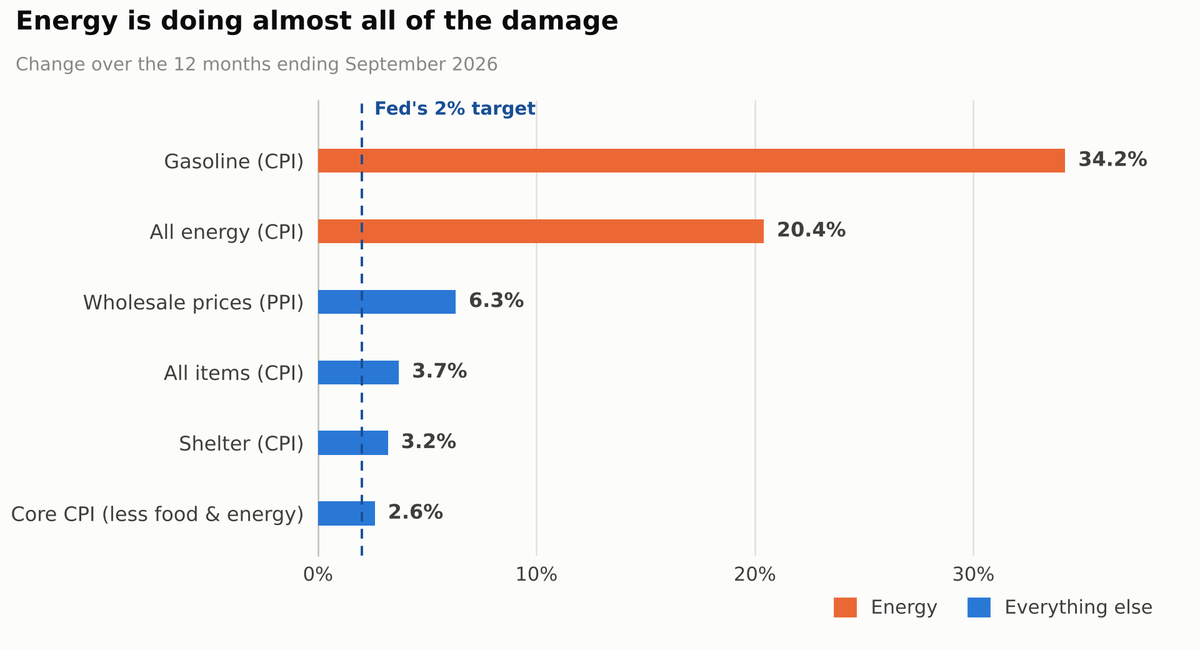
Figure 2. Twelve-month price changes through September 2026. Consumer figures from the Bureau of Labor Statistics, Consumer Price Index, released October 14, 2026. Wholesale figure from the BLS Producer Price Index, released October 15, 2026.
Gasoline is up 34.2% from a year ago, and the BLS said it “accounted for over half of the monthly all items increase” in September. Strip out food and energy and core inflation is 2.6% — elevated, but a long way from 3.7%. Shelter, the biggest line in most household budgets, rose 3.2%.
Energy prices have climbed since early July largely because of supply disruptions in the Middle East, as Forbes noted in its October 19 preview of the Fed meeting. Interest rates do not drill oil wells. But the Fed worries that expensive fuel seeps into the price of everything that gets shipped or trucked — and that people start expecting higher prices as a matter of course.
There is evidence they already do. The University of Michigan's preliminary October survey put consumer sentiment at 46.3, down from 48.1 in September and 53.6 a year ago. Consumers in that survey expect prices to rise 4.7% over the next year.
A Fed hike is not a mortgage-rate hike
This is the part that trips up almost everyone.
The Fed sets a very short-term rate — essentially an overnight rate for banks. Your 30-year mortgage is priced off the 10-year Treasury bond, not off the Fed's rate, and the bond market moves on expectations, not announcements. By the time the Fed actually acts, bond investors have usually already repriced.
You can see that now. The 10-year Treasury yield closed at 5.12% on October 20, per the Federal Reserve's H.15 release, down from 5.19% on October 14 — yields drifted down during the very stretch in which economists turned unanimous about a December hike. HousingWire reported on October 20 that CME's FedWatch tool showed roughly 85% of traders expecting a pause next week, with nearly 75% pricing in a quarter-point hike in December.
So the December hike is, to a large degree, already in your rate.
One thing is working against you, though. HousingWire also reported that the gap between the 10-year Treasury and the 30-year mortgage rate — the “spread,” which covers lenders' costs and risk — had widened to 2.21% as of October 15, from 1.92% in early September. When that gap widens, a falling Treasury yield doesn't reach you in full. That is a real part of why the 30-year average has sat at 7.40% for two straight weeks even as bond yields eased.
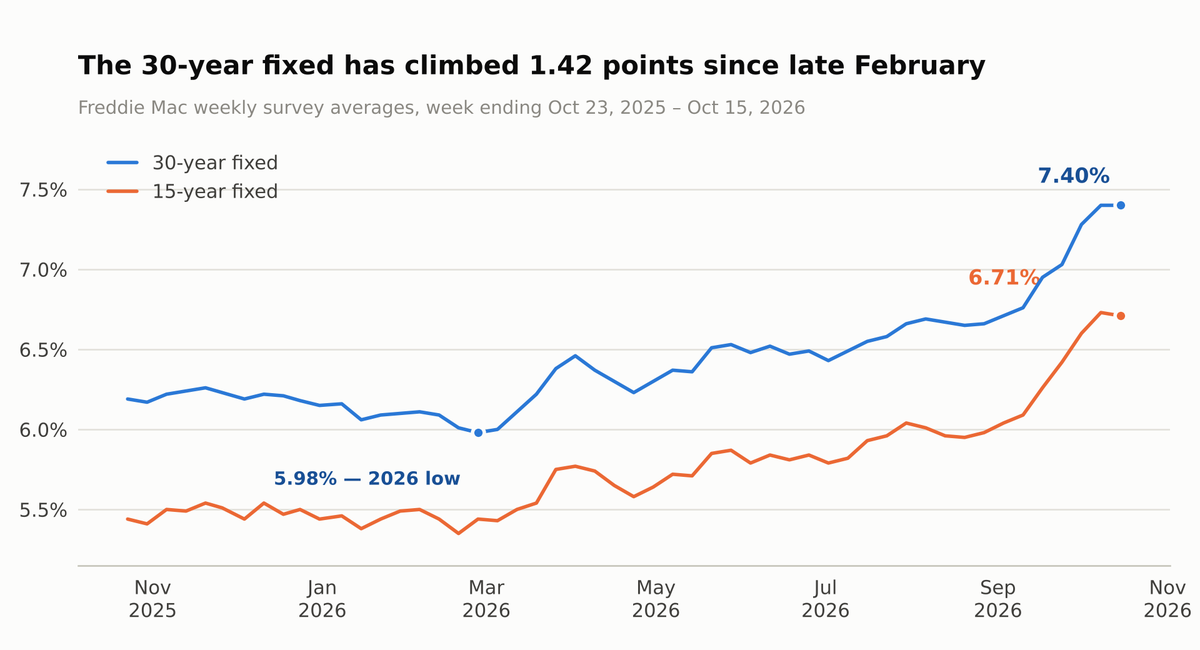
Figure 3. Weekly survey averages, Freddie Mac Primary Mortgage Market Survey, weeks ending October 23, 2025 through October 15, 2026. Latest data released October 15, 2026.
The 30-year fixed averaged 7.40% last week and the 15-year 6.71%, per Freddie Mac. A year ago: 6.27% and 5.52%. The low point of 2026 was 5.98%, back in late February.
What it costs in dollars
The national median existing-home price was $417,500 in September, according to the National Association of Realtors. With 20% down, that's a $334,000 loan.
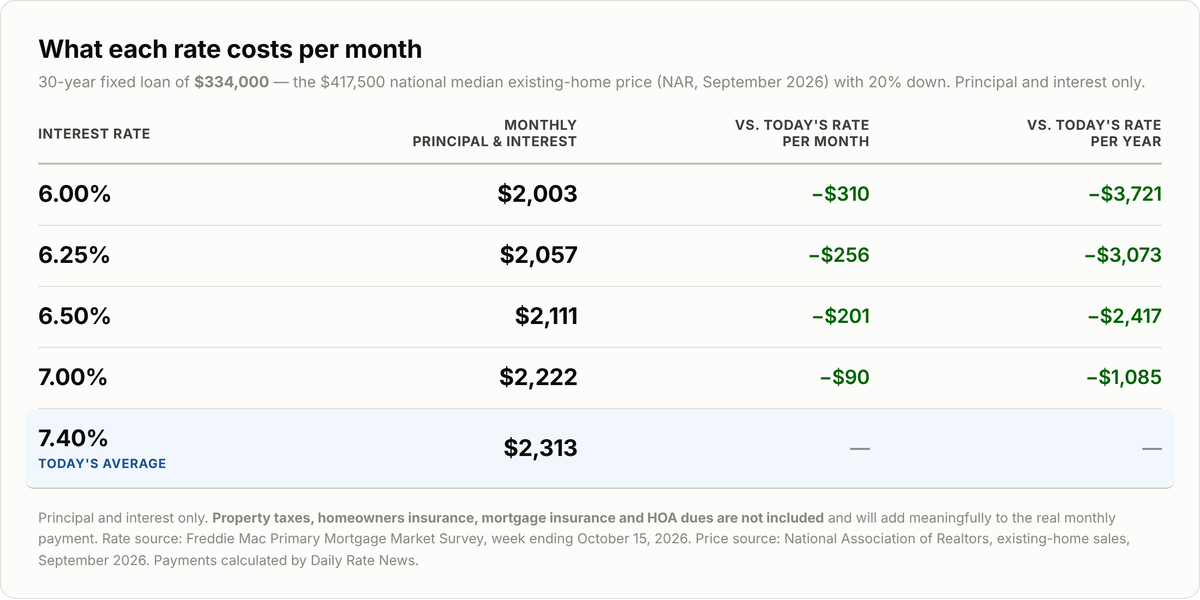
Figure 4. Monthly principal and interest on a $334,000 30-year fixed loan. Rates from Freddie Mac's Primary Mortgage Market Survey, week ending October 15, 2026; median price from the National Association of Realtors, September 2026 existing-home sales, released October 13, 2026. Payments calculated by Daily Rate News.
At today's 7.40% average, principal and interest run about $2,313 a month. At 6.50%, the same loan would cost $2,111 — roughly $201 less a month, or $2,417 a year. Getting back to 6.00% would save about $310 a month, or $3,721 a year.
Those figures are principal and interest only. Property taxes, homeowners insurance, mortgage insurance and HOA dues come on top, and often add several hundred dollars.
The housing market, briefly
Existing-home sales rose 1.5% in September to an annual pace of 3.99 million, NAR reported — still down 2.2% from a year earlier. NAR chief economist Lawrence Yun was blunt about the cause: “Further increases in mortgage rates in recent weeks mean fewer buyers can qualify to purchase a home.”
The friendlier number is inventory: 1.60 million homes for sale, up 4.6% from a year ago, a 4.8-month supply against 4.5 months a year earlier. Homes sat a median of 33 days. There is more to choose from, and less pressure to decide overnight, than two years ago.
New construction is pulling back. The Census Bureau reported on October 20 that housing starts fell 5.2% in September to an annual rate of 1,221,000, single-family starts down 4.6%. Census notes the change is not statistically significant on its own, but the direction is clear: builders are slowing down.
What to watch
Today, 8:30 a.m. Eastern: weekly jobless claims. Last week: 199,000, a historically low level. A sharp jump is the one thing that could pull rates down fast.
Today, noon Eastern: Freddie Mac's weekly rate survey. Last week: 7.40%.
Friday, 10:00 a.m. Eastern: the University of Michigan's final October survey, including that 4.7% inflation expectation.
Next Wednesday, October 28: the Fed's decision. Expect no change — but read the statement for hints about December.
What I'd do
If you're buying and under contract, lock. With the Fed meeting next week and oil prices unsettled, more can go wrong in the next two weeks than can go right. Ask me about a float-down option.
If you're shopping, don't wait for 6% to come back. Buy on the payment you can comfortably carry at today's rate, and treat any future refinance as a bonus, not a plan.
If you already own at 6% or below, leave that loan alone. If you need cash, a second mortgage or HELOC will almost always beat refinancing your whole balance up to 7.40%.
If you own at 7.5% or higher, let's keep a target rate on file. If the 30-year drops far enough that your break-even is inside two years, I'll call you.
Reply or call me — I'd rather run your real numbers than have you guess from a national average.
Want your actual number?
National averages are a starting point, not a quote. Send me your price range, down payment and credit profile and I'll run the real payment.
REFERENCES
1. Freddie Mac. Primary Mortgage Market Survey — “Mortgage Rates Hold Steady at 7.40%.”October 15, 2026. https://www.freddiemac.com/pmms
2. Freddie Mac. Mortgage Rates Weekly Archive, 2026.https://www.freddiemac.com/pmms/archive
3. Reuters (Indradip Ghosh). Fed to skip October but raise rates again in December, nearly all economists say: Reuters poll. October 20, 2026. https://www.investing.com/news/economy-news/fed-to-skip-october-but-raise-rates-again-in-december-nearly-all-economists-say-reuters-poll-4960095
4. Board of Governors of the Federal Reserve System. Federal Reserve issues FOMC statement. September 16, 2026. https://www.federalreserve.gov/newsevents/pressreleases/monetary20260916a.htm
5. Board of Governors of the Federal Reserve System. H.15 Selected Interest Rates (Daily).Released October 21, 2026. https://www.federalreserve.gov/releases/h15/
6. Board of Governors of the Federal Reserve System. FOMC Meeting Calendar.https://www.federalreserve.gov/monetarypolicy/fomccalendars.htm
7. U.S. Bureau of Labor Statistics. Consumer Price Index — September 2026. Released October 14, 2026. https://www.bls.gov/news.release/cpi.nr0.htm
8. U.S. Bureau of Labor Statistics. Producer Price Indexes — September 2026. Released October 15, 2026. https://www.bls.gov/news.release/ppi.nr0.htm
9. U.S. Bureau of Labor Statistics. Producer Price Index up 6.3 percent in September; largest 12-month increase since December 2022 (The Economics Daily). October 21, 2026. https://www.bls.gov/opub/ted/2026/producer-price-index-up-6-3-percent-in-september-largest-12-month-increase-since-december-2022.htm
10. National Association of Realtors. Existing-Home Sales Increased 1.5% in September.Released October 13, 2026. https://www.nar.realtor/newsroom/existing-home-sales-increased-1-5-in-september-according-to-nar-report
11. U.S. Census Bureau and U.S. Dept. of Housing and Urban Development. New Residential Construction, September 2026. Released October 20, 2026. https://www.census.gov/construction/nrc/pdf/newresconst.pdf
12. University of Michigan. Surveys of Consumers — preliminary October 2026. Released October 9, 2026. https://www.sca.isr.umich.edu/
13. U.S. Department of Labor. Unemployment Insurance Weekly Claims. Released October 15, 2026. https://www.dol.gov/ui/data.pdf
14. HousingWire. Mortgage rates dip as 10-year Treasury yield slides. October 20, 2026. Source for the CME FedWatch-derived odds and the Treasury-to-mortgage spread. https://www.housingwire.com/articles/mortgage-rates-dip-treasury-yield/
15. Forbes (Simon Moore). What To Look For From The Fed's October Meeting. October 19, 2026. https://www.forbes.com/sites/simonmoore/2026/10/19/what-to-look-for-from-the-feds-october-meeting/