
Thursday, August 20, 2026 at 6:18 AM PDT
The Fed just told us it thought about raising rates. Here's what that means for your mortgage.
Yesterday afternoon the Federal Reserve released the notes from its July meeting. Three officials voted to raise interest rates, and “many” more said a hike would be needed if inflation doesn't cool. The bond market noticed, and so should you.
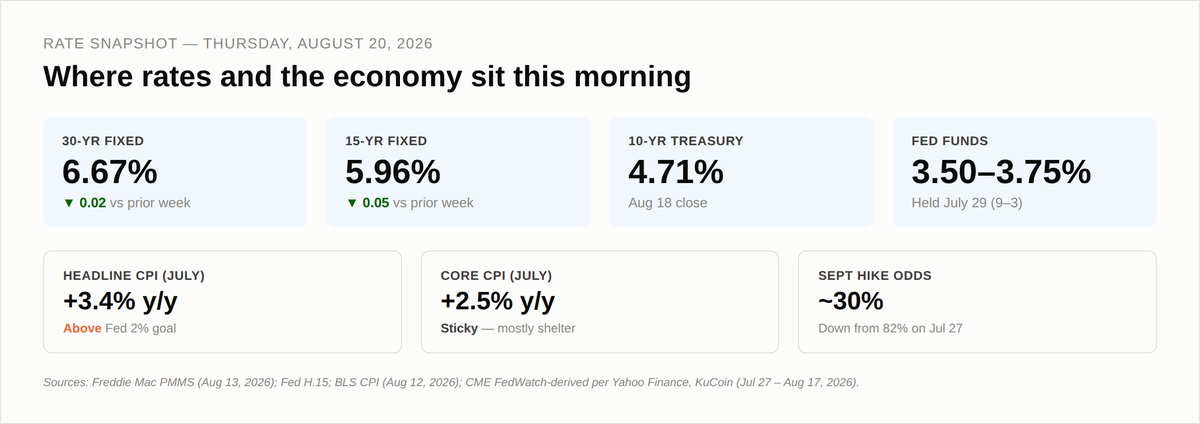
Figure 1. Today's rate snapshot. Sources: Freddie Mac PMMS (Aug 13, 2026); Federal Reserve H.15 (Aug 19, 2026); BLS CPI (Aug 12, 2026); CME FedWatch-derived odds per Yahoo Finance and KuCoin.
What actually happened yesterday
Every six weeks or so the Fed's policy committee meets to set the country's short-term interest rate. Three weeks later, they publish the minutes — a detailed record of who said what. Those minutes for the July 28–29 meeting came out at 2 p.m. Eastern on Wednesday, August 19, 2026.
Two things in that document changed the conversation.
First, the vote to hold rates steady was 9 to 3, not unanimous. Three regional Federal Reserve bank presidents — Beth Hammack, Neel Kashkari and Lorie Logan — voted to raise the federal funds rate by a quarter of a percentage point right then and there. Dissents happen, but three at once is unusual.
Second, and more important, the minutes said “many participants assessed that policy tightening would likely be necessary if inflation did not decline.” In plain English: if the next couple of inflation reports come in warm, a rate hike is on the table for the September meeting. That's a very different tone from the summer chatter about rate cuts.
The federal funds rate is currently set to a range of 3.50% to 3.75%. That's the rate banks charge each other overnight, and it's the anchor for almost every other rate in the economy — including yours.
Why this matters for your mortgage rate
Mortgage rates don't track the Fed's short-term rate directly. They track the 10-year Treasury yield, which is the interest rate the U.S. government pays to borrow money for a decade. Investors in that Treasury market are always trying to guess where the Fed will be over the next several years. When the Fed sounds worried about inflation, investors demand a higher yield, and mortgage rates drift up with it.
The 10-year Treasury closed Tuesday, August 18, at 4.71%, per the Federal Reserve's H.15 release. That's actually well below where it sat in early July. But the direction it moves from here depends heavily on the tone in Washington — and yesterday's tone was tougher than expected.
For context, Freddie Mac's weekly survey put the average 30-year fixed mortgage at 6.67% as of last Thursday, August 13. The 15-year fixed averaged 5.96%. This morning, Forbes Advisor's daily average has the 30-year at 6.66%. Rates are essentially unchanged from a week ago, but they've drifted up since early July, when the 30-year sat closer to 6.43%.
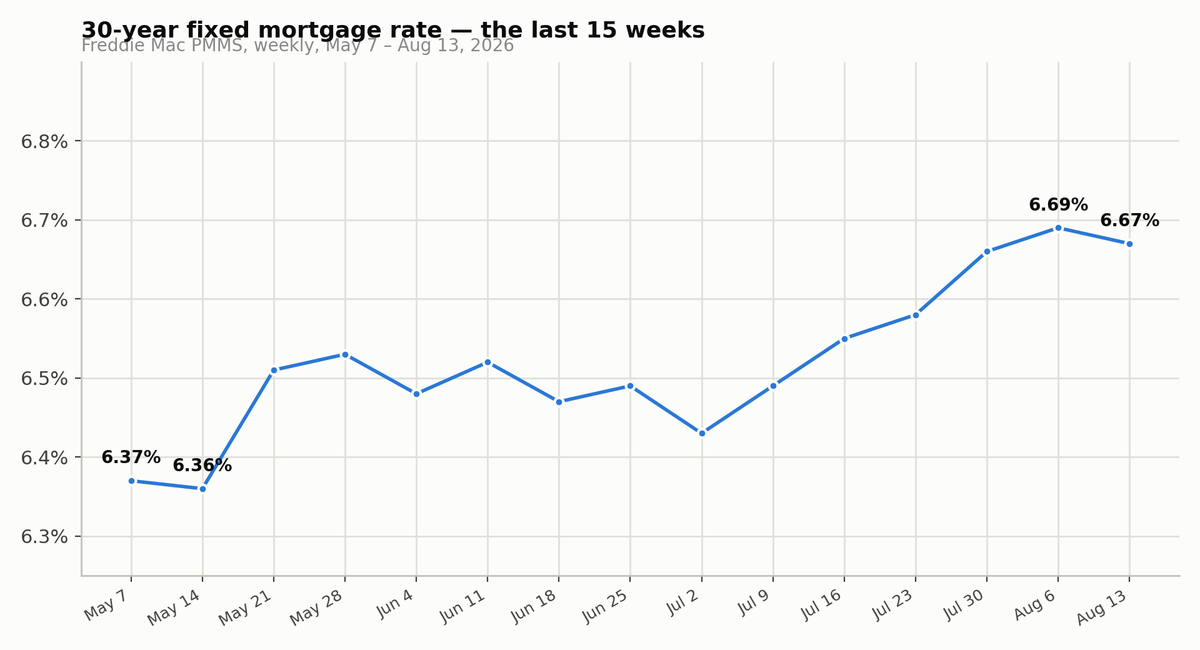
Figure 2. The 30-year fixed mortgage average drifted from 6.36% in mid-May to 6.67% last week. Source: Freddie Mac Primary Mortgage Market Survey, weekly releases through Aug 13, 2026.
What it costs in dollars
The best way to feel a rate change is on the monthly payment. The median existing-home price in July was $434,100, according to the National Association of Realtors. Assuming 20% down, that's a loan of $347,280.
At today's 6.66%, principal and interest come to $2,231.71 a month. See Figure 4 below for the full breakdown — the important thing is that a half-point difference either way is worth roughly $150 a month, or about $1,800 a year, on this loan. That's a car payment. Property taxes, homeowner's insurance, mortgage insurance (if your down payment is smaller than 20%) and any HOA dues are on top of that number and can easily add another $400 to $700 a month depending on where you live.
What the housing market looks like right now
The big story on the ground is that homes are sitting a little longer and appreciating a little slower, but nothing has broken.
The NAR reported existing-home sales fell 1.7% in July to a seasonally adjusted annual rate of 4.06 million homes. That's up 0.7% from a year ago — barely — and inventory now sits at 1.54 million existing homes for sale, or 4.6 months of supply. Anything under six months is generally considered a seller's market, so we're still there, but not by as much as we used to be.
On the construction side, the Census Bureau's July report (released Monday) was mixed. Housing starts fell 12.4% from June to a 1.24 million annual pace — a genuinely weak number. But building permits, which are a better forward-looking signal, rose 5.0% to a 1.44 million pace. Builders are still planning, even if they hit pause on breaking ground in July.
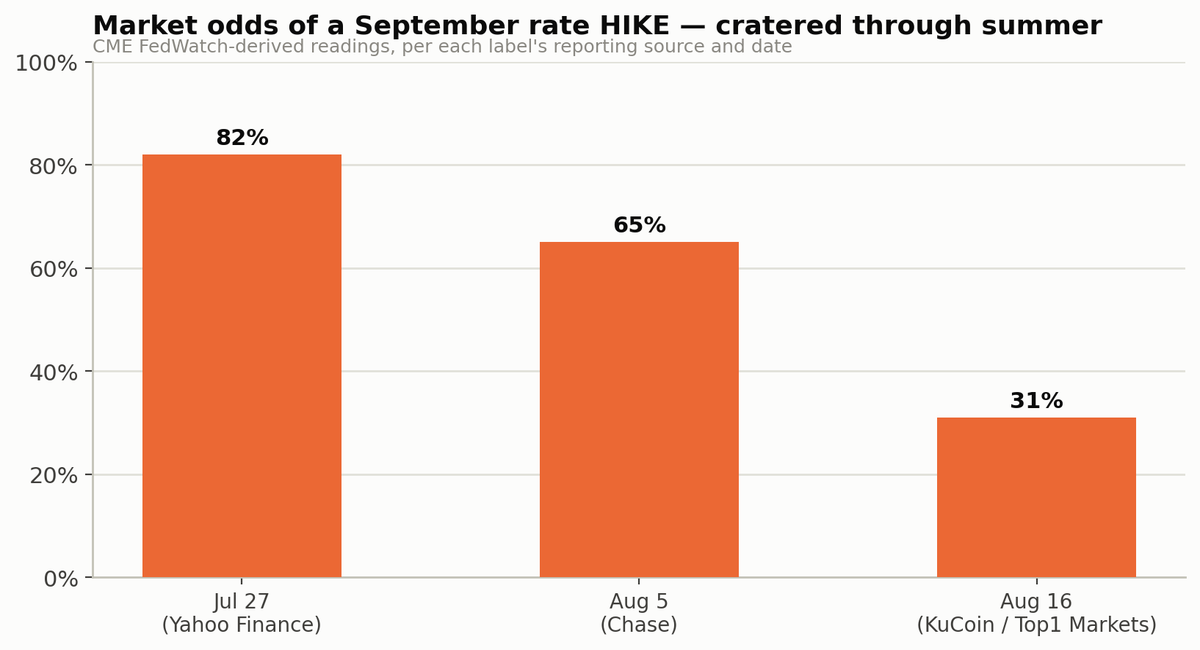
Figure 3. Market-implied odds of a September rate hike have collapsed since July's peak. Sources: Yahoo Finance (Jul 27), Chase (Aug 5), KuCoin and TOP1 Markets (Aug 16), all citing CME FedWatch.
What to watch this week and next
Three things could move rates from here:
Fed speakers. Chair Jerome Powell and several other Fed officials will speak over the next two weeks. Any hint that they agree with the three dissenters would push mortgage rates up. Any hint they don't could ease them back down.
Personal Consumption Expenditures inflation on Friday, August 29. This is the inflation gauge the Fed watches most closely. A hot number would make September's rate decision much more uncomfortable.
The August jobs report on Friday, September 5. A soft report — like the surprising jobs miss on August 1 — would give the Fed cover to hold. A strong one would push the odds of a hike back up.
Market-implied odds of a September hike sat around 30% on Tuesday, according to CME FedWatch-derived readings reported by Yahoo Finance and KuCoin. That's down from 82% on July 27 (Yahoo Finance), but the minutes make it likely those odds tick higher into month-end.
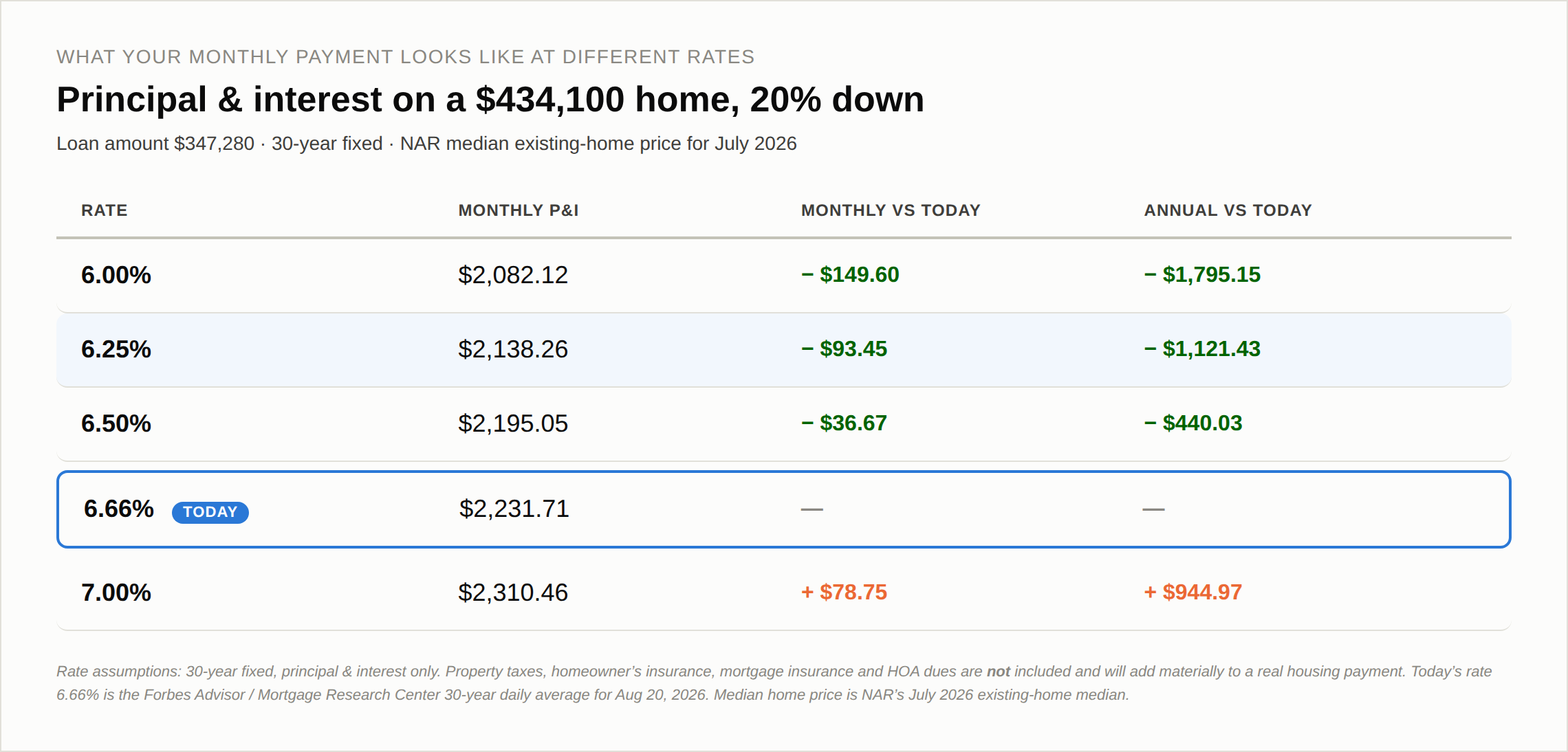
Figure 4. Monthly principal and interest on a $434,100 home with 20% down (loan amount $347,280), at five rates. Taxes, insurance, MI and HOA are excluded. Sources: NAR (July median price); Forbes Advisor / Mortgage Research Center (today's 6.66% average).
What I would do
If you're shopping for a home, don't try to time a rate cut that may not arrive on the schedule you want. Focus on the payment you can comfortably afford at today's rate. If rates fall meaningfully later, you can refinance — a common rule of thumb is that a refinance pays for itself when your rate drops by about three-quarters of a point and you plan to stay put for at least two more years.
If you're under contract right now, this is a good week to lock your rate if you haven't. The next two weeks carry more headline risk than usual, and the risk is skewed toward rates going up, not down.
If you're considering a refinance on a loan from 2023 or 2024 at 7.25% or higher, run the numbers again. Even a move down to today's 6.66% can be worth it depending on your balance and how long you'll stay in the home. Ask for a full break-even analysis in writing before you commit.
And if you're just renewing your rent and wondering if now is finally the time — the honest answer is that affordability today is a coin flip between the payment and the price. Homes are sitting longer, which gives you a little more negotiating room than you had last year, but rates aren't giving you a discount. If you love the house and can afford the payment, that's still the right question to ask, not “will rates go down in October?”
I'm here if you want to walk through your specific numbers. Reply to this email or book a 15-minute call and I'll pull them together.
References
Freddie Mac. Primary Mortgage Market Survey — Mortgage Rates Average 6.67%. Aug 13, 2026. freddiemac.com/pmms
Federal Reserve. Minutes of the Federal Open Market Committee, July 28–29, 2026. Aug 19, 2026. federalreserve.gov
Federal Reserve. H.15 Selected Interest Rates — Daily. Data through Aug 18, 2026. federalreserve.gov/releases/h15
Bureau of Labor Statistics. Consumer Price Index Summary — July 2026. Aug 12, 2026. bls.gov
National Association of Realtors. Existing-Home Sales Report — July 2026. Aug 11, 2026. nar.realtor
U.S. Census Bureau. New Residential Construction — July 2026. Aug 18, 2026. census.gov
Forbes Advisor. Mortgage Rates Today: August 20, 2026. forbes.com
Yahoo Finance. Odds of Fed Rate Hike This Year Fall as Goldman Sachs Warns Against Hawkish Bets. Aug 17, 2026. finance.yahoo.com
KuCoin. Fed September Rate Hike Odds Fall to 30.6% Ahead of FOMC Minutes. Aug 2026. kucoin.com
Chase. Will the Fed Hike Rates in September? Aug 5, 2026. chase.com
All figures are original to Daily Rate News, computed from the primary sources above. They are free for the sending loan officer to reproduce with their own branding. No AI-generated imagery is used anywhere in this issue.