
Tuesday, September 1, 2026 at 9:26 AM PDT
The Fed just changed the conversation — and Friday decides where rates go next
For most of this year the argument was about when the Federal Reserve would cut. After Chair Kevin Warsh spoke in Jackson Hole on Friday, the market is arguing about whether the Fed will raise. Here is what actually changed, what it does to your payment, and why the jobs report on Friday morning matters more than anything else this week.
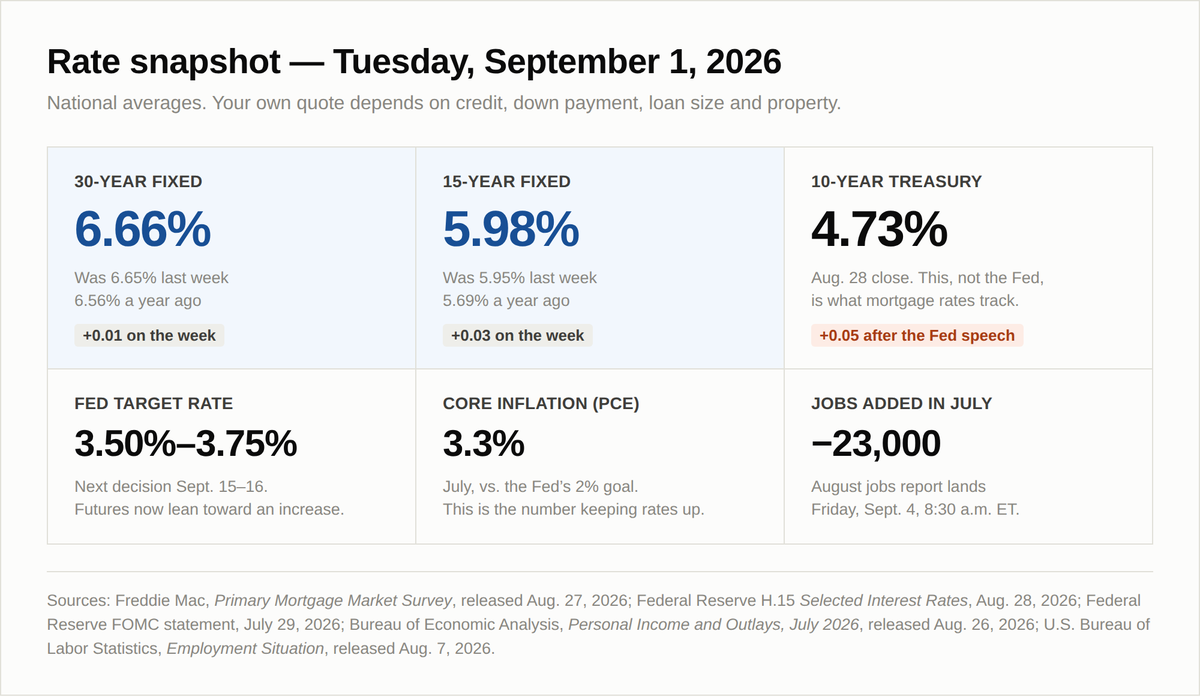
Figure 1. Rate snapshot as of September 1, 2026. Sources: Freddie Mac, Primary Mortgage Market Survey, released August 27, 2026; Federal Reserve H.15 Selected Interest Rates, August 28, 2026; Federal Reserve FOMC Statement, July 29, 2026; Bureau of Economic Analysis, Personal Income and Outlays, July 2026, released August 26, 2026; U.S. Bureau of Labor Statistics, Employment Situation, released August 7, 2026.
What happened
Every August, central bankers meet in Jackson Hole, Wyoming, and the Fed chair gives a speech that markets pick apart word by word. On Friday, August 28, Kevin Warsh gave his first one as chair. The line that moved money was this:
“We must be confident that underlying inflation is moving to our objective, clearly and at sufficient speed. Otherwise, we have work to do.”
In Fed language, “work to do” means raising rates. Traders heard it that way. The two-year Treasury yield — the bond that most closely tracks what people expect the Fed to do over the next couple of years — jumped 11 basis points to 4.34% that day. A basis point is one hundredth of a percentage point, so that is a move of 0.11%. Small in isolation, large for a single afternoon in the bond market.
The betting shifted just as fast. Fed funds futures are contracts that let traders wager on the Fed’s next move, and CME Group publishes the implied odds. Before the speech, those odds put the chance of a rate increase at the September 15–16 meeting at roughly 35%. By the close on Friday they were near 60%. As of Monday, August 31, Marketplace reported CME’s FedWatch tool at about 66%.
This did not come out of nowhere. At the July 29 meeting the Fed held its target rate at 3.50%–3.75%, but the vote was 9–3, and all three dissenters wanted an increase rather than a cut.
Why inflation is driving this
The Fed’s job is to keep inflation near 2%. It is not there.
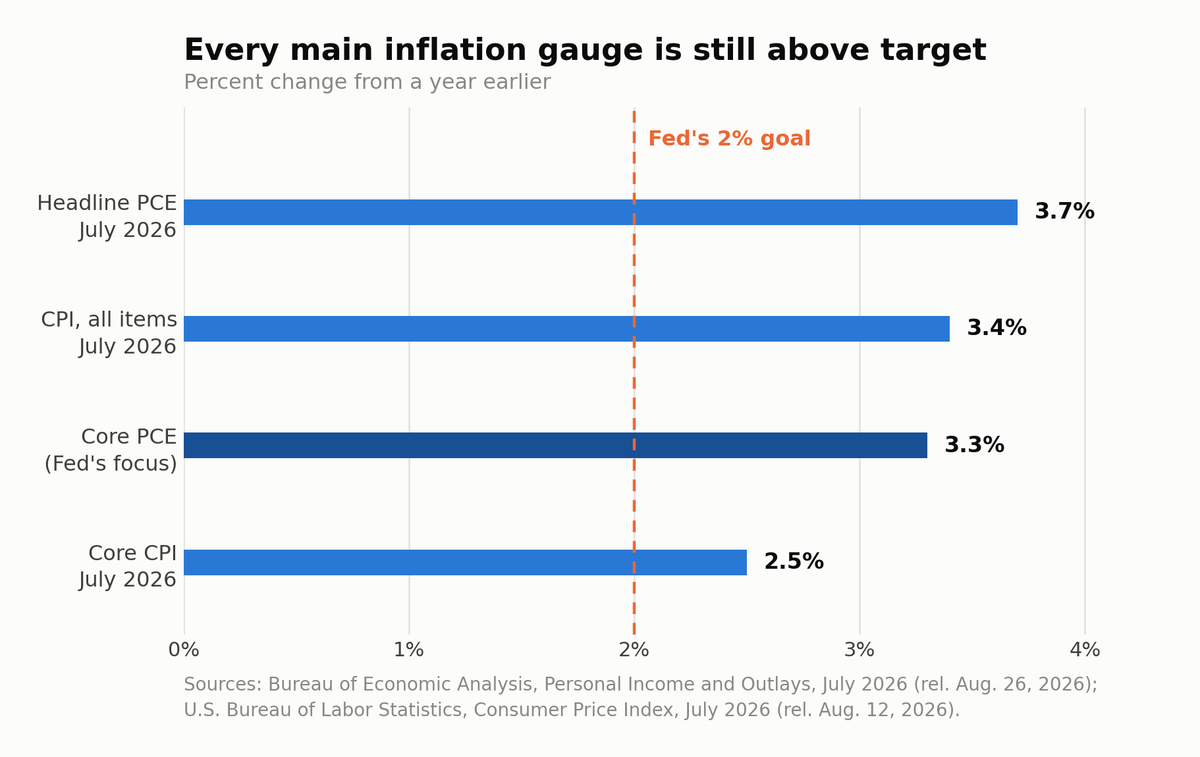
Figure 2. Every main inflation gauge is still above the Fed's 2% target. Sources: Bureau of Economic Analysis, Personal Income and Outlays, July 2026, released August 26, 2026; U.S. Bureau of Labor Statistics, Consumer Price Index, July 2026, released August 12, 2026.
The Fed’s preferred gauge, core PCE — “core” meaning it strips out food and energy prices, which bounce around too much to read a trend from — rose 3.3% in the year through July, according to the Bureau of Economic Analysis. Including food and energy, the figure is 3.7%.
One oddity worth explaining, because it confuses people: core CPI, a different inflation measure from the Bureau of Labor Statistics, came in at just 2.5%. That is lower than core PCE, which is the reverse of the usual pattern, and it is why you may have seen headlines calling inflation both “cooling” and “too hot” in the same week. The two indexes weight housing and medical costs differently. The Fed watches PCE. So should you.
Why this may not move your mortgage rate much
Here is the part that trips up almost every homebuyer: the Fed does not set mortgage rates. It sets the overnight rate banks charge each other. Thirty-year mortgage rates track the ten-year Treasury yield instead, because a 30-year loan usually gets paid off or refinanced in under a decade.
The ten-year sits at 4.73% as of the August 28 close, per the Federal Reserve’s H.15 release. It rose about 5 basis points on Warsh’s speech — less than half the two-year’s move. That is the bond market saying: tighter policy now, but slower growth later.
Freddie Mac’s weekly survey put the 30-year fixed at 6.66% on August 27, essentially flat from 6.65% the week before. But note the date — that survey closed the day before the speech. Thursday’s release, September 3, will be the first read that includes any reaction.
What it costs in dollars
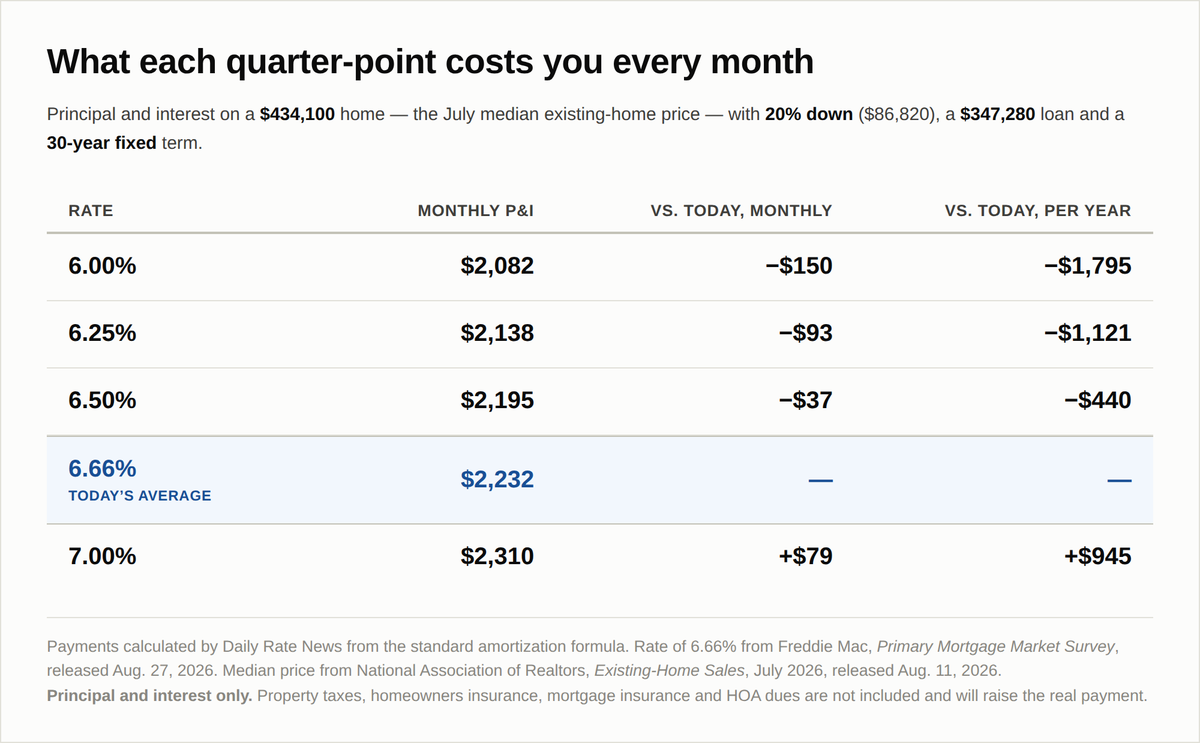
Figure 3. Monthly principal and interest at five rates. Payments calculated by Daily Rate News using the standard amortization formula. Rate from Freddie Mac, Primary Mortgage Market Survey, released August 27, 2026. Median price from National Association of Realtors, Existing-Home Sales, July 2026, released August 11, 2026. Principal and interest only; taxes, insurance, mortgage insurance and HOA dues are excluded.
On the national median existing-home price of $434,100 with 20% down, a quarter-point costs about $37 to $57 a month in principal and interest. Moving from 6.66% to 7.00% adds $79 a month, or $945 a year. Moving down to 6.25% saves $93 a month.
That is the honest scale of it. A quarter-point is real money over thirty years, but it is not usually the difference between buying and not buying. Do not let it become the reason you sit out a house you want.
The other half of the story: jobs
If inflation were the only data point, the Fed would probably already have raised. It has not, because hiring has gone flat.
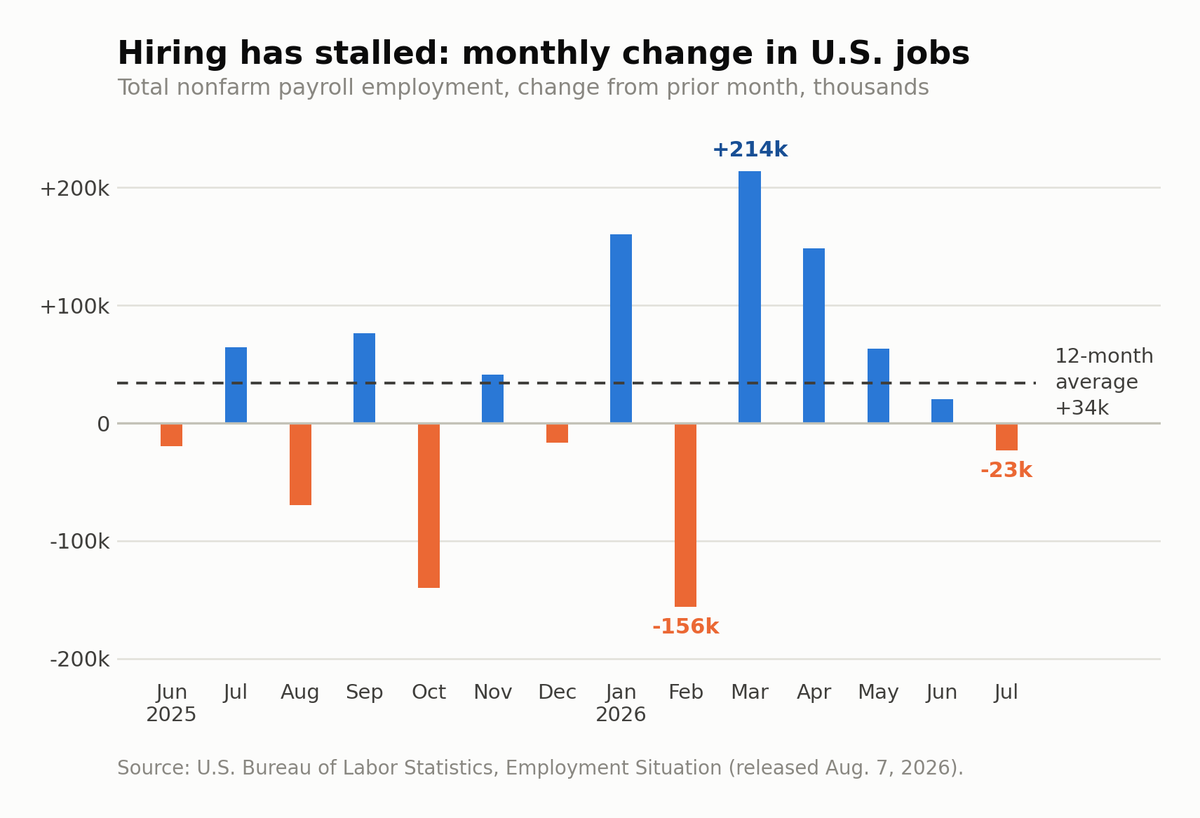
Figure 4. Monthly change in total nonfarm payroll employment, June 2025 through July 2026. Source: U.S. Bureau of Labor Statistics, Employment Situation, released August 7, 2026.
The economy shed 23,000 jobs in July. Revisions cut May and June by a combined 103,000. Over the prior twelve months the average gain was just 34,000 a month — a fraction of a healthy pace. Unemployment is 4.1%.
This is the tension: prices are running hot, hiring is not. Raising rates fights the first and worsens the second.
The housing market right now
Existing-home sales ran at a 4.06 million annual pace in July, down 1.7% from June but slightly ahead of a year ago, per the National Association of Realtors. The median price rose 2.0% to $434,100. Inventory sits at 1.54 million homes, a 4.6-month supply.
New construction is softer. New home sales fell 10.5% in July to a 607,000 annual rate, and builders are sitting on a 9.6-month supply, according to the Census Bureau and HUD. That is a lot of unsold inventory — which is why builders are the most likely people in this market to pay for a rate buydown.
What to watch this week
Today, 10:00 a.m. ET — July job openings (JOLTS) and the ISM manufacturing index.
Wednesday — ADP private payrolls, an imperfect preview of Friday.
Thursday, September 3 — Freddie Mac’s weekly survey, the first to reflect the speech.
Friday, 8:30 a.m. ET — the August jobs report. This is the one that matters. A weak number takes a September hike off the table; a strong one likely puts it back on.
August CPI arrives September 11, four days before the Fed meets.
What I’d do
If you are under contract: lock. The risk is no longer symmetric. There is a real chance of a hike in two weeks and no serious case for a sharp drop before then. Ask me about a float-down option so you keep some upside if Friday’s jobs number is weak.
If you are shopping: get fully underwritten now, not just pre-qualified. If rates jump on Friday, sellers get more negotiable and competition thins — that is when a buyer who can close quickly wins.
If you are thinking about refinancing: at 6.66%, this only works if you closed above roughly 7.25%, or if you are consolidating higher-cost debt. Send me your current rate and balance and I will run the break-even in writing — no cost, no pressure.
If you have an adjustable-rate loan resetting in the next year: call me this week. A Fed increase feeds directly into ARM adjustments in a way it does not feed into fixed rates.
Rates are not going to collapse. They may not spike either. What has changed is that the next surprise is more likely to be upward than downward — and that is worth planning around.
Want your own numbers, not the national average?
Send me your price range or your current loan and I’ll run the real payment — taxes, insurance and all — before Friday’s report.
REFERENCES
1. Freddie Mac. Primary Mortgage Market Survey — Mortgage Rates Hold Steady. Released August 27, 2026.
https://www.freddiemac.com/pmms
2. Board of Governors of the Federal Reserve System. H.15 Selected Interest Rates (Daily). Data for August 28, 2026; posted August 31, 2026.
https://www.federalreserve.gov/releases/h15/
3. Warsh, Kevin. Remarks at the Federal Reserve Bank of Kansas City Economic Policy Symposium, Jackson Hole, Wyoming. August 28, 2026.
https://www.federalreserve.gov/newsevents/speech/warsh20260828a.htm
4. Board of Governors of the Federal Reserve System. FOMC Statement. July 29, 2026.
https://www.federalreserve.gov/newsevents/pressreleases/monetary20260729a.htm
5. Board of Governors of the Federal Reserve System. FOMC Meeting Calendars. Accessed September 1, 2026.
https://www.federalreserve.gov/monetarypolicy/fomccalendars.htm
6. U.S. Bureau of Economic Analysis. Personal Income and Outlays, July 2026. Released August 26, 2026.
https://www.bea.gov/news/2026/personal-income-and-outlays-july-2026
7. U.S. Bureau of Labor Statistics. Consumer Price Index — July 2026. Released August 12, 2026.
https://www.bls.gov/news.release/cpi.nr0.htm
8. U.S. Bureau of Labor Statistics. Employment Situation — July 2026. Released August 7, 2026.
https://www.bls.gov/news.release/empsit.nr0.htm
9. U.S. Bureau of Labor Statistics. Schedule of Selected Releases, September 2026. Accessed September 1, 2026.
https://www.bls.gov/schedule/2026/09_sched_list.htm
10. National Association of Realtors. Existing-Home Sales Report Shows 1.7% Decrease in July. Released August 11, 2026.
https://www.nar.realtor/newsroom/nar-existing-home-sales-report-shows-1-7-decrease-in-july
11. U.S. Census Bureau and U.S. Dept. of Housing and Urban Development. New Residential Sales, July 2026. Released August 25, 2026.
https://www.census.gov/construction/nrs/current/index.html
12. Marketplace. Will the Fed raise rates at the September FOMC meeting? August 31, 2026 — citing CME Group’s FedWatch tool for the ~66% implied probability of a quarter-point increase.
https://www.marketplace.org/story/2026/08/31/will-the-fed-raise-rates-at-september-fomc-meeting
13. Benzinga. Fed hike odds after Warsh’s Jackson Hole speech. August 28, 2026 — citing CME Group fed funds futures for the move from 35% to 59%.
https://www.benzinga.com/markets/prediction-markets/26/08/61499396/fed-hike-odds-warsh-jackson-hole
14. Federal Reserve Bank of New York. Economic Calendar, September 2026. Accessed September 1, 2026.
https://www.newyorkfed.org/research/calendars/i-sep26.html
About the figures. All four figures were built for this issue from the published data cited in each caption. They are original work, free for you to reproduce, and contain no AI-generated imagery — every chart and table is computed directly from the source releases above.
Photography note. No photograph is included in this issue. If you want to add one, free-license options include Unsplash, Pexels and Pixabay, and photography produced by U.S. government agencies is generally in the public domain. Credit the photographer where the license requires it.
This newsletter is for general information only and is not a commitment to lend and not an offer or guarantee of any interest rate, loan approval, or loan terms. Rates quoted are national averages from the sources cited above; they are not quotes and your actual rate will depend on your credit profile, loan amount, down payment, property type, occupancy, lock period and other factors. Rates and terms are subject to change without notice. All loans are subject to credit approval, underwriting, and property appraisal. Payment examples show principal and interest only and exclude property taxes, homeowners insurance, mortgage insurance and HOA dues, so your actual payment will be higher. Not financial, tax or legal advice — consult your own advisors.