Tuesday, August 25, 2026 at 9:16 AM PDT
Rates Are Holding Their Breath Until Friday
The average 30-year mortgage slipped again last week, to 6.65%. But the bond market has mostly stopped reacting to the economy and started watching one podium in Wyoming — where the new Fed chair gives his first big speech on Friday.
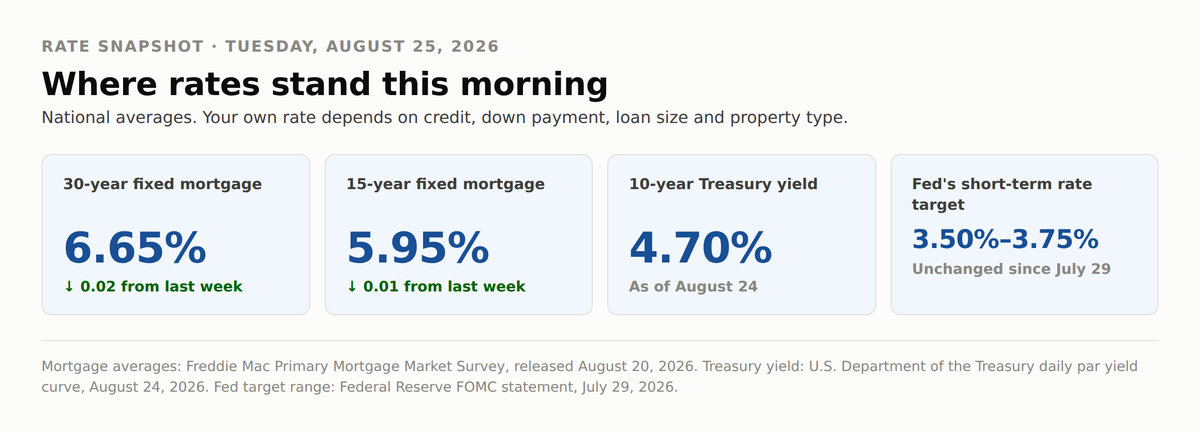
Figure 1. Rate snapshot for August 25, 2026. Sources: Freddie Mac Primary Mortgage Market Survey (released August 20, 2026); U.S. Department of the Treasury daily par yield curve (August 24, 2026); Federal Reserve FOMC statement (July 29, 2026).
Where things stand this morning
The average 30-year fixed mortgage came in at 6.65% in Freddie Mac's weekly survey released August 20 — down from 6.67% the week before, the second small decline in a row. The 15-year average was 5.95%.
Two cents off your rate is not news. Here is the number that is: a year ago, that same survey read 6.58%. After twelve months of headlines about a slowing economy, mortgage rates are slightly higher than they were last August.
That is the puzzle worth understanding, and it comes down to one thing: the bond market cannot decide whether the Federal Reserve's next move is down or up.
Why your rate didn't fall
Mortgage rates don't follow the Fed's headline interest rate. They follow the 10-year Treasury yield — the interest the U.S. government pays to borrow money for ten years. When that yield rises, mortgage rates rise with it, usually within days.
That yield closed at 4.70% on August 24. On August 21 it touched 4.74%, its highest reading since July 31, according to Treasury Department data.
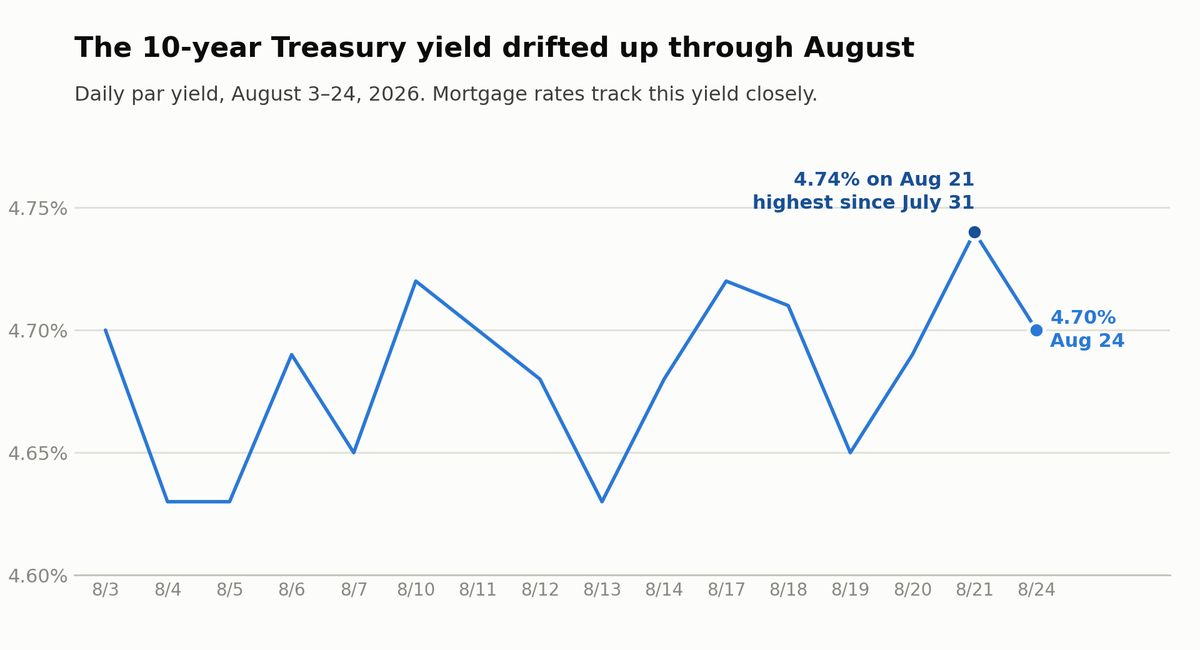
Figure 2. Daily 10-year Treasury par yield, August 3–24, 2026. Source: U.S. Department of the Treasury, Daily Treasury Par Yield Curve Rates.
So why is the yield stuck up there? Because the two things the Fed cares about are pointing in opposite directions.
The job market is cooling. The Labor Department reported on August 7 that the economy lost 23,000 jobs in July. It also revised May and June down by a combined 103,000 jobs. Unemployment sits at 4.1%. Normally, a job market like that would push mortgage rates down fast.
Inflation is not cooperating. The Consumer Price Index released August 12 showed prices up 3.4% over the past year — well above the Fed's 2% goal. But look at what is expensive, because this is the whole story.
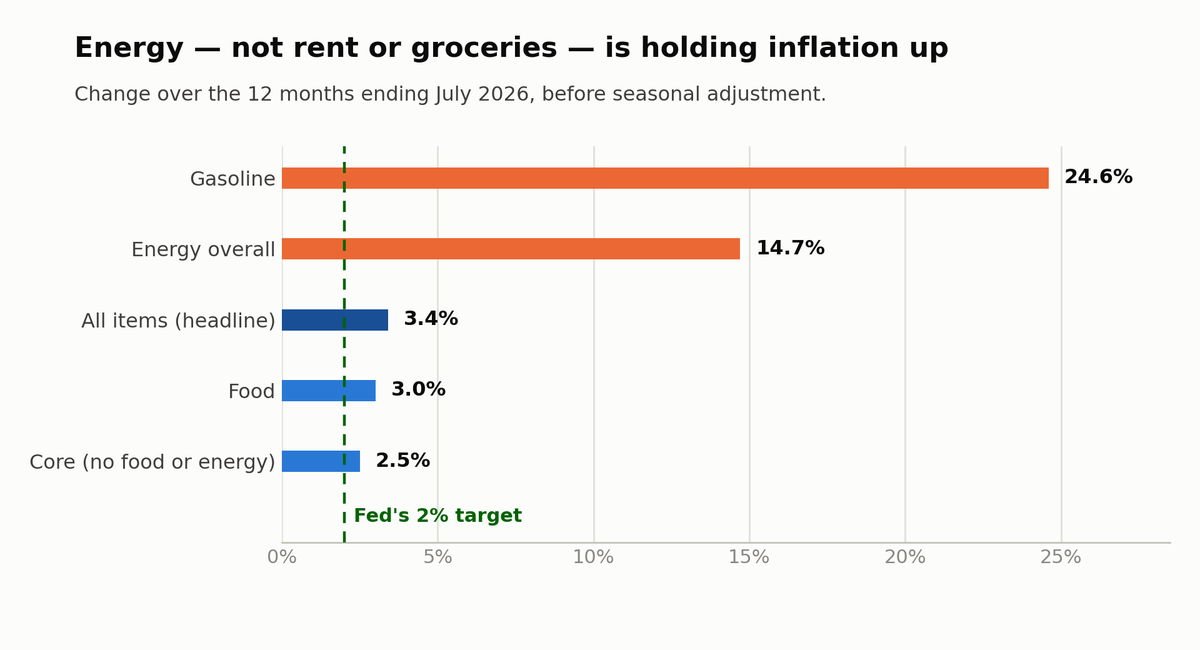
Figure 3. 12-month change in consumer prices by category, for the 12 months ending July 2026, not seasonally adjusted. Source: U.S. Bureau of Labor Statistics, Consumer Price Index — July 2026 (released August 12, 2026).
Strip out food and energy and inflation is running at just 2.5% — close to normal. Shelter costs rose 3.2%. The spike is almost entirely fuel: gasoline is up 24.6% over the year, and energy overall is up 14.7%, driven by supply disruptions tied to conflict in the Middle East.
This is why rates are stuck: the Fed cannot lower rates to help a weak job market without risking that high fuel prices turn into lasting inflation.
The Fed left its short-term rate at 3.50%–3.75% on July 29 — and three of its own officials voted to raise it. Reuters reported on August 21 that futures markets put the odds of a rate increase at the September 15–16 meeting near 35%, rising to about 66% by December. Not everyone agrees: Goldman Sachs told clients in mid-August that it thinks market pricing is "too hawkish" and expects the Fed to hold steady into 2027.
What this costs in real dollars
Here is what those decimal points are worth on a real house. The median existing home sold for $434,100 in July, according to the National Association of Realtors. With 20% down, that's a $347,280 loan.
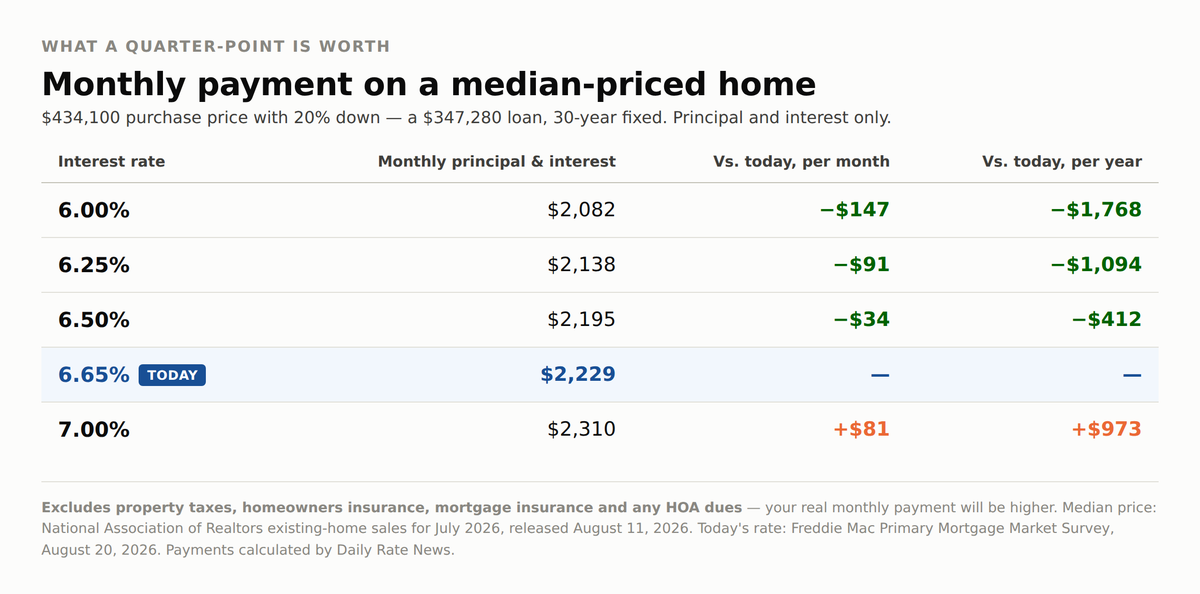
Figure 4. Monthly principal and interest on a $347,280 30-year fixed loan (median existing-home price of $434,100 with 20% down). Median price source: National Association of Realtors, Existing-Home Sales for July 2026, released August 11, 2026. Today's rate: Freddie Mac PMMS, August 20, 2026. Payments calculated by Daily Rate News.
A quarter-point is worth about $35 to $40 a month at this loan size — roughly $450 a year. Getting from today's 6.65% down to 6.00% would save about $147 a month, or $1,768 a year.
Worth knowing, not worth losing sleep over. And a caution: those figures are principal and interest only. Property taxes, homeowners insurance, mortgage insurance and HOA dues all sit on top, and together they often add several hundred dollars a month.
The housing market right now
Existing-home sales ran at an annual pace of 4.06 million in July, down 1.7% from June. The median price rose 2.0% from a year earlier — the 37th straight month of annual price gains.
The more useful number for buyers is inventory: 1.54 million homes were for sale, a 4.6-month supply, and homes took an average of 29 days to sell. A balanced market is usually around six months. So supply is better than it was, but sellers still hold a modest edge in most places.
NAR chief economist Lawrence Yun noted that sales have been "remarkably stable" despite higher rates, and said sales would likely strengthen considerably if rates moved toward 6%.
What to watch this week
Friday, August 28 — the big one. Fed Chair Kevin Warsh, who took office in May, gives his first keynote at the Kansas City Fed's annual symposium in Jackson Hole, Wyoming. Markets have moved sharply on this speech in past years.
One honest caveat: this year's official theme is financial innovation and payments — not interest rates. Warsh may say very little about where rates are headed. But traders will parse every sentence anyway, so expect some movement Friday morning regardless.
Also this week: the symposium runs Thursday through Saturday, and other Fed officials speak throughout.
What I'd do
If you're under contract and closing within 30 days, locking now is the reasonable default. There is a real chance Friday's speech pushes rates either way, and a coin flip isn't a strategy when you have a closing date.
If you're 60 to 90 days out, ask me about a lock with a float-down option — you get protection now and can still capture a drop if one comes.
If you're waiting for 6%, understand what has to happen first: fuel prices need to come down enough that the Fed can cut without worrying about inflation. That could happen. It hasn't yet, and nobody can tell you when.
If you bought at 7% or higher, run the refinance math with me now, not later. If we get a window, it may be short — and having your paperwork ready is what turns a good week into a closed loan.
Questions about your specific situation? Reply to this email or call me directly. I'm happy to run the numbers on your actual price range.
References
Freddie Mac. Primary Mortgage Market Survey. Released August 20, 2026. freddiemac.com/pmms
U.S. Department of the Treasury. Daily Treasury Par Yield Curve Rates. Data through August 24, 2026. home.treasury.gov
U.S. Bureau of Labor Statistics. Consumer Price Index — July 2026. Released August 12, 2026. bls.gov/news.release/cpi.nr0.htm
U.S. Bureau of Labor Statistics. The Employment Situation — July 2026. Released August 7, 2026. bls.gov/news.release/empsit.nr0.htm
National Association of Realtors. Existing-Home Sales, July 2026. Released August 11, 2026. nar.realtor
Board of Governors of the Federal Reserve System. FOMC Statement. July 29, 2026. federalreserve.gov
Board of Governors of the Federal Reserve System. Kevin Warsh takes oath of office as chairman. May 22, 2026. federalreserve.gov
Board of Governors of the Federal Reserve System. FOMC Meeting Calendar. Accessed August 25, 2026. federalreserve.gov
Federal Reserve Bank of Kansas City. Jackson Hole Economic Policy Symposium, August 27–29, 2026. Accessed August 25, 2026. kansascityfed.org
Reuters. Fed rate expectations ahead of Jackson Hole. August 21, 2026 (CME FedWatch-derived futures odds).
Goldman Sachs research commentary on Fed policy, mid-August 2026, as reported by Yahoo Finance.
About the figures. Figures 1–4 were produced by Daily Rate News from the published data cited above. They are original works, contain no AI-generated imagery, and are free for the sender to reproduce and redistribute. Any photograph added to this issue should carry its own credit; free-license options include Unsplash, Pexels and Pixabay, and photography produced by U.S. federal government agencies is generally in the public domain.