
Wednesday, September 2, 2026 at 9:46 AM PDT
Oil is setting mortgage rates this week, not the Fed
The 10-year Treasury yield hit its highest level in nearly three years Wednesday morning, and traders now believe the Federal Reserve’s next move is more likely to be a rate hike than a cut. Here’s what that does to your payment — and why Friday morning could change the picture again.
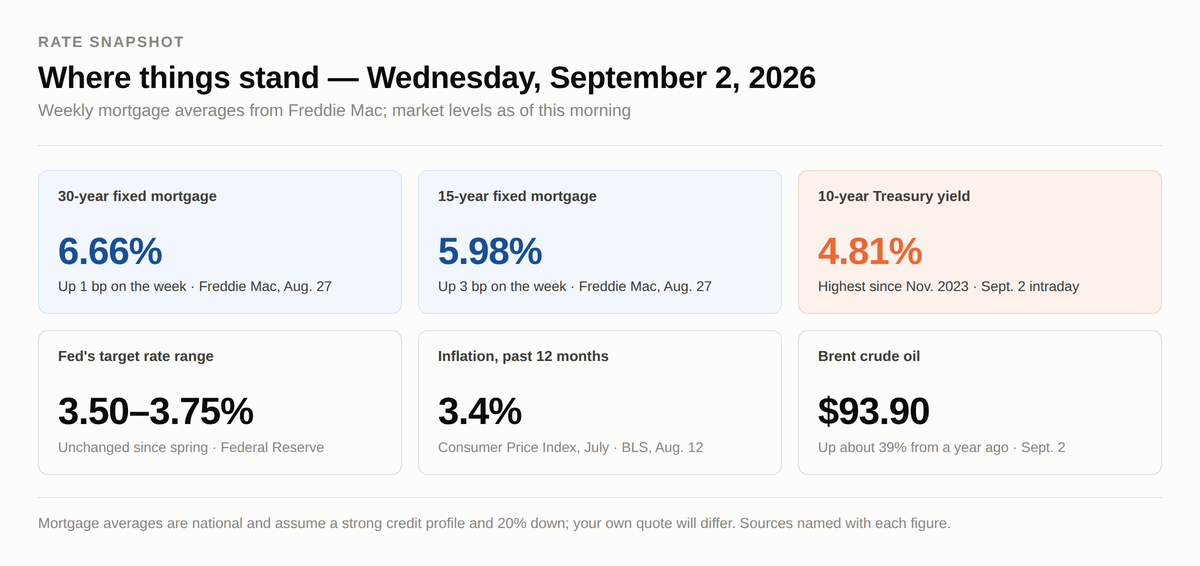
Figure 1. Rate snapshot for September 2, 2026. Mortgage averages: Freddie Mac Primary Mortgage Market Survey, released August 27, 2026. Treasury yield: intraday level reported by CNBC, September 2, 2026. Target rate: Federal Reserve FOMC statement, July 29, 2026. Inflation: U.S. Bureau of Labor Statistics CPI for July 2026, released August 12, 2026. Oil: Brent crude spot price, September 2, 2026.
What happened
The short version: the bond market had a bad week, and mortgage rates follow the bond market.
The yield on the 10-year Treasury note — the government IOU that mortgage pricing tracks more closely than anything else — climbed to about 4.81% Wednesday morning, its highest level since November 2023, CNBC reported. Six trading days earlier it sat at 4.64%.
Two things pushed it there.
Oil. Renewed U.S. airstrikes on Iran and fresh trouble around the Strait of Hormuz — the narrow channel a large share of the world’s oil passes through — sent crude sharply higher. Brent, the global benchmark, topped $95 a barrel Tuesday before easing back to roughly $93.90 Wednesday. That is about 39% above where it was a year ago.
The Fed’s new chair. Kevin Warsh, who was sworn in as chairman in May, gave the keynote at the Fed’s Jackson Hole conference on August 28. He called the central bank’s 2% inflation goal “a firm, fixed target” and said the Fed’s old habit of telling markets in advance what it planned to do “has overstayed its welcome.” Traders heard a straightforward message: this Fed will raise rates if inflation misbehaves, and it won’t warn you first.
They repriced accordingly. By Tuesday, the CME FedWatch tool put the odds of a rate increase at the Fed’s September 15–16 meeting at 66% — up from 40% a week earlier, according to Charles Schwab. A month ago the debate was about how soon cuts would arrive.
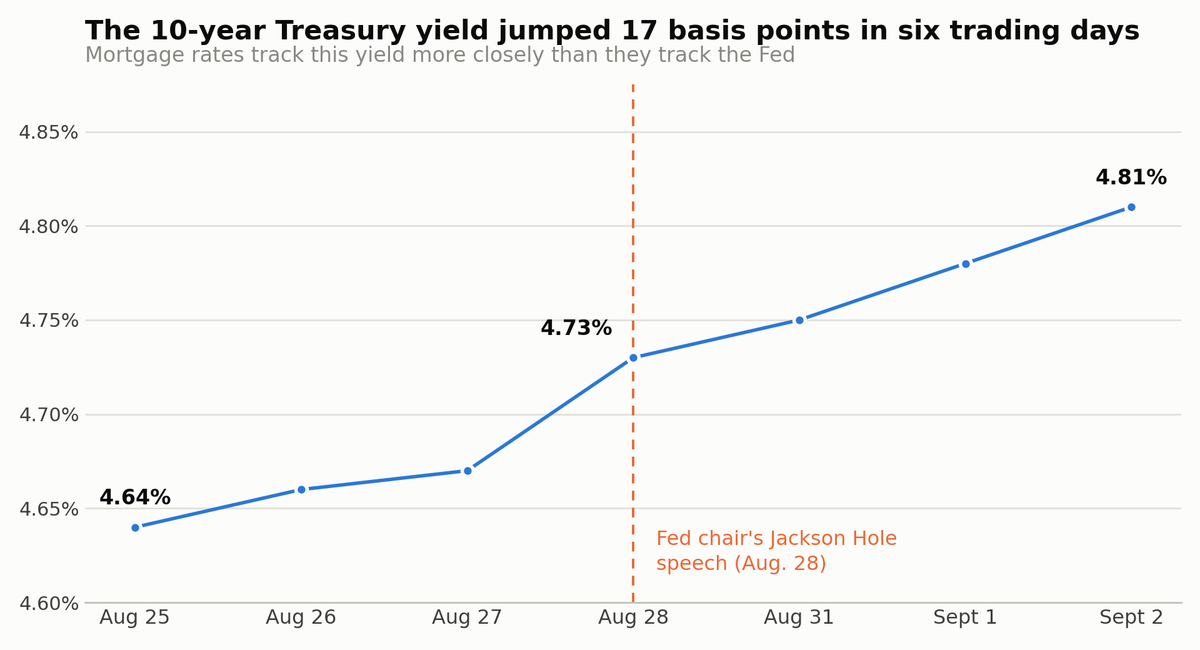
Figure 2. 10-year Treasury yield, August 25 – September 2, 2026. August 25–31 are daily closing yields from the Federal Reserve H.15 release; September 1 and September 2 are intraday levels reported by Charles Schwab and CNBC respectively.
Why an oil shock becomes a higher mortgage rate
Your lender doesn’t set your rate — investors do. Mortgages get bundled into bonds that compete with Treasurys for the same dollars. When investors expect inflation to run hot, they demand a higher return to tie up money for 30 years, because inflation eats the value of every payment they’ll collect. That higher demanded return becomes the higher rate quoted to you.
Right now the inflation picture is lopsided in an unusual way. Consumer prices rose 3.4% over the 12 months through July, the Bureau of Labor Statistics reported on August 12. But strip out food and energy — what economists call “core” inflation, the part that moves slowly — and it was just 2.5%, close to the Fed’s goal. Energy alone was up 14.7%.
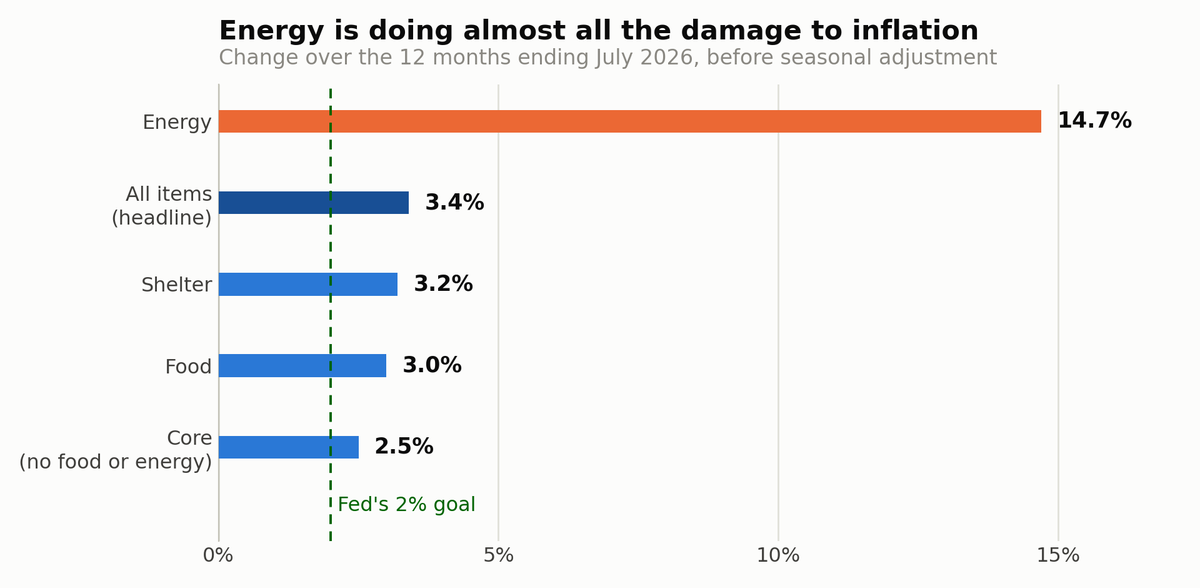
Figure 3. Consumer Price Index, 12-month percent change through July 2026, not seasonally adjusted. Source: U.S. Bureau of Labor Statistics, Consumer Price Index Summary, released August 12, 2026.
Central bankers usually look past an oil spike, because oil comes back down. The worry this time is that inflation has been above target long enough — Warsh pointed to 65 months of it — that another energy shock gets baked into what workers ask for and what businesses charge. Three of the twelve Fed officials who voted in July already wanted to raise rates.
Where rates actually are today
Freddie Mac’s weekly survey put the 30-year fixed at 6.66% and the 15-year at 5.98% on August 27, both essentially flat on the week. But that survey closed before the Jackson Hole speech and before the oil move. Daily trackers have already caught up: Mortgage News Daily’s index had the 30-year at 6.87% on August 31, the highest in more than a year. Freddie Mac’s next reading lands Thursday at noon Eastern, and it will almost certainly be higher.
What it costs in dollars
Here’s the part that matters at the kitchen table. The median existing home sold for $434,100 in July, according to the National Association of Realtors. With 20% down, that’s a $347,280 loan.
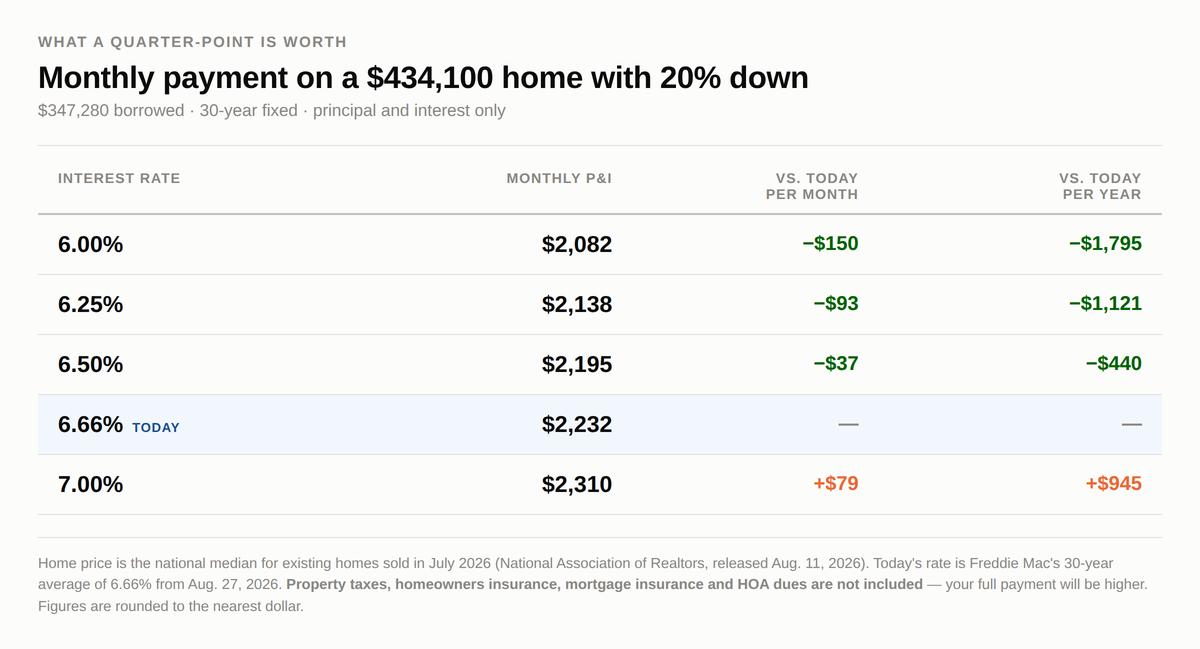
Figure 4. Monthly principal and interest, 30-year fixed, on a $347,280 loan. Home price is the median existing-home sale price for July 2026 from the National Association of Realtors, released August 11, 2026. “Today” uses Freddie Mac’s 30-year average of 6.66% from August 27, 2026. Calculated by Daily Rate News.
Moving from 6.66% to 7.00% costs about $79 a month, or $945 a year. Going the other way, from 6.66% down to 6.25%, saves about $93 a month. A quarter-point is worth about $57 a month at this price — real money, but not enough to justify sitting out a house you actually want.
The housing market underneath all this
Sales have been stubbornly steady. Existing-home sales ran at an annual pace of 4.06 million in July, down 1.7% from June but slightly above last July. “Home sales have been remarkably stable, even amid the rising mortgage rate environment of the past few months,” NAR chief economist Lawrence Yun said. Inventory sat at 1.54 million homes, a 4.6-month supply.
New construction is a different story. New single-family home sales fell 10.5% in July to an annual rate of 607,000, the Census Bureau reported, with 9.6 months of supply on the ground. The median new home sold for $393,800 — less than the median existing home, which is unusual and tells you builders are cutting prices and buying down rates to move inventory.
Borrowers are pulling back at the margins. Mortgage applications fell 1.0% in the week ending August 21, with refinances down 2%, the Mortgage Bankers Association reported.
What to watch
Thursday, noon ET — Freddie Mac’s weekly rate survey. Expect a jump.
Friday, 8:30 a.m. ET — the August jobs report. This is the big one. Payrolls actually fell by 23,000 in July, and revisions erased 103,000 jobs from May and June. Unemployment is 4.1%.
September 11 — August inflation data, the last major reading before the Fed meets.
September 15–16 — the Fed’s decision.
Normally a weak jobs number pushes mortgage rates down, because a soft economy means less inflation pressure. That relationship is strained right now: with oil driving prices and a chair who has made price stability the headline, a mediocre jobs report may not buy you much relief. A strong one, on the other hand, would likely push rates higher still.
What I’d do
If you’re under contract and closing within 45 days, lock. The risk is lopsided this week: two scheduled events that can move rates, and little that argues for waiting.
If you’re floating, ask your lender for a float-down. Many lenders offer a one-time option to capture a drop if one comes. That’s how you keep the upside without carrying the downside.
If you were waiting on a refinance, run the break-even now, not on vibes. Divide your closing costs by your monthly savings. If it takes more than about three years to recover and you might move sooner, it isn’t a refinance — it’s a fee.
If you’re buying, spend your energy on price and credits, not rate timing. With nearly ten months of new-home supply out there, builders have far more room to negotiate than the bond market has to move for you. A seller-paid buydown or a price cut beats the quarter-point you’re hoping to catch.
One last thing about the Fed: even if it raises rates on September 16, that does not automatically raise your mortgage rate. The Fed sets a very short-term rate; mortgages follow the 10-year Treasury, which has already moved on the expectation. The damage is largely done — which is also why a Fed cut, whenever it arrives, won’t hand you a 5% mortgage the next morning.
Questions about your specific situation? Reply to this email or call me directly.
References
Freddie Mac. Primary Mortgage Market Survey — “Mortgage Rates Hold Steady.” Released August 27, 2026.
https://www.freddiemac.com/pmmsU.S. Bureau of Labor Statistics. Consumer Price Index — July 2026. Released August 12, 2026.
https://www.bls.gov/news.release/cpi.nr0.htmU.S. Bureau of Labor Statistics. Employment Situation — July 2026. Released August 7, 2026.
https://www.bls.gov/news.release/empsit.nr0.htmU.S. Bureau of Economic Analysis. Personal Income and Outlays, July 2026. Released August 26, 2026.
https://www.bea.gov/news/2026/personal-income-and-outlays-july-2026Board of Governors of the Federal Reserve System. Federal Reserve issues FOMC statement. July 29, 2026.
https://www.federalreserve.gov/newsevents/pressreleases/monetary20260729a.htmKevin Warsh, Board of Governors of the Federal Reserve System. Keynote remarks at the 2026 Jackson Hole Economic Policy Symposium. August 28, 2026.
https://www.federalreserve.gov/newsevents/speech/warsh20260828a.htmBoard of Governors of the Federal Reserve System. H.15 Selected Interest Rates. Daily; accessed September 2, 2026.
https://www.federalreserve.gov/releases/h15/National Association of Realtors. Existing-Home Sales — July 2026. Released August 11, 2026.
https://www.nar.realtor/newsroom/nar-existing-home-sales-report-shows-1-7-decrease-in-julyU.S. Census Bureau and U.S. Department of Housing and Urban Development. Monthly New Residential Sales, July 2026. Released August 25, 2026.
https://www.census.gov/construction/nrs/pdf/newressales.pdfMortgage Bankers Association. Mortgage Applications Decrease in Latest MBA Weekly Survey (week ending August 21, 2026). Released August 26, 2026.
https://www.mba.org/news-and-research/newsroom/news/2026/08/26/mortgage-applications-decrease-in-latest-mba-weekly-surveyCharles Schwab. Crude, Yields Flex Muscle, Bruising Stocks Early (CME FedWatch odds of a September rate hike). September 1, 2026.
https://www.schwab.com/learn/story/stock-market-update-openCNBC. 10-year U.S. Treasury yield hits highest level since November 2023. September 2, 2026.
https://www.cnbc.com/2026/09/02/bond-yields-treasurys-inflation.htmlMortgage News Daily. Highest Mortgage Rates in Over a Year, But Just Barely. August 31, 2026.
https://www.mortgagenewsdaily.com/markets/mortgage-rates-08312026Trading Economics. Brent Crude Oil — spot price. Accessed September 2, 2026.
https://tradingeconomics.com/commodity/brent-crude-oil
A note on the figures: Figures 1 through 4 were produced by Daily Rate News from the published data cited in each caption. They are original, free for you to reproduce in your own newsletter, and contain no AI-generated imagery. Figure 4 is our own calculation from the cited median price and rate. If you would like to add a photograph, free-license options include Unsplash, Pexels and Pixabay, and photography produced by U.S. government agencies is generally in the public domain.
This email is for informational and educational purposes only and is not a commitment to lend. Rates shown are national averages from the sources cited and are not an offer or a quote; your own rate depends on your credit, loan amount, down payment, property type, occupancy, loan program and other factors, and can change daily. Payment examples cover principal and interest only and exclude property taxes, homeowners insurance, mortgage insurance and HOA dues. All loans are subject to credit approval and program guidelines. Equal Housing Lender.