
Saturday, August 22, 2026 at 9:27 AM PDT
Mortgage rates slipped again this week. The bond market says don't get comfortable.
The 30-year average eased to 6.65%. But the Federal Reserve's own meeting notes show three officials voted to raise rates last month, the Treasury Department had to step in to calm the bond market, and the new Fed chair gives his first big speech on Friday. Here's what all of that means for your payment.
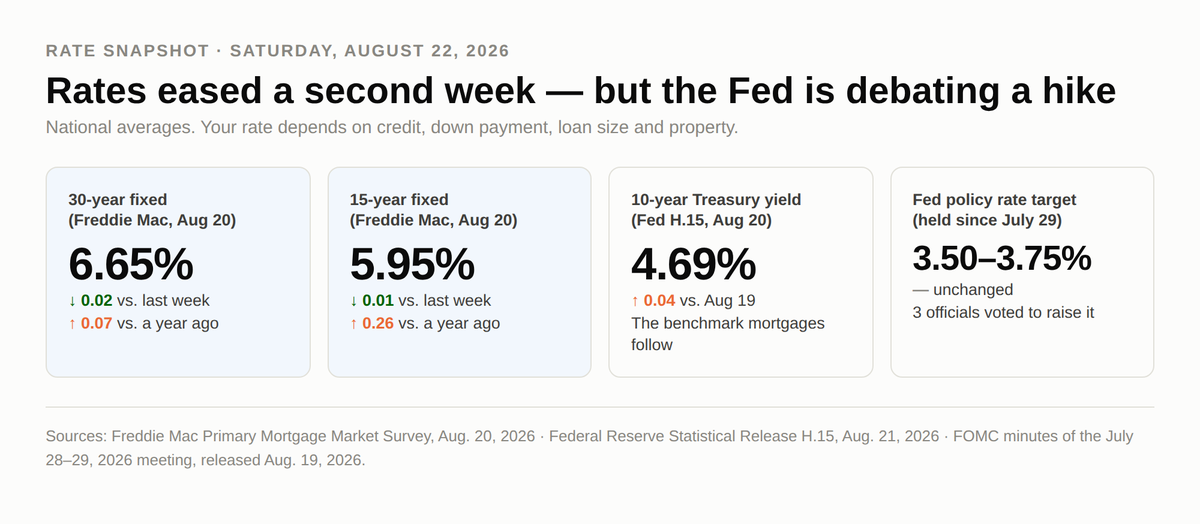
Figure 1. Rate snapshot for the week ending August 20, 2026. Sources: Freddie Mac Primary Mortgage Market Survey, released August 20, 2026; Federal Reserve Statistical Release H.15, released August 21, 2026; FOMC minutes of the July 28-29, 2026 meeting, released August 19, 2026.
The number that made the headlines
Freddie Mac's weekly survey, released Thursday, August 20, put the average 30-year fixed mortgage at 6.65%, down from 6.67% a week earlier. That's the second weekly decline in a row. The 15-year fixed averaged 5.95%, down from 5.96%.
Two cautions. Rates are still higher than a year ago, when the same survey read 6.58%. And Freddie Mac's number is a weekly average built from applications submitted earlier in the week. Daily trackers were running higher by Friday — Mortgage News Daily's index sat at 6.77% on August 21. If you got a quote this weekend starting with a 6.7, your loan officer wasn't padding it.
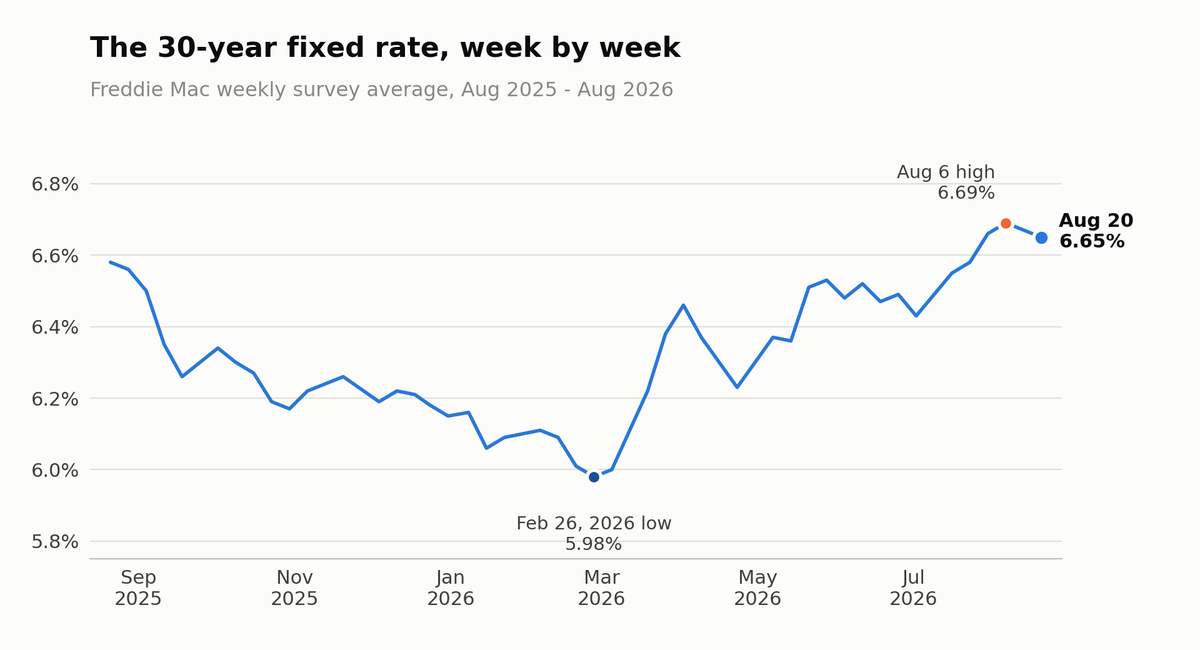
Figure 2. Weekly average 30-year fixed mortgage rate, August 21, 2025 through August 20, 2026. Source: Freddie Mac Primary Mortgage Market Survey; latest release August 20, 2026.
Why rates aren't falling further
Mortgage rates don't follow the Fed's headline interest rate. They shadow the yield on the 10-year Treasury note — the interest the U.S. government pays to borrow money for ten years. When investors demand more to lend to the government, they demand more to lend to you, too. That yield finished at 4.69% on August 20, according to the Federal Reserve's own daily rate release.
The reason it's stuck comes down to inflation. Consumer prices were 3.4% higher this July than in July 2025, the Bureau of Labor Statistics reported on August 12. That's well above the Fed's 2% goal.
But dig one layer down and the picture splits in two. Strip out food and energy — the two categories that swing hardest month to month — and prices rose just 2.5% over the year. Economists call that "core" inflation, and it's much closer to normal. The gap is almost entirely energy: gasoline, electricity and heating costs were up 14.7% from a year earlier.
That split is the whole argument inside the Federal Reserve right now. One camp sees an energy problem that will fade on its own. The other sees inflation that has been above target too long.
The Fed is arguing about hiking, not cutting
On August 19, the Fed released the notes from its July 28–29 meeting. The committee voted 9 to 3 to leave its policy rate alone, in a range of 3.50% to 3.75%. But all three of those "no" votes — from Fed officials Beth Hammack, Neel Kashkari and Lorie Logan — were votes to raise rates by a quarter point. Not one official voted to cut.
The notes go further. Several participants argued that moving now could "forestall the need for a steeper and potentially more costly sequence of tightening moves at a later stage." In plain English: a small hike now beats a big one later.
If you have been waiting for the Fed to cut rates and drag your mortgage quote down with it, the people who set that rate are currently having the opposite conversation.
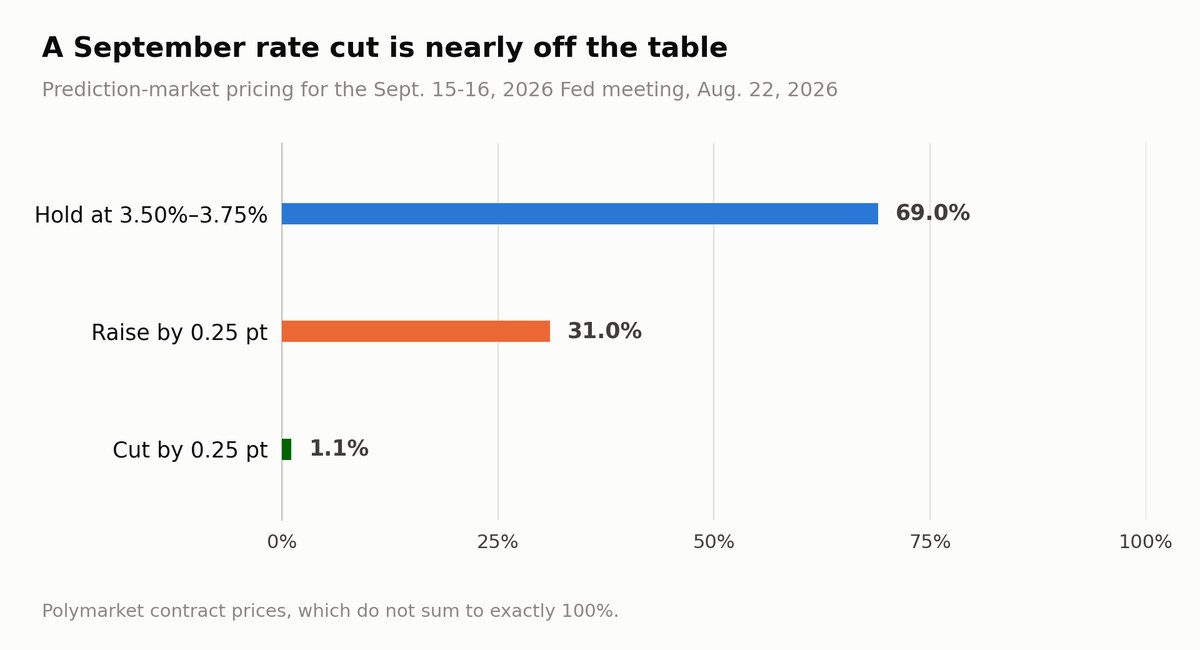
Figure 3. Prediction-market pricing for the September 15-16, 2026 Federal Open Market Committee meeting, as of August 22, 2026. Source: Polymarket contract prices. CME FedWatch was reported near 70% hold / 30% hike on August 19, 2026.
Traders agree. Contracts tied to the Fed's September 15–16 meeting were pricing roughly a 69% chance of no change and a 31% chance of an increase as of Saturday. The odds of a cut were about 1%.
The government stepped in to steady bonds
Here's the piece that got less attention but matters more for your rate. On August 19, the Treasury Department announced it would more than double the size of its bond "buybacks" — operations where the government repurchases its own older debt from investors — for bonds maturing in 10 to 30 years. The maximum per operation goes from $2 billion to at least $4 billion, starting September 9.
Governments do this to add buyers when there aren't enough. Long-term yields dipped on the news, then gave most of it back within a day, with the 30-year Treasury yield hovering near 5.2%. Analysts quoted by CNBC called the relief limited.
The takeaway isn't the mechanics. It's the signal: the part of the bond market that sets your mortgage rate is strained enough that Washington felt the need to help.
What this costs in actual dollars
Here is that rate range as monthly payments.
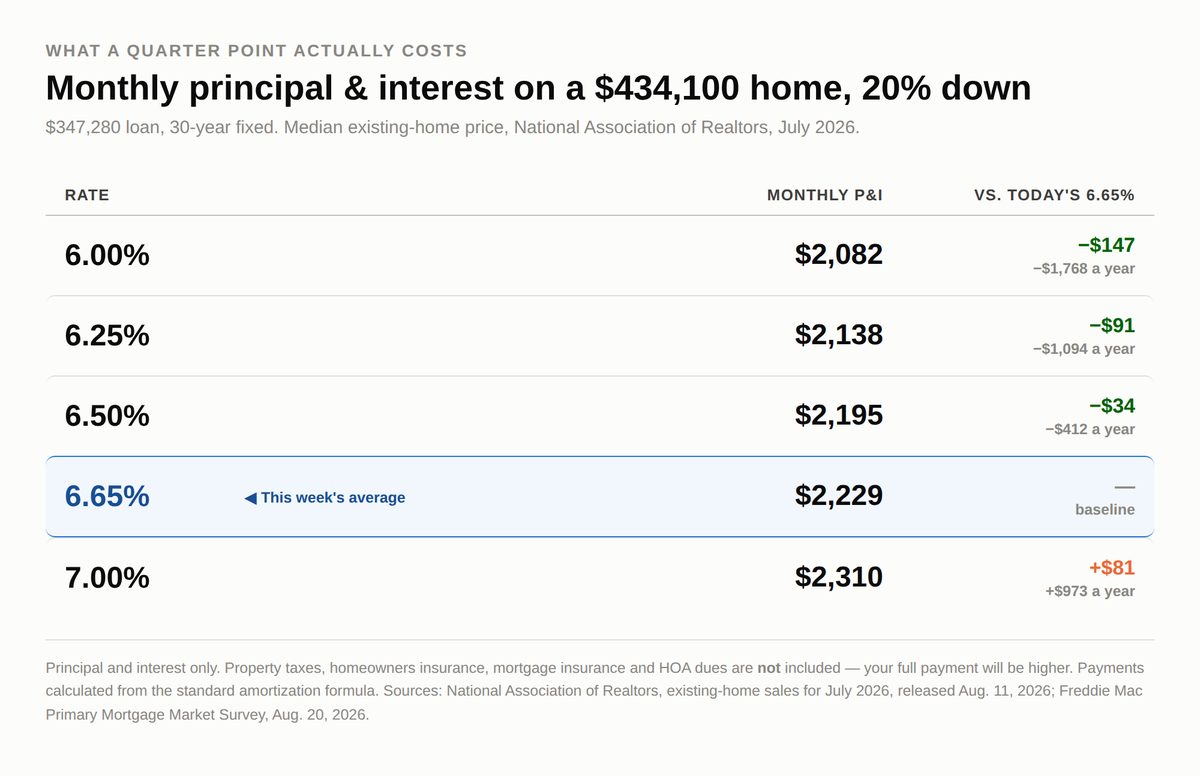
Figure 4. Monthly principal and interest by rate, calculated by Daily Rate News using the standard amortization formula. Sources: National Association of Realtors, Existing-Home Sales for July 2026, released August 11, 2026 (median price $434,100); Freddie Mac Primary Mortgage Market Survey, August 20, 2026.
The median existing home sold for $434,100 in July, per the National Association of Realtors. With 20% down, that's a $347,280 loan. At this week's 6.65%, principal and interest run about $2,229 a month.
A quarter of a percentage point is worth about $57 a month on that loan — roughly $680 a year. The full stretch from 7.00% down to 6.00% is $228 a month, or $2,740 a year. That's real money. But notice how much rate movement it takes to change your payment meaningfully: waiting on a quarter point rarely justifies losing the house you want.
The housing market, briefly
Existing-home sales ran at an annual pace of 4.06 million in July, down 1.7% from June but up 0.7% from a year ago, NAR reported on August 11. The median price rose 2.0% over the year.
Inventory is the more interesting number: 1.54 million homes listed, a 4.6-month supply — meaning it would take 4.6 months to sell every listing at the current pace. Under about six months is generally a seller's market, so buyers have more room than two years ago, but not a lot.
"Home sales have been remarkably stable, even amid the rising mortgage rate environment of the past few months," NAR chief economist Lawrence Yun said.
What to watch this week
Friday, August 28 is the big one. The Kansas City Fed's annual Jackson Hole symposium runs August 27–29, and it will be Fed Chair Kevin Warsh's first as chair. Markets read these speeches closely for hints about the next move. Given July's three hike votes, whatever he says about inflation is likely to move bond yields — and mortgage rates with them.
Thursday, August 27 brings the next Freddie Mac weekly survey.
What I'd do
If you're under contract, lock. With the Fed openly discussing a hike and a chairman's speech on Friday, the downside risk to floating outweighs the upside this week.
If you're shopping, get more than one quote. Freddie Mac's own chief economist, Sam Khater, made the point in Thursday's release: borrowers "can potentially save thousands by shopping around for the best mortgage rate." A half-point spread between lenders is common — worth more than any forecast.
If you're waiting for 5%, reconsider the plan. The 30-year hasn't been below 6% in this survey since February, when it briefly touched 5.98%. Nothing in this week's data points that direction. Buy the house that works at today's payment, and treat a future refinance as a bonus rather than a plan.
If you're weighing a refinance, divide your closing costs by your monthly savings. That's how many months you must stay to break even. Under 24 months is usually worth doing.
As always, these are national averages. Your actual rate depends on your credit score, down payment, loan amount and property type. Reply to this email and I'll run your specific numbers.
Want your own numbers?
I'll run a payment breakdown on the price range you're actually shopping — no cost, no obligation.
REFERENCES
1. Freddie Mac. Primary Mortgage Market Survey: Mortgage Rates Decline for Second Consecutive Week. August 20, 2026. https://www.freddiemac.com/pmms
2. Board of Governors of the Federal Reserve System. Statistical Release H.15, Selected Interest Rates (Daily). August 21, 2026. https://www.federalreserve.gov/releases/h15/
3. Federal Open Market Committee. Minutes of the Federal Open Market Committee, July 28-29, 2026. released August 19, 2026. https://www.federalreserve.gov/monetarypolicy/fomcminutes20260729.htm
4. Federal Open Market Committee. Federal Reserve issues FOMC statement. July 29, 2026. https://www.federalreserve.gov/newsevents/pressreleases/monetary20260729a.htm
5. U.S. Bureau of Labor Statistics. Consumer Price Index, July 2026. released August 12, 2026. https://www.bls.gov/news.release/cpi.nr0.htm
6. National Association of Realtors. Existing-Home Sales Report Shows 1.7% Decrease in July. August 11, 2026. https://www.nar.realtor/newsroom/nar-existing-home-sales-report-shows-1-7-decrease-in-july
7. U.S. Department of the Treasury. Treasury Announces Increased Sizes of Nominal Long-End Liquidity Support Buybacks Beginning September 9. August 19, 2026. https://home.treasury.gov/news/press-releases/sb0607
8. CNBC. Treasury bond buybacks ease long-term yields, but analysts see limited relief. August 20, 2026. https://www.cnbc.com/2026/08/20/treasury-bond-buybacks-long-term-yields.html
9. Axios. Treasury to double down on buybacks to steady bond market. August 19, 2026. https://www.axios.com/2026/08/19/rates-treasury-borrowing-bessent
10. Mortgage News Daily. Mortgage Rates Daily Index. August 21, 2026. https://www.mortgagenewsdaily.com/newsletter/n/20260821
11. Polymarket. Fed decision in September. accessed August 22, 2026. https://polymarket.com/event/fed-decision-in-september-762
12. Federal Reserve Bank of Kansas City. Jackson Hole Economic Policy Symposium 2026: Financial Innovation - Implications for Payments and Policy. August 27-29, 2026. https://www.kansascityfed.org/research/jackson-hole-economic-symposium/
13. Board of Governors of the Federal Reserve System. FOMC Meeting Calendars and Information. accessed August 22, 2026. https://www.federalreserve.gov/monetarypolicy/fomccalendars.htm
A note on the figures. All four figures above were produced originally for this issue from published government and industry data. They are free for the sender to reproduce and redistribute. No AI-generated imagery appears anywhere in this newsletter; every graphic is a chart or table computed from the sources listed. If you wish to add a photograph, free-license options include Unsplash, Pexels and Pixabay, and photography produced by U.S. government agencies is generally in the public domain.