
Sunday, August 23, 2026 at 9:43 AM PDT
Mortgage rates slipped again — but next week is the one to watch
The 30-year fixed averaged 6.65% last week, its second small decline in a row. Under that calm surface, bond traders are quietly betting the Federal Reserve's next move might be up, not down — and the Fed's biggest speech of the year lands Friday.
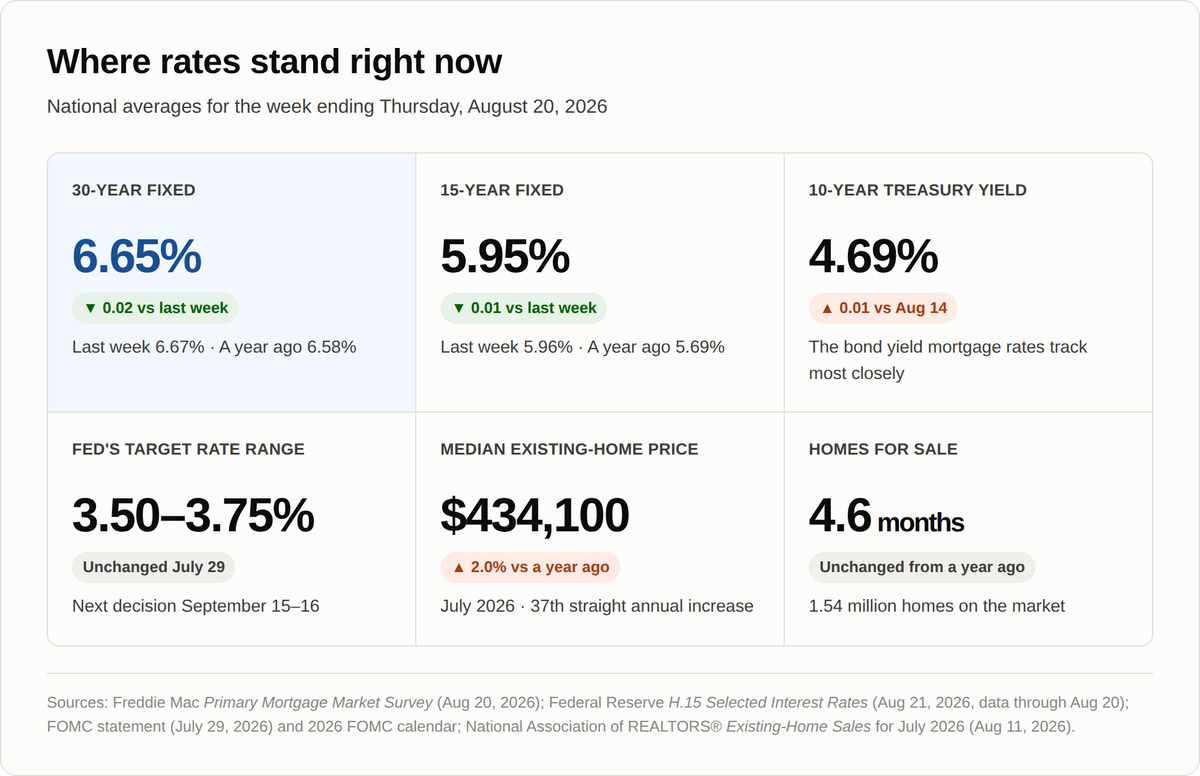
Figure 1. Rate and housing snapshot. Sources: Freddie Mac Primary Mortgage Market Survey, released August 20, 2026; Federal Reserve H.15 Selected Interest Rates, released August 21, 2026 (data through August 20); FOMC statement of July 29, 2026; National Association of REALTORS® Existing-Home Sales for July 2026, released August 11, 2026.
Rates eased for a second straight week
Freddie Mac's weekly survey put the average 30-year fixed mortgage at 6.65% for the week ending August 20, down from 6.67% the week before. The 15-year fixed averaged 5.95%, down from 5.96%.
These are small moves. What makes them worth a minute of your time is the direction: rates climbed steadily through July, peaked at 6.69% on August 6, and have drifted down since.
A year ago, the 30-year averaged 6.58%. So we are slightly worse off than last August, not better — a useful reality check if you have been waiting for a return to the 5s.
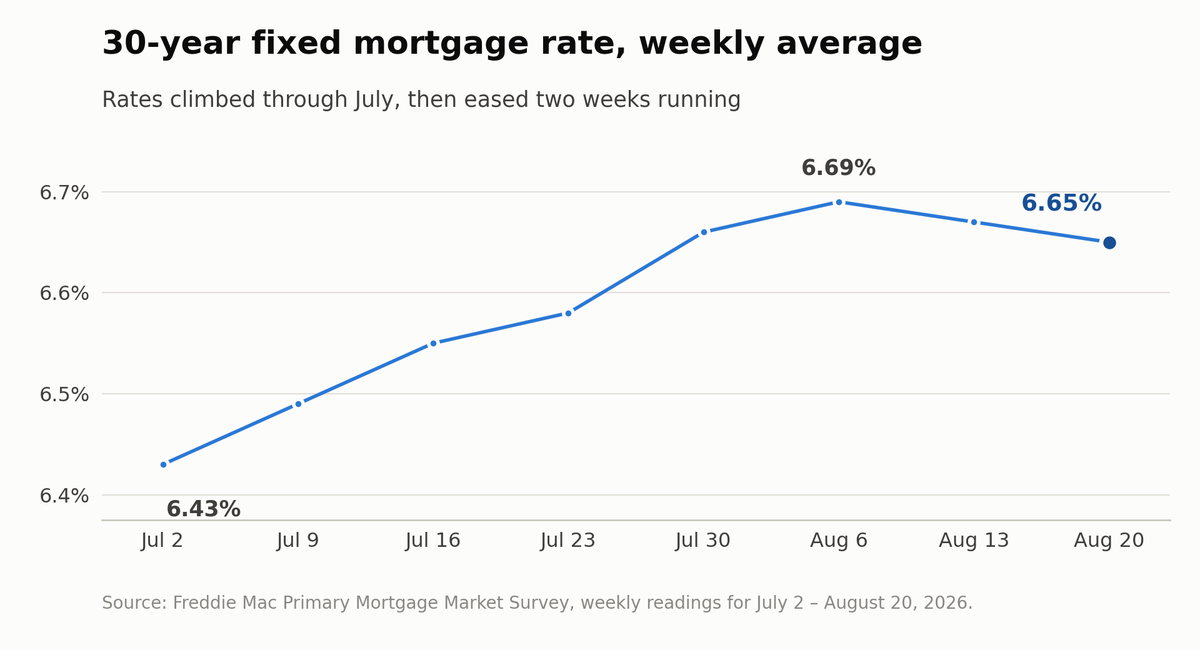
Figure 2. Weekly 30-year fixed mortgage rate averages, July 2 through August 20, 2026. Source: Freddie Mac Primary Mortgage Market Survey, released weekly on Thursdays; latest release August 20, 2026.
Why rates aren't falling faster
Mortgage rates don't follow the Fed's headline interest rate directly. They tend to track the 10-year Treasury yield, which is what big investors accept to lend the U.S. government money for a decade. That yield sat at 4.69% on August 20, according to the Federal Reserve's daily H.15 report — essentially flat over the week.
The reason it isn't falling comes down to inflation. In the 12 months through July, consumer prices rose 3.4%, the Bureau of Labor Statistics reported on August 12. Strip out food and energy — what economists call "core" inflation, because those two categories swing wildly — and the increase was 2.5%. Prices charged by producers, an early warning signal for what shoppers pay later, were up 4.7%.
All of those are above the Fed's 2% target. Energy is doing much of the damage: the energy index alone was up 14.7% over the year.
Here's the awkward part. The job market is going the other way. Employers cut 23,000 jobs in July, and the government revised May and June down by a combined 103,000 positions. Unemployment is 4.1%.
That leaves the Fed pulled in two directions: inflation says hold or tighten, jobs say ease. It has kept its target rate range at 3.50%–3.75% since its July 29 meeting — though that decision was not unanimous. Three of the twelve voting members dissented, and all three wanted a rate increase.
Which brings us to the part most homebuyers have not heard. Investors are not currently betting on a rate cut. Charles Schwab's Weekly Trader's Outlook on August 21 noted that market pricing implied roughly a 40% chance the Fed raises rates at its September 15–16 meeting. Not cuts — raises.
If you have been holding out for a Fed rate cut to rescue your rate this fall, the market is not currently pricing one in.
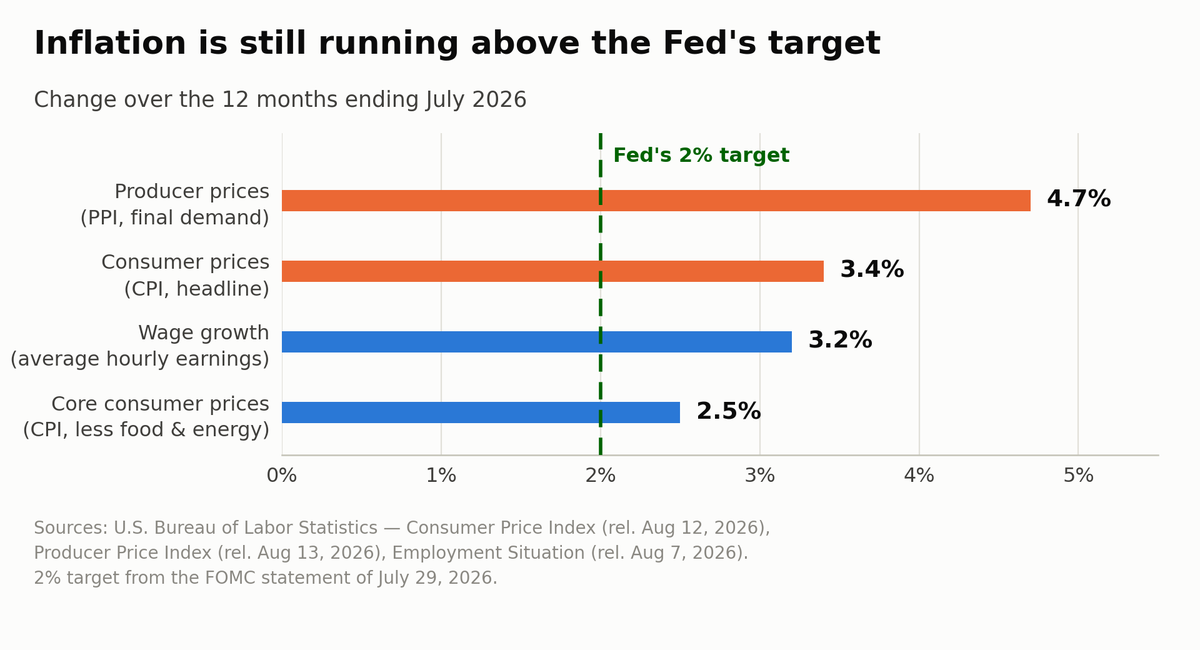
Figure 3. Twelve-month price and wage changes through July 2026. Sources: U.S. Bureau of Labor Statistics Consumer Price Index, released August 12, 2026; Producer Price Index, released August 13, 2026; Employment Situation, released August 7, 2026. Two percent target from the FOMC statement of July 29, 2026.
What this costs you in real money
Percentages are abstract. Dollars are not.
The median existing home sold for $434,100 in July, per the National Association of REALTORS®. With 20% down, that's a loan of $347,280. At today's 6.65%, principal and interest run about $2,229 a month.
Move that rate around and the picture changes:
At 6.50%, you'd pay $2,195 — about $34 less a month, $412 a year.
At 6.25%, $2,138 — roughly $91 less a month, $1,094 a year.
At 7.00%, $2,310 — about $81 more a month, $973 a year.
A quarter-point is worth roughly $55 to $60 a month on a loan this size. That adds up over the years you keep the loan — but it is small enough that it should not be the only thing driving whether you buy a house.
One important caveat: those numbers are principal and interest only. Property taxes, homeowners insurance, mortgage insurance and HOA dues are all on top, and together they often add several hundred dollars a month.
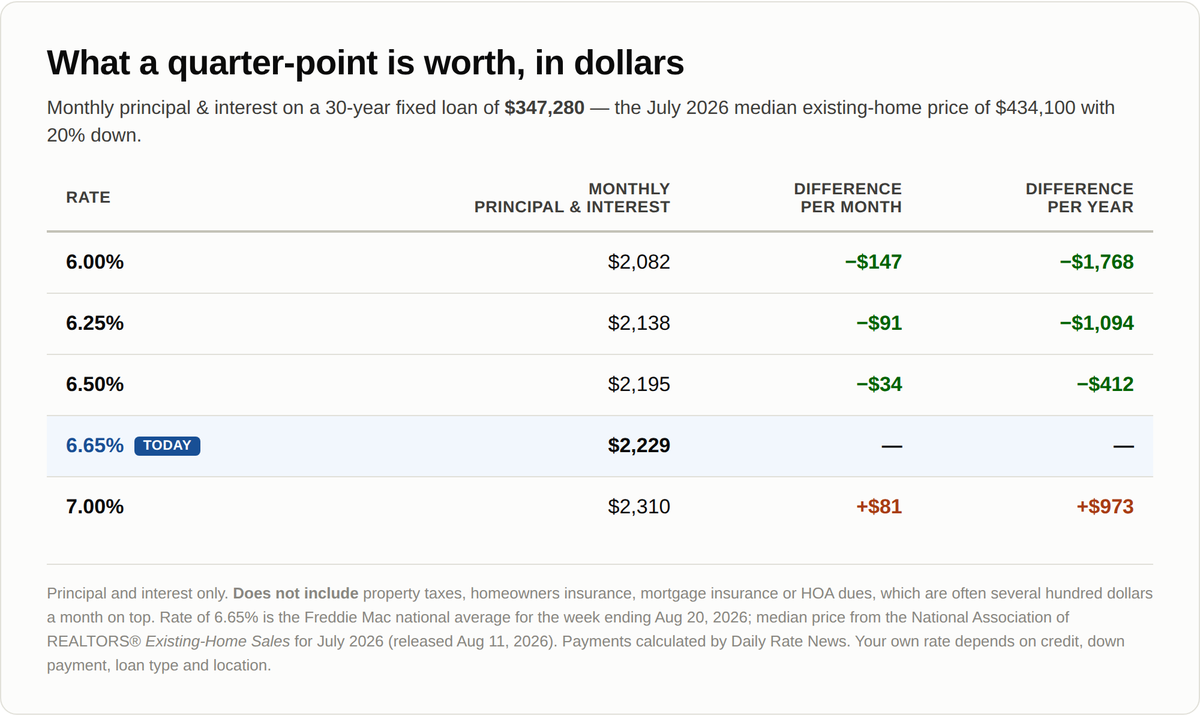
Figure 4. Monthly principal and interest at a range of rates on a $347,280 loan. Sources: median existing-home price of $434,100 from the National Association of REALTORS® Existing-Home Sales for July 2026, released August 11, 2026; 6.65% rate from Freddie Mac's survey of August 20, 2026. Payments calculated by Daily Rate News using standard 360-month amortization. Taxes, insurance, mortgage insurance and HOA dues are excluded.
The housing market itself is quiet
Existing-home sales ran at an annual pace of 4.06 million in July, down 1.7% from June but up 0.7% from a year earlier. The median price rose 2.0% over the year — the 37th consecutive month of annual increases.
Inventory is the story worth knowing. There were 1.54 million homes on the market, about a 4.6-month supply at the current sales pace, unchanged from a year ago. Historically, roughly six months is considered a balanced market. Under that, sellers have the edge.
New construction is not riding to the rescue soon either. Housing starts fell 12.4% in July to an annual rate of 1.24 million, the Census Bureau reported on August 18. Permits — the earlier signal — actually rose 5.0%, so builders have not given up. But permits become finished houses on a timeline measured in quarters, not weeks.
Consumers, for their part, are gloomy. The University of Michigan's preliminary August consumer sentiment reading came in at 51.0, down from July and well below the 58.2 recorded a year ago.
What to watch this week
The calendar is light until Thursday, and then it isn't.
Tuesday: July new home sales from the Census Bureau.
Thursday through Saturday: the Kansas City Fed's Jackson Hole symposium. Fed Chair Kevin Warsh, who took office in May, is expected to deliver the keynote Friday morning — his first as Chair.
Thursday: the next weekly Freddie Mac rate survey.
Friday: final August consumer sentiment, including household inflation expectations.
Jackson Hole is the one that matters. Fed chairs have historically used this speech to signal a shift in thinking, and markets move on the wording. With a new Chair speaking for the first time and a September meeting where a rate increase is a live possibility, the range of outcomes Friday is wider than usual.
One honest caveat: the Kansas City Fed does not publish the symposium's full program until the evening before it begins, so the Friday keynote slot is what's been reported ahead of the event rather than an officially posted agenda.
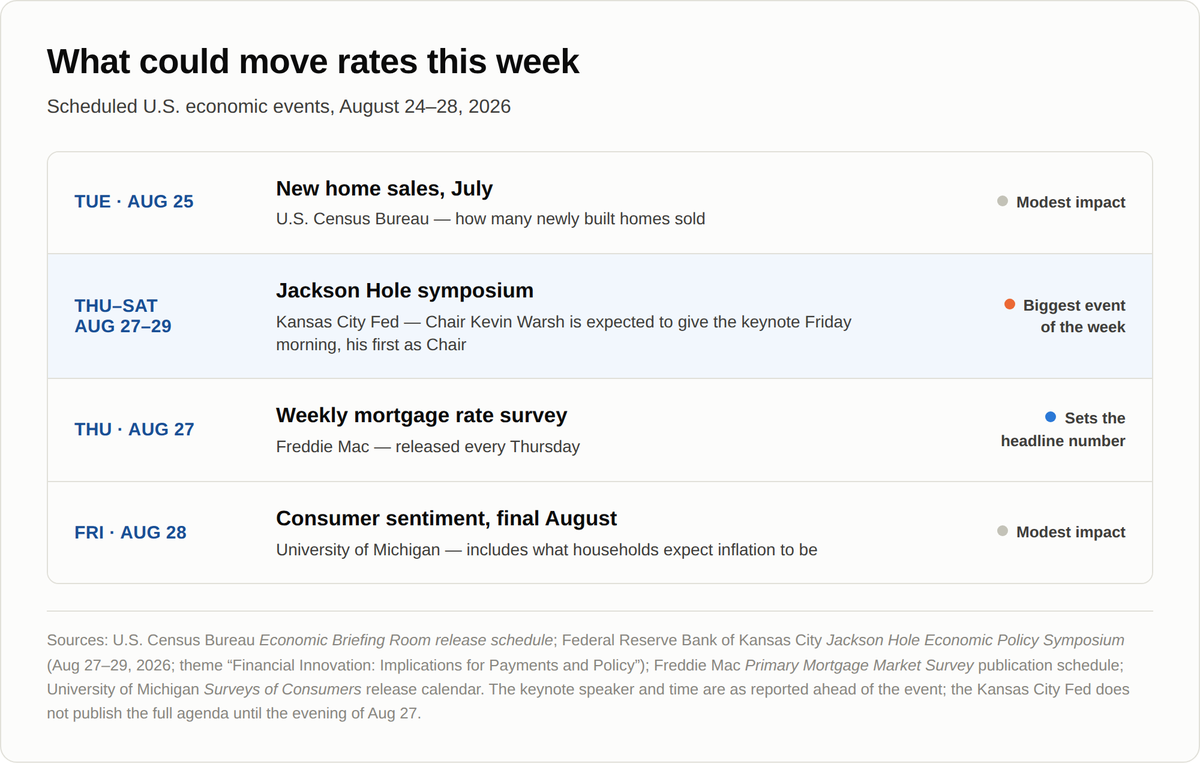
Figure 5. Scheduled U.S. economic events, August 24–28, 2026. Sources: U.S. Census Bureau release schedule; Federal Reserve Bank of Kansas City Jackson Hole Economic Policy Symposium; Freddie Mac survey schedule; University of Michigan Surveys of Consumers calendar.
What I'd do
If you're under contract to buy: consider locking before Thursday. You are not being offered a great rate right now, but you are being offered a known one. Sitting unlocked through a Jackson Hole keynote from a brand-new Fed Chair is a coin flip, and it is not a coin flip you're paid to take.
If you're shopping but haven't found a house: don't try to time this. Get fully underwritten so you can move fast, and pick your price on the payment you're comfortable with today — not the payment you hope exists in November.
If you already own and are watching for a refinance: run the math on your break-even, which is your closing costs divided by your monthly savings. If you're sitting above 7.5%, today's market is already worth a conversation. If you're in the 6s, a small dip won't be enough.
And regardless: shop more than one lender. As Freddie Mac's chief economist Sam Khater put it in last week's release, borrowers "can potentially save thousands by shopping around for the best mortgage rate." That is free money, and it does not require guessing what the Fed does next.
Questions about your specific situation? Reply to this email — I'd rather run your actual numbers than have you guess from a national average.
References
Freddie Mac. Mortgage Rates Decline for Second Consecutive Week (Primary Mortgage Market Survey). August 20, 2026. https://www.freddiemac.com/pmms
Board of Governors of the Federal Reserve System. H.15 Selected Interest Rates. August 21, 2026. https://www.federalreserve.gov/releases/h15/
Board of Governors of the Federal Reserve System. Federal Reserve issues FOMC statement. July 29, 2026. https://www.federalreserve.gov/newsevents/pressreleases/monetary20260729a.htm
Board of Governors of the Federal Reserve System. 2026 FOMC Meeting Calendar. accessed August 23, 2026. https://www.federalreserve.gov/monetarypolicy/fomccalendars.htm
U.S. Bureau of Labor Statistics. Consumer Price Index — July 2026. August 12, 2026. https://www.bls.gov/news.release/pdf/cpi.pdf
U.S. Bureau of Labor Statistics. Producer Price Indexes — July 2026. August 13, 2026. https://www.bls.gov/news.release/ppi.nr0.htm
U.S. Bureau of Labor Statistics. The Employment Situation — July 2026. August 7, 2026. https://www.bls.gov/news.release/empsit.nr0.htm
National Association of REALTORS®. Existing-Home Sales Report Shows 1.7% Decrease in July. August 11, 2026. https://www.nar.realtor/newsroom/nar-existing-home-sales-report-shows-1-7-decrease-in-july
U.S. Census Bureau and U.S. Department of Housing and Urban Development. New Residential Construction, July 2026. August 18, 2026. https://www.census.gov/construction/nrc/pdf/newresconst.pdf
U.S. Census Bureau and U.S. Department of Housing and Urban Development. New Residential Sales, June 2026 (next release scheduled August 25, 2026). July 24, 2026. https://www.census.gov/construction/nrs/pdf/newressales.pdf
University of Michigan. Surveys of Consumers — preliminary August 2026 results. August 2026. http://www.sca.isr.umich.edu/
Charles Schwab (Jim Ferraioli). Weekly Trader's Outlook. August 21, 2026. https://www.schwab.com/learn/story/weekly-traders-outlook
Federal Reserve Bank of Kansas City. Jackson Hole Economic Policy Symposium (August 27–29, 2026). accessed August 23, 2026. https://www.kansascityfed.org/research/jackson-hole-economic-symposium/
Board of Governors of the Federal Reserve System. Kevin M. Warsh, Chair — biography. accessed August 23, 2026. https://www.federalreserve.gov/aboutthefed/bios/board/warsh.htm
About these figures. All five figures were built by Daily Rate News from the published government and industry data cited in each caption. They are original, contain no AI-generated imagery, and are free for the sender to reproduce and redistribute. Photography, if added, should come from a free-license source such as Unsplash, Pexels or Pixabay; U.S. government photography is in the public domain.