
Monday, August 24, 2026 at 9:54 AM PDT
Mortgage Rates Eased Again. The Bond Market Is Bracing for Friday
The 30-year average slipped for a second straight week. But long-term government bond yields are sitting near the top of their range, and traders have started pricing in something almost nobody expected this year: a real chance the Fed's next move is an increase, not a cut. Friday morning should tell us a lot.
Where rates stand this morning
Freddie Mac's weekly survey put the average 30-year fixed mortgage at 6.65% for the week ending August 20, down from 6.67% the week before. The 15-year fixed averaged 5.95%. That's two weeks of small declines in a row.
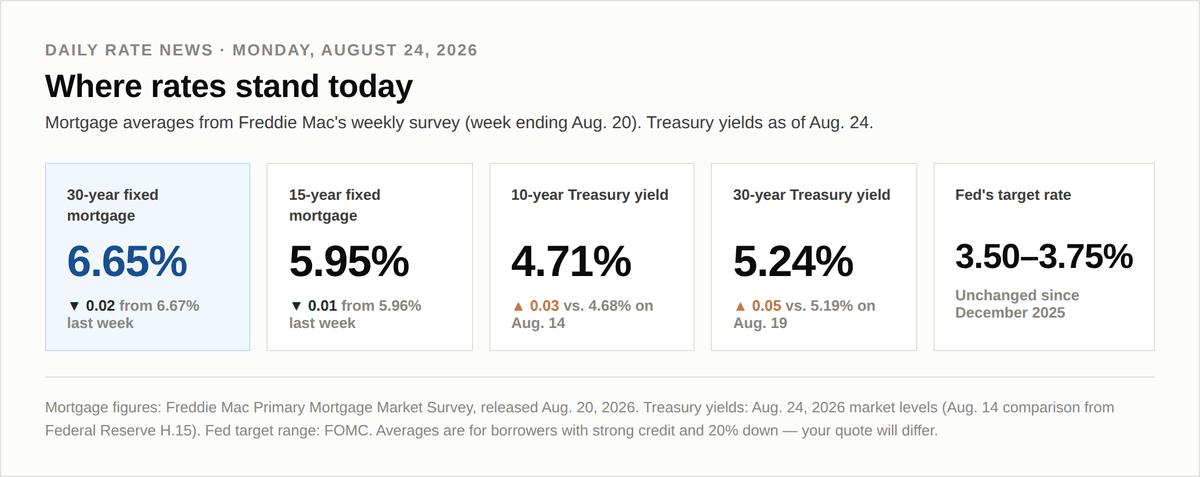
Figure 1. Rate snapshot. Mortgage averages: Freddie Mac Primary Mortgage Market Survey, released August 20, 2026. Treasury yields: August 24, 2026 market levels, with the August 14 and August 19 comparisons from Federal Reserve H.15 (released August 21, 2026).
Sam Khater, Freddie Mac's chief economist, put it plainly in the release: “With a dip in rates providing modest relief for homebuyers, it's important to remember borrowers can potentially save thousands by shopping around for the best mortgage rate.”
Two-hundredths of a percent isn't going to change anyone's life. But why it moved is worth five minutes of your time, because it points at what happens next.
The Fed doesn't set your mortgage rate. This does.
Almost everyone assumes the Federal Reserve sets mortgage rates. It doesn't.
The Fed sets a very short-term rate — what banks charge each other to borrow overnight. That target is currently 3.50% to 3.75%, and it hasn't moved since a quarter-point cut in December 2025.
Your 30-year mortgage is priced off something else entirely: long-term U.S. government bonds, especially the 10-year Treasury. When investors demand a higher yield — the annual return a bond pays its buyer — to lend the government money for ten years, they demand more to lend you money for thirty. Mortgage rates follow.
And the long end of the bond market has been tense.
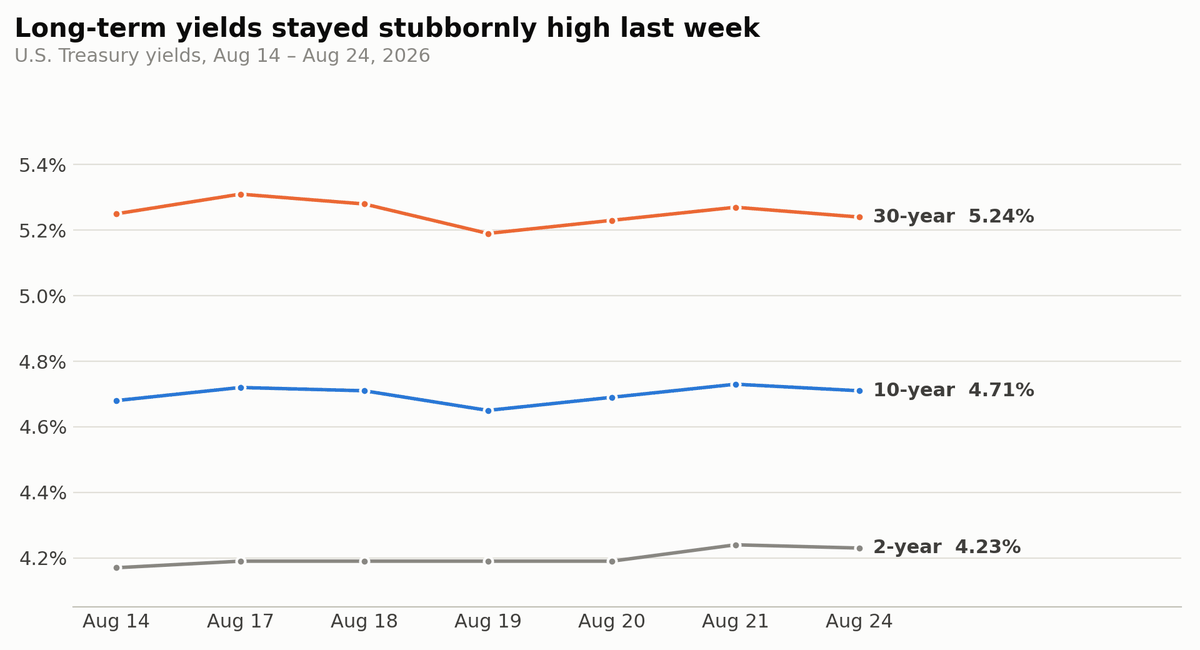
Figure 2. U.S. Treasury yields, August 14–24, 2026. August 14–20 are official constant-maturity yields from Federal Reserve H.15 (released August 21, 2026). August 21 and August 24 are market levels reported by Washington Trust and Trading Economics.
The 10-year finished last week at 4.73% and eased to about 4.71% on Monday. The 30-year Treasury has been the sore spot, closing Friday around 5.27% before settling near 5.24%.
There was a brief reprieve. On August 19, Treasury Secretary Scott Bessent announced the government would at least double its buybacks of older long-dated debt, from $2 billion to at least $4 billion per operation, starting September 9. Long-term yields dropped hard that day. Within two trading sessions, the entire move had been given back.
Why the market is even whispering about a rate hike
Here's the tension the Fed is stuck in.
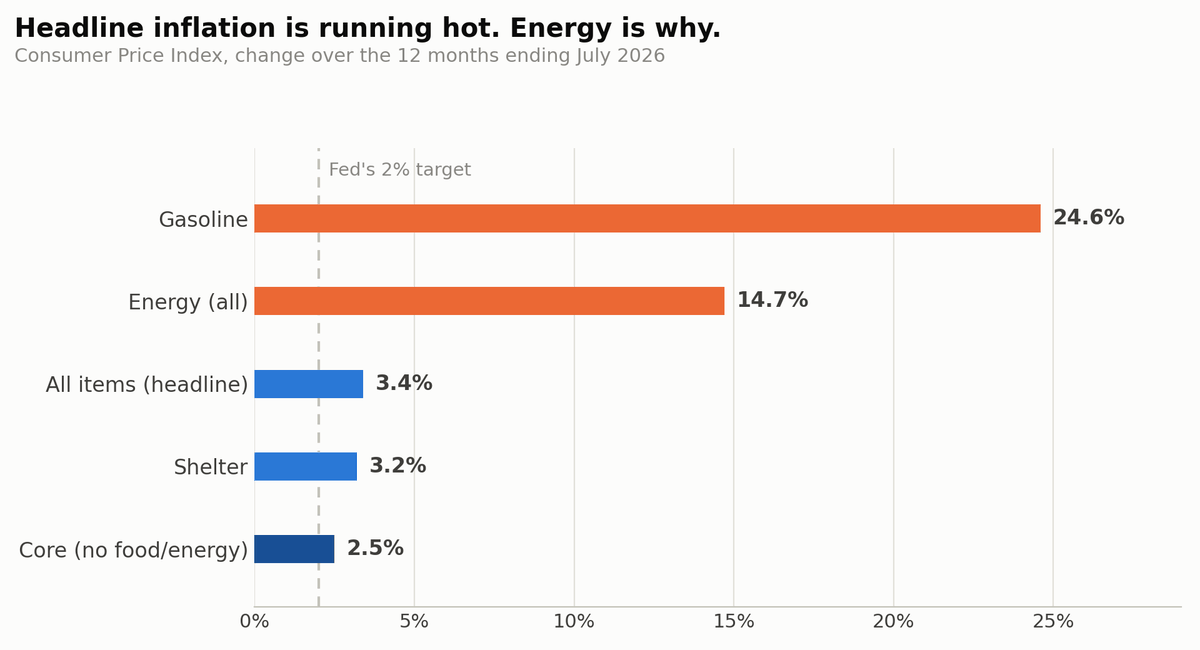
Figure 3. Consumer Price Index, 12-month changes through July 2026. Source: U.S. Bureau of Labor Statistics, Consumer Price Index — July 2026, released August 12, 2026.
Headline inflation ran at 3.4% over the twelve months through July — well above the Fed's 2% goal. But strip out food and energy and the “core” rate was just 2.5%. Shelter, the single biggest piece of most household budgets, rose 3.2%. The gap is almost entirely energy: the energy index climbed 14.7% over the year, with gasoline up 24.6%.
Meanwhile the job market is soft. Employers cut 23,000 jobs in July, and the government revised May and June down by a combined 103,000 (Bureau of Labor Statistics, released August 7). Unemployment sat at 4.1%.
Normally weak hiring means rate cuts are coming. Not this time. At the July 28–29 meeting, the Fed held rates steady on a 9–3 vote — and all three dissenters wanted to raise rates a quarter point. The minutes, released August 19, showed officials prepared to hike if inflation doesn't cool.
Markets have noticed. Brown Brothers Harriman, writing on August 23, pegged the odds of a September hike at about 40%. Chrisman Commentary put it at roughly one in three on August 21. Brown Brothers Harriman's figure comes from fed funds futures pricing. Neither firm shows meaningful odds of a cut.
If you have been waiting for the Fed to rescue your rate, the market is telling you to stop waiting.
What this actually costs in dollars
The national median existing home sold for $434,100 in July (National Association of Realtors, August 11). With 20% down, that's a $347,280 loan.
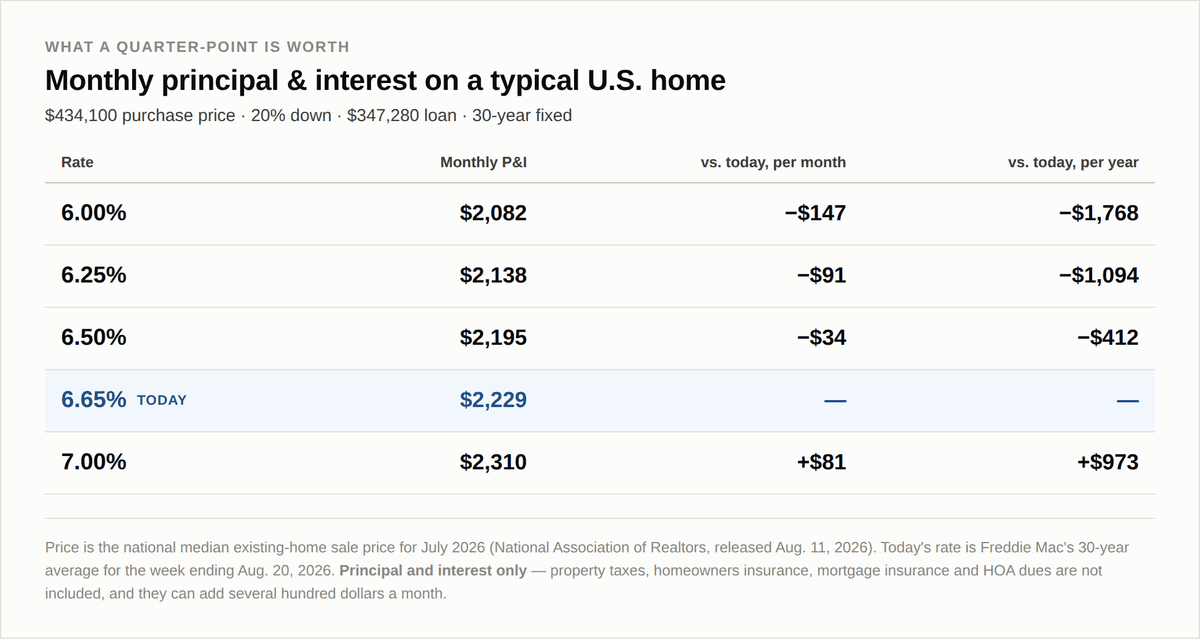
Figure 4. Monthly principal and interest on a $347,280 30-year fixed loan. Price source: National Association of Realtors, Existing-Home Sales, July 2026, released August 11, 2026. Today's rate: Freddie Mac PMMS, week ending August 20, 2026. Taxes, insurance, mortgage insurance and HOA dues excluded.
At this loan size, a quarter-point is worth about $56 a month — roughly $675 a year. Getting from today's 6.65% down to 6.00% would save about $147 a month, or $1,768 a year.
That's the honest scale of it. A quarter-point is real money over thirty years, but it is not the difference between affording a house and not. Price, down payment, and how long you actually keep the loan matter more.
The housing market, briefly
Existing-home sales ran at an annual pace of 4.06 million in July, down 1.7% from June but up 0.7% from a year earlier. The median price rose 2.0% year over year. There were 1.54 million homes for sale — a 4.6-month supply — and the typical listing went under contract in 29 days. First-time buyers made up 29% of sales. (All NAR, August 11.)
NAR's chief economist Lawrence Yun noted that year-to-date sales are up 2.4%, adding: “there's no doubt that the housing market would be thriving if average mortgage rates were to return near 6%.”
New construction is a different picture. Housing starts fell 12.4% in July to an annual rate of 1,239,000, though building permits rose 5.0% (Census Bureau and HUD, August 18).
What to watch this week
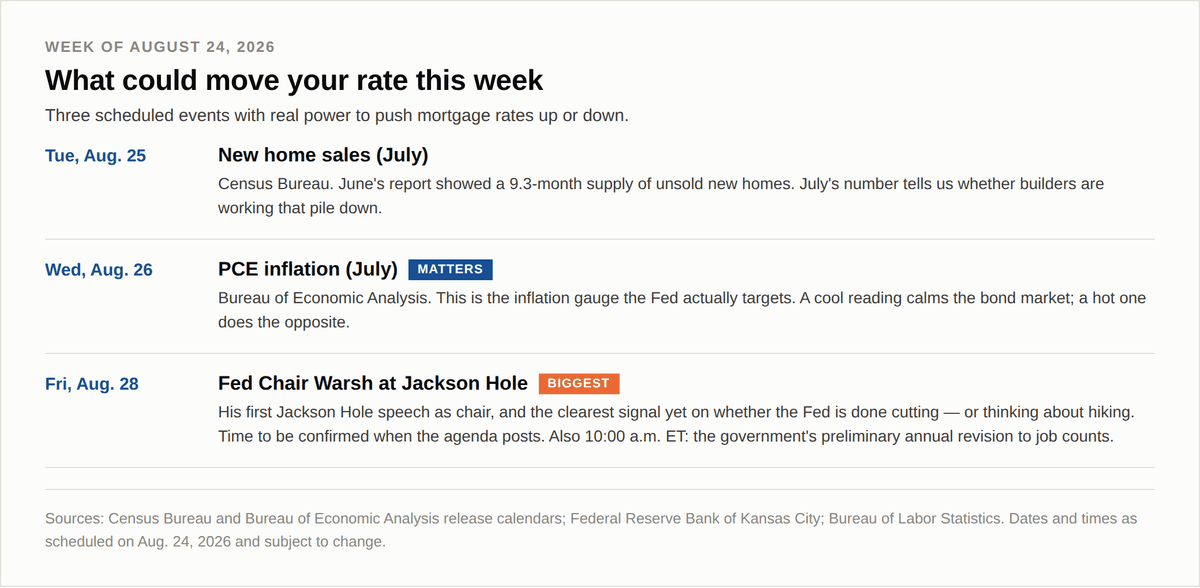
Figure 5. Scheduled releases and events, week of August 24, 2026. Sources: Census Bureau and Bureau of Economic Analysis release calendars; Federal Reserve Bank of Kansas City; Bureau of Labor Statistics.
Wednesday brings the July PCE inflation report — the gauge the Fed actually targets. But Friday is the day that matters. Fed Chair Kevin Warsh gives his first Jackson Hole keynote — the full agenda isn't out yet, but the keynote customarily lands mid-morning Eastern — and the market has almost no read on what he'll say. At 10:00 a.m. Eastern that same morning, the Labor Department releases its preliminary annual revision to the job counts, which has surprised badly before.
Two events with real power to move rates, landing within hours of each other. Expect a bumpy Friday.
What I'd do
If you're under contract and closing in the next 30 days: lock. There is no scenario this week where the upside of floating justifies the risk of Friday. Call me and we'll get it done.
If you're shopping and 60-plus days out: don't try to time this. Get fully underwritten now so you can move fast in either direction. If rates drop, you're ready. If they jump, you already know your number.
If you're sitting on a rate above 7.25%: run the math with me. At 6.65% the refinance may already pencil out, and the break-even is usually shorter than people assume — often under three years once you see the actual closing costs.
If your rate starts with a 5: stay put. Nothing in this market is worth giving that up. If you need cash, a second mortgage or a HELOC almost always beats refinancing the whole thing.
The bond market is nervous, the Fed is split, and Friday is a coin flip. That's not a reason to panic — it's a reason to have your plan ready before the news happens instead of after. Reply to this email or call me and we'll build yours.
REFERENCES
1. Freddie Mac. Primary Mortgage Market Survey — Mortgage Rates Decline for Second Consecutive Week. August 20, 2026.
https://www.freddiemac.com/pmms
2. U.S. Bureau of Labor Statistics. Consumer Price Index — July 2026. August 12, 2026.
https://www.bls.gov/news.release/cpi.nr0.htm
3. U.S. Bureau of Labor Statistics. The Employment Situation — July 2026. August 7, 2026.
https://www.bls.gov/news.release/empsit.nr0.htm
4. Board of Governors of the Federal Reserve System. FOMC Statement. July 29, 2026.
https://www.federalreserve.gov/newsevents/pressreleases/monetary20260729a.htm
5. Board of Governors of the Federal Reserve System. Minutes of the Federal Open Market Committee, July 28–29, 2026. August 19, 2026.
https://www.federalreserve.gov/monetarypolicy/fomcminutes20260729.htm
6. Board of Governors of the Federal Reserve System. H.15 Selected Interest Rates (Daily).August 21, 2026.
https://www.federalreserve.gov/releases/h15/
7. National Association of Realtors. Existing-Home Sales Report Shows 1.7% Decrease in July. August 11, 2026.
https://www.nar.realtor/newsroom/nar-existing-home-sales-report-shows-1-7-decrease-in-july
8. U.S. Census Bureau and U.S. Dept. of Housing and Urban Development. New Residential Construction, July 2026. August 18, 2026.
https://www.census.gov/construction/nrc/pdf/newresconst.pdf
9. U.S. Census Bureau and U.S. Dept. of Housing and Urban Development. New Residential Sales, June 2026. July 24, 2026.
https://www.census.gov/construction/nrs/pdf/newressales.pdf
10. Brown Brothers Harriman. Drivers for the Week of August 24, 2026. August 23, 2026.
https://www.bbh.com/us/en/insights/blog/mind-on-the-markets/Drivers-for-the-Week-of-August-24-2026.html
11. Chrisman Commentary. Capital Markets Wrap, August 21, 2026. August 21, 2026.
https://chrismancommentary.com/post/capital-markets-wrap-august-21-2026/
12. Washington Trust. Week in Review, August 21, 2026. August 21, 2026.
https://www.watrust.com/articles/week-in-review-august-21-2026
13. Trading Economics. United States Government Bond 10Y / 30Y. accessed August 24, 2026.
https://tradingeconomics.com/united-states/government-bond-yield
14. Federal Reserve Bank of Kansas City. Jackson Hole Economic Policy Symposium, August 27–29, 2026. program page.
https://www.kansascityfed.org/research/jackson-hole-economic-symposium/
15. U.S. Bureau of Economic Analysis. Personal Income and Outlays release schedule.accessed August 24, 2026.
https://www.bea.gov/
16. Reuters. U.S. Treasury to double sizes of debt buybacks. August 19, 2026.
About the figures. All five figures in this issue are original, computed directly from the published sources named in each caption and drawn for this newsletter. There is no AI-generated imagery and no stock photography anywhere in this issue. You are free to reproduce these images in your own marketing. If you want to add a photograph, free-license options include Unsplash, Pexels and Pixabay, and photography produced by U.S. federal government agencies is generally in the public domain.
One figure we could not confirm. The exact start time of Chair Warsh's Jackson Hole keynote on August 28 has not been published — the Kansas City Fed typically releases the full agenda the evening before. We describe it as mid-morning Eastern rather than naming a time.